Getting Started: Introducing Introductions | MIT Learn
MIT RES.3-003 Learn to Build Your Own Videogame with the Unity Game Engine and Microsoft Kinect, IAP 2017 View the complete course: https://ocw.mit.edu/RES-3-003IAP17 Instructor: Kyle Keane Kyle Keane describes the first ice breaker of the class and how we will manage the task of having everyone in

Before you start
- Basic Python familiarity
- Comfort with algebra or calculus basics
- Interest in robotics systems
About this guide
MIT RES.3-003 Learn to Build Your Own Videogame with the Unity Game Engine and Microsoft Kinect, IAP 2017 View the complete course: https://ocw.mit.edu/RES-3-003IAP17 Instructor: Kyle Keane
Kyle Keane describes the first ice breaker of the class and how we will manage the task of having everyone introduce themselves.
License: Creative Commons BY-NC-SA More information at https://ocw.mit.edu/terms More courses at https://ocw.mit.edu
Common questions
What will I learn in Getting Started: Introducing Introductions | MIT Learn?
MIT RES.3-003 Learn to Build Your Own Videogame with the Unity Game Engine and Microsoft Kinect, IAP 2017 View the complete course: https://ocw.mit.edu/RES-3-003IAP17 Instructor: Kyle Keane Kyle Keane describes the first ice breaker of the class and how we will manage the task of
Is Getting Started: Introducing Introductions | MIT Learn free?
HumanoidHub has not verified public pricing for this guide. Open MIT OpenCourseWare for the current access terms before enrolling.
Do I need any prerequisites?
Recommended prep: Basic Python familiarity; Comfort with algebra or calculus basics; Interest in robotics systems.
How long does it take?
Self-paced (provider defined). Most learners complete this guide in self-directed sessions over a few weeks.
Does it offer a certificate?
This guide does not include a formal certificate. Focus is on the learning material itself.
Related guides

Expanding on Tutorials | MIT Learn
<p>Kyle Keane talks about the logistics and purpose of expanding on tutorials, and how this is related to creating, inventing, and learning.
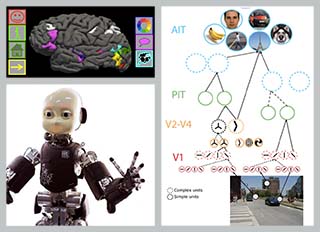
Large-Scale Incremental Learning for Robotics | Brains, Minds and Machines Summer Course | Brain and Cognitive Sciences
This resource contains information regarding brains, minds and machines summer course: Lec8-6.
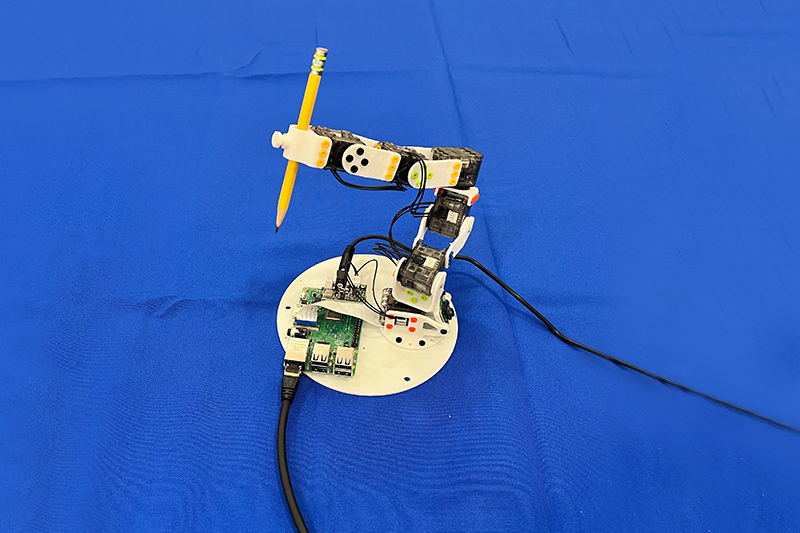
Robot, know thyself: New vision-based system teaches machines to understand their bodies
A vision-based control system called Neural Jacobian Fields enables soft and rigid robots to learn self-supervised motion control using only a monocular camera. The system, developed by MIT CSAIL researchers, combines 3D scene reconstruction with embodied representation and closed-loop control.

[PDF] Humanoid Robots: A New Kind of Tool
In 1993, we began a project aimed at con-structing a humanoid robot for use in explor-ing theories of human intelligence.1,2 In addi-tion to the relevant engineering, computer architecture, and real-time-control issues, we’ve had to address issues particular to inte-grated systems:What types of sens
Ch. 1 - Introduction - Robotic Manipulation
In the previous exercise, you manually set up a simulation by creating a `DiagramBuilder`, adding a `MultibodyPlant` and `SceneGraph`, loading robots, and wiring everything together. In this exercise, you will learn to use `HardwareStation` and model directives specified in `YAML` configuration file

How to Get Into Robotics
In this course, you will learn about the dynamic world of robotics, which blends engineering, electronics, and computer science to create innovations that enhance our daily lives. You'll learn to envision a future where humanoid robots assist the elderly, autonomous cars ensure safety and medical
Robots that use these skills

SE01 Humanoid Robot
EngineAI
EngineAI SE01 is a full-size bipedal humanoid focused on smooth, human-like gait for research and industrial applications.
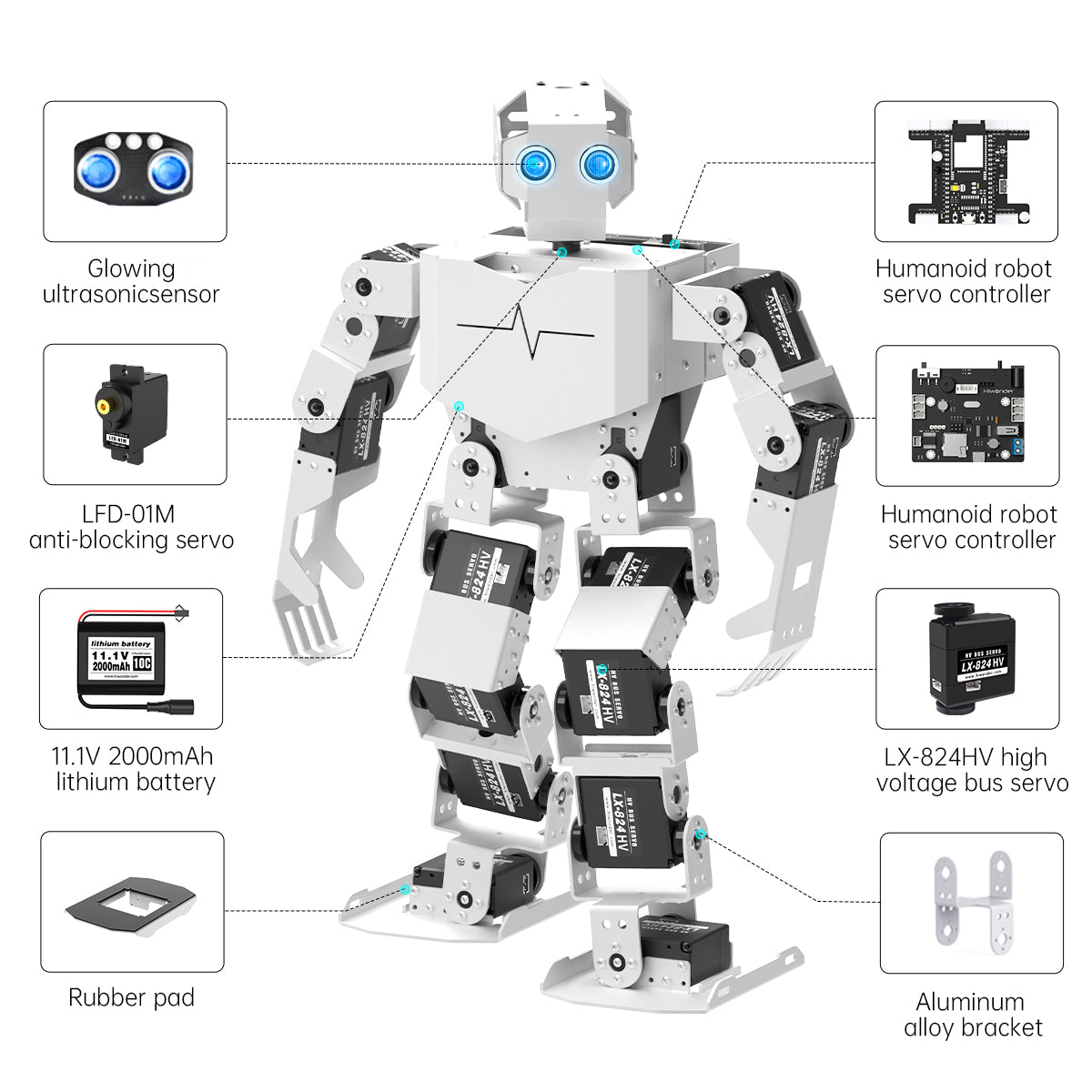
HiWonder TonyBot Humanoid Robot Kit
Hiwonder
Hiwonder TonyBot is a small humanoid (biped) robot kit for STEM learning with 16 DOF servo joints and app/program control.

1X EVE
1X Technologies
1X EVE is a wheeled humanoid robot from 1X Technologies aimed at mobile service work in institutional and industrial settings.
Refer a learner and get early access to our paid pathways and 1:1 mentorship pilot.
Join referral listNew robots, industry moves, and funding in your weekly robotics briefing.
Unsubscribe anytime.