Unit 8 Panel: Robotics | Brains, Minds and Machines Summer Course | Brain and Cognitive Sciences
MIT OpenCourseWare is a web based publication of virtually all MIT course content. OCW is open and available to the world and is a permanent MIT activity
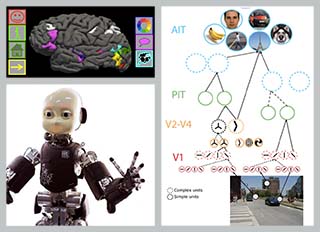
Before you start
- Basic Python familiarity
- Comfort with algebra or calculus basics
- Interest in robotics systems
About this guide
MIT OpenCourseWare is a web based publication of virtually all MIT course content. OCW is open and available to the world and is a permanent MIT activity
Common questions
What will I learn in Unit 8 Panel: Robotics | Brains, Minds and Machines Summer Course | Brain and Cognitive Sciences?
MIT OpenCourseWare is a web based publication of virtually all MIT course content. OCW is open and available to the world and is a permanent MIT activity
Is Unit 8 Panel: Robotics | Brains, Minds and Machines Summer Course | Brain and Cognitive Sciences free?
HumanoidHub has not verified public pricing for this guide. Open MIT OpenCourseWare for the current access terms before enrolling.
Do I need any prerequisites?
Recommended prep: Basic Python familiarity; Comfort with algebra or calculus basics; Interest in robotics systems.
How long does it take?
Self-paced (provider defined). Most learners complete this guide in self-directed sessions over a few weeks.
Does it offer a certificate?
This guide does not include a formal certificate. Focus is on the learning material itself.
Related guides

Expanding on Tutorials | MIT Learn
<p>Kyle Keane talks about the logistics and purpose of expanding on tutorials, and how this is related to creating, inventing, and learning.
Large-Scale Incremental Learning for Robotics | Brains, Minds and Machines Summer Course | Brain and Cognitive Sciences
This resource contains information regarding brains, minds and machines summer course: Lec8-6.
Lecture 8.4: Stefanie Tellex - Human-Robot Collaboration | Brains, Minds and Machines Summer Course | Brain and Cognitive Sciences
MIT OpenCourseWare is a web based publication of virtually all MIT course content. OCW is open and available to the world and is a permanent MIT activity

Industrial Robotics
Image 3Preview this course # Industrial Robotics Mathematical models and practical applications Created byFabrizio Frigeni Last updated 9/2019 English Image 4Preview this course Purchase options Subscribe and save From$13.00/month Access to 28,000+ top-rated courses Cancel anytime
What are Robotics? | Stanford HAI
Robotics is the field that combines engineering and computer science, and now often artificial intelligence, to design and build machines capable of performing physical tasks. When integrated with AI, robots can perceive their surroundings, make decisions, and adapt to new situations without explici
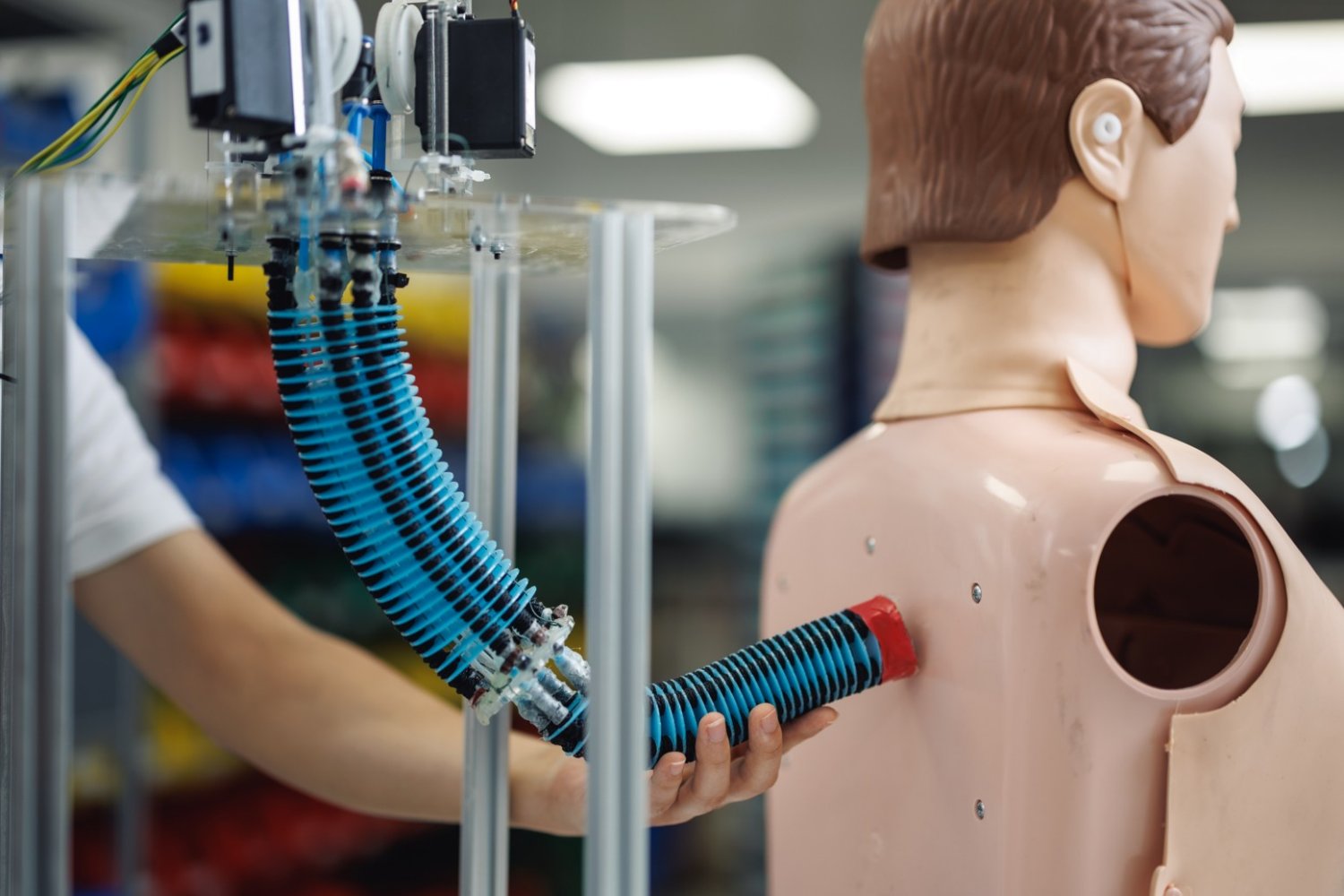
A neural blueprint for human-like intelligence in soft robots
A new AI control system enables soft robotic arms to learn a wide repertoire of motions and tasks once, then adjust to new scenarios on the fly without needing retraining or sacrificing functionality. The work was co-led by researchers at the Singapore-MIT Alliance for Research and Technology (SMART
Robots that use these skills

Modular Robot with Paneled Body
Realbotix
Realbotix M-Series is a modular robot with a paneled body and interchangeable face/body components for lifelike interaction use cases.

NEURA 4NE1
NEURA Robotics
NEURA 4NE1 is a full-size humanoid robot platform from NEURA Robotics aimed at industrial and logistics tasks, with NVIDIA Thor compute and a reservation-based rollout.

1X EVE
1X Technologies
1X EVE is a wheeled humanoid robot from 1X Technologies aimed at mobile service work in institutional and industrial settings.
Refer a learner and get early access to our paid pathways and 1:1 mentorship pilot.
Join referral listNew robots, funding, and signals. Every Thursday.
Unsubscribe anytime.