1X begins production of NEO humanoids in California facility
“Humanoid robots require high-performance, real-time AI inference and continuous training and testing in simulation for safe and reliable operation,” said Deepu Talla, vice president of robotics and edge AI at NVIDIA.
Key takeaways
- Figure AI released a video in May 2026 showing two of its Helix 02 humanoids making a bed faster than a human and handling tasks such as opening doors and draping clothing after being trained on new data, though the company has not set a consumer release date.
- 1X Technologies announced the launch of full‑scale production for its NEO humanoid at a new Hayward, California plant, saying the first‑year run sold out within five days and that domestic shipments to the public are slated to begin later in 2026.
- Japan Airlines, in partnership with GMO AI & Robotics, began a trial at Tokyo’s Haneda Airport that will run through 2028 to evaluate humanoid robots for moving baggage and cargo on the tarmac, emphasizing the robots’ human‑like form as a way to adapt to busy airport environments without major infrastructure changes.
- Genesis AI unveiled its GENE‑26.5 foundation model in a May 6, 2026 demo, demonstrating dexterous manipulation such as solving a Rubik’s Cube and performing complex physical tasks, and indicated that a general‑purpose robot based on the technology will be shown soon.
- Hugging Face introduced an open‑source “app store” for its low‑cost Reachy Mini desktop humanoid, offering more than 200 ready‑to‑run applications and positioning the platform as a hobbyist and developer‑friendly alternative to higher‑priced commercial robots.
“Humanoid robots require high-performance, real-time AI inference and continuous training and testing in simulation for safe and reliable operation,” said Deepu Talla, vice president of robotics and edge AI at NVIDIA. “By using NVIDIA Jetson Thor as the brain and the NVIDIA Isaac open robotics platform as its training ground, 1X is able to accelerate the development and deployment of intelligent robots like NEO that can work safely alongside humans.”
1X plans to ship humanoid to consumers this year
While the first year’s production sold out within five days of the October launch, 1X Technologies said it is currently using the Hayward line to supply its research and development and internal home-testing programs.
Domestic shipments to the public are scheduled to begin in 2026. “This is more than just a factory opening — it’s proof that the future of humanoid robotics is being built right here in the U.S.,” stated Bernt Børnich, founder and CEO of 1X. “We’re not dreaming about abundance; we’re manufacturing it. More production means more robots, and more robots mean the fastest path to physical AI. Production is happening now, and American consumers will be among the first in the world to welcome NEO into their homes.”
NEO factory is vertically integrated, uses robots
1X Technologies said its production process includes several specialized zones: The Robot Report
1X begins production of NEO humanoids in California facility
By Mike Oitzman |
1X is hiring staffers for its new humanoid robot factory in California. | Credit: 1X Technologies
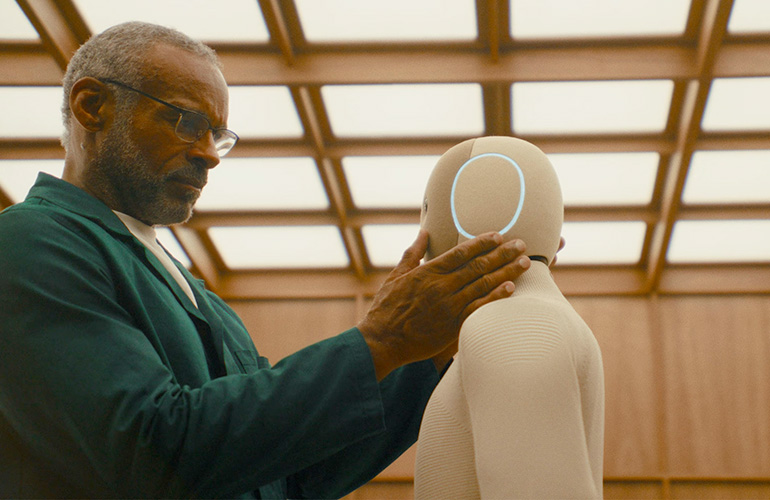
1X Technologies AS this week said launched full-scale production at its new facility in Hayward, Calif. It serves as the primary hub for NEO, the company’s humanoid robot designed to operate quietly—at a decibel level lower than a modern refrigerator—while navigating domestic spaces.
New robots, funding, and signals. Every Thursday.
Unsubscribe anytime.
Mentioned in this article