China is exploring humanoid robots for war – but what role could ...
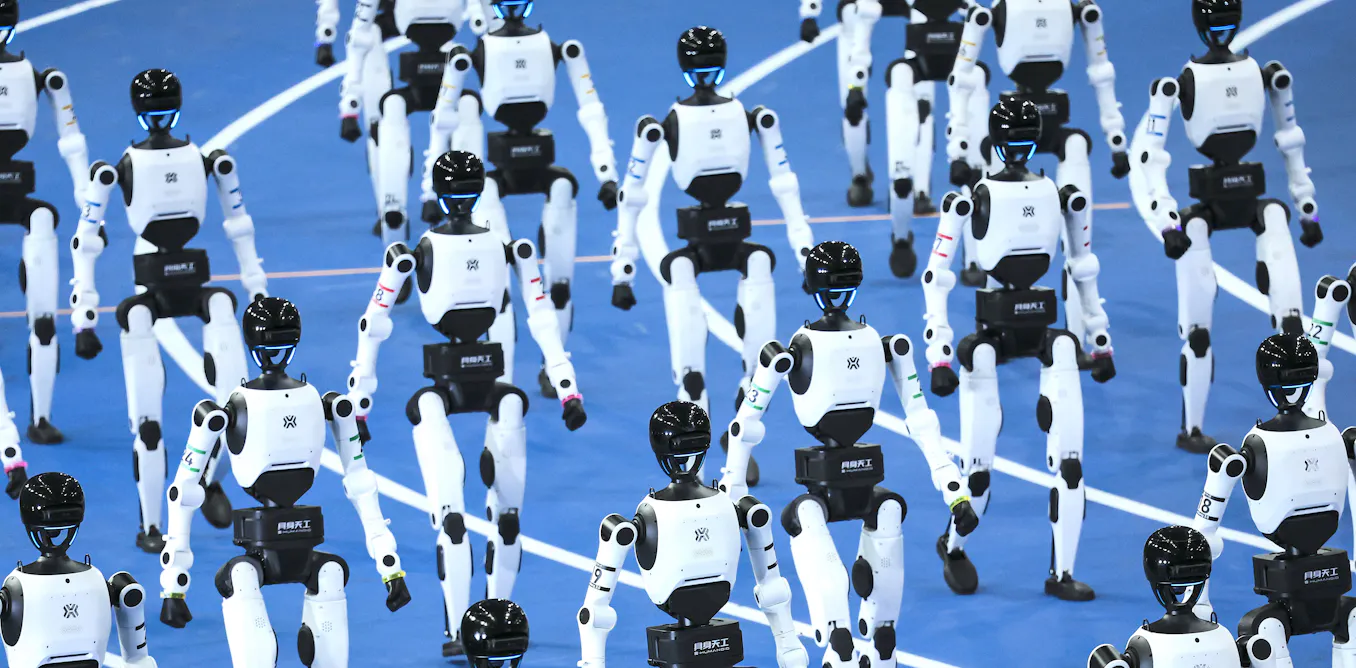
At the World Humanoid Robot Games in Beijing, a humanoid robot named Tiangong Ultra ran the 100-metre sprint in a staggering 8.64 seconds, shattering Jamaican sprinter Usain Bolt’s legendary human world record of 9.58 seconds.
Key takeaways
- In September 2026 a wave of high‑profile announcements underscored the rapid expansion of humanoid robotics.
- NVIDIA unveiled “SONIC,” an AI controller that converts VR, video and natural‑language commands into robot actions, promising to broaden the motion repertoire of humanoids, while related work on “touch‑dreaming” techniques lifted task‑success rates by over 90 percent earlier in the year.
- Goldman Sachs dramatically raised its market outlook, projecting shipments of roughly 6.5 million humanoid robots by 2035—a five‑fold jump from its previous estimate—and valuing the sector at about $138 billion.
- In China, the People’s Liberation Army allocated about $300,000 in June to collect and label sensor data for fielded robots, and Reuters reported that the PLA is urging researchers to accelerate the transition of commercial humanoids into combat roles.
- That push coincided with Xpeng’s release of a video on September 11 showing its IRON humanoid walking off an assembly line unaided, and a Chinese startup, JoyIn, claiming its “Aether” model, built on a perceptive‑control approach, can achieve a 90 percent first‑attempt success rate—a claim it says mirrors OpenAI’s technology.
At the World Humanoid Robot Games in Beijing, a humanoid robot named Tiangong Ultra ran the 100-metre sprint in a staggering 8.64 seconds, shattering Jamaican sprinter Usain Bolt’s legendary human world record of 9.58 seconds.
The internet laughed at the robots’ awkward, lurching finishes and spectacular falls – but the laughter masked a chilling reality.
Just two days after the games concluded the official newspaper of China’s People’s Liberation Army (PLA) called for researchers to accelerate moving these cutting-edge machines from the laboratory to military training grounds. They referred to them not as experiments, but as “combatants”. With enough skill, a dedicated adversary can replicate advanced robotic behaviour with relative ease. We can no longer afford to treat humanoid robotics purely as an academic pursuit or a commercial novelty. We need an urgent international conversation about how to control these advances.
Just as we regulate the export of certain microchips and aerospace components, we must begin protecting the software architecture and training pipelines that give these machines their minds. The hardware is walking out of the lab – it is time our policies caught up. Carbon fibre and aluminium bodies keep mass and inertia (how a robot’s mass resists change) low. Advancements in actuator technology deliver torque capacities of up to 400Nm (Newton-metres – a unit of torque, or twisting force) in humanoid joints, providing the ultimate combination of power and agility.
What you saw on the track in Beijing was not just a triumph of motors, but a triumph of coding. A real breakthrough is happening in software.
Robots are trained in virtual simulation environments, running millions of trial-and-error scenarios through reinforcement learning before the robot ever takes a physical step. Reinforcement learning is an area of artificial intelligence (AI) where robots make decisions based on the results of their actions.
New robots, funding, and signals. Every Thursday.
Unsubscribe anytime.
Mentioned in this article