China’s EV makers see synergy in their race to beat Tesla in humanoid robotics
Electric & new energy vehicles BusinessChina Business # In FocusChina’s ‘Tesla imitators’ have a new mission: build affordable humanoid robots for consumers Robotics has supply chain synergy with smart EV production because key components like cameras and r...
Key takeaways
- On September 8 2026 Xpeng announced that its first advanced general‑purpose humanoid robot, IRON, autonomously walked off a newly commissioned production line in Guangzhou, marking the company’s move from prototype demonstrations to volume manufacturing. The line achieves more than 80 % core‑process automation; IRON itself has 76 degrees of freedom (21 per hand), three in‑house Turing AI chips that deliver up to 2,250 TOPS for on‑board decision making, and can perform complex tasks without remote teleoperation. Xpeng plans to begin mass production by the end of 2026, targeting 1,000 units per month with a goal of one million units a year by 2030.
- At the same time, NVIDIA’s Science Robotics paper introduced SONIC, an AI controller that translates VR, video, and language commands into precise humanoid motor actions, thereby expanding the motion repertoire of such robots. China now accounts for 97 % of global humanoid robot shipments; domestic production lines capable of 10,000 units a year are already operating, and 62,500 units are expected to be shipped within China in 2026.
- In Europe, a new startup has secured 34 000 pre‑orders and a $2.4 billion pipeline, positioning it to scale production to hundreds of thousands of units.
Electric & new energy vehicles
BusinessChina Business
In FocusChina’s ‘Tesla imitators’ have a new mission: build affordable humanoid robots for consumers
Robotics has supply chain synergy with smart EV production because key components like cameras and radar, as well as software, are in both
5-MIN READ5-MIN
Listen
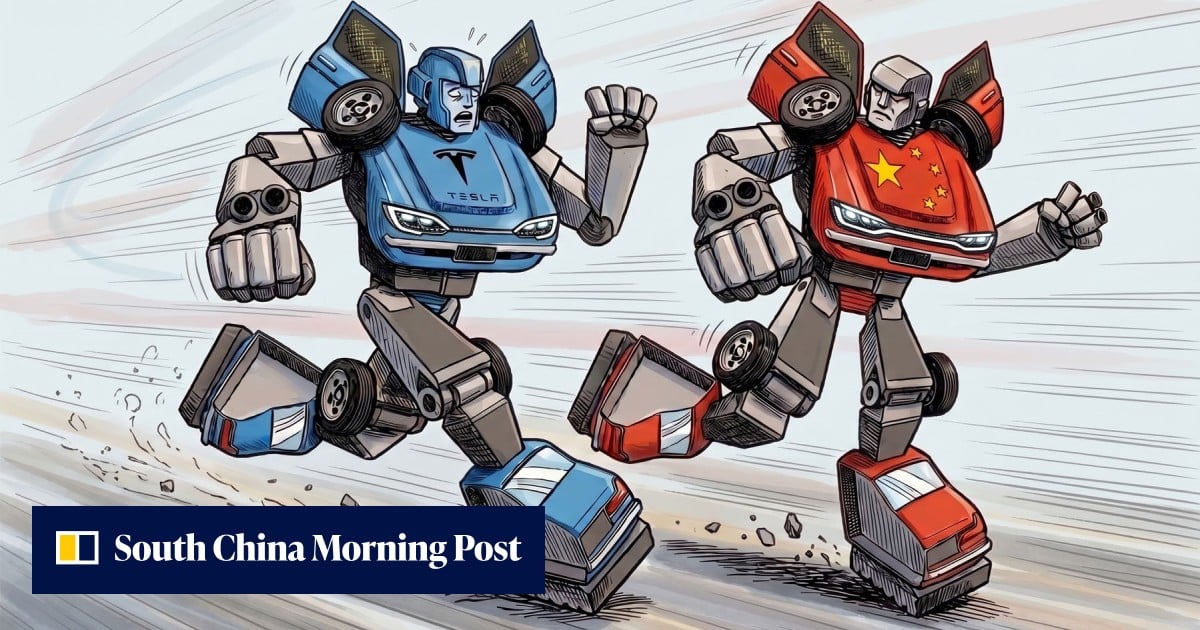
Illustration: Dennis Yip
Daniel Renin Shanghai
When Nio CEO William Li outlined earnings prospects for the Shanghai-based carmaker in March, he could not help but liken the automotive business to the development of robots.
“I think robotics will represent a natural extension of our carmaking capabilities and business acumen,” Li told reporters at a media briefing after Nio posted its first-ever quarterly profits for the three months ending December. These players, from BYD – the world’s largest electric vehicle (EV) maker – to Stellantis-backed Leapmotor, are once again being labelled as Tesla imitators because the US carmaker is accelerating commercialisation of its humanoid robot Optimus.
Select Voice
Select Speed “Don’t you think that every car we produce in the future will actually be a robot? Its perception, decision-making, and execution will all be based on artificial intelligence.”
While Li has adopted a “latecomer” strategy in robotics to avoid potential big losses in early-stage investment, he is convinced that robotics and carmaking have synergistic benefits.
The premium cars Nio is building already embody perception, decision-making and control systems – similar to those of robots.
That perspective on the future of mobility, buoyed by rapid growth of physical AI, is typical of the more than 10 Chinese manufacturers of intelligent vehicles that have ventured into robotics.
New robots, funding, and signals. Every Thursday.
Unsubscribe anytime.
Mentioned in this article