China's humanoid robots are stealing the show, but a quieter machine revolution is unfolding
# Beyond China's humanoid robots, a quieter machine revolution is unfolding "I take a nap and the world changes," says Chen Tianyu. His world certainly does.
Key takeaways
- The most recent headlines on humanoid robots center on the 2026 World Humanoid Robot Games in Beijing, where Chinese machines dramatically outpaced human athletes— a Tiangong Ultra model completed the 100‑metre sprint in 9.39 seconds, shattering Usain Bolt’s 9.58‑second record, while another robot set a 400‑metre world record of 38.15 seconds and a standing‑high‑jump of 3.40 metres, though both finalists crashed into a padded wall at the finish.
- Engineers attributed the speed gains to liquid‑cooled motors and higher limb torque, while experts warned that such feats do not yet translate into practical autonomy for tasks like warehouse or household work.
- Parallel developments were reported at the University of Miami, where the Fourier Intelligence GR‑2 humanoid joined the RoboCanes team and is being programmed for household chores and coordinated soccer play, leveraging large‑language‑model advances.
- Meanwhile, a Shanghai‑based firm’s engineer claimed that fully functional humanoid robot soldiers could be fielded within five to ten years, positioning the technology as a strategic asset for national defence.
- Despite the spectacle, analysts highlighted that commercial profitability remains elusive, noting that most humanoid research still focuses on experimental performance rather than mass‑deployment capabilities.
Beyond China's humanoid robots, a quieter machine revolution is unfolding
"I take a nap and the world changes," says Chen Tianyu.
His world certainly does. The 28-year-old keeps up with the latest technology by spending his spare time in factories that are switching to automation. That way he knows what to prioritise when teaching his class about artificial intelligence (AI) and robotics.
In front of him, around 30 college students are studying code. One of them is typing furiously as his eyes dart from the screen to the robot: "The idea is it will grab that cylindrical piece and move it over there." CRP Technology, which employs around 300 people, has been building robot arms for nine years. Each arm can be tailored to a factory's needs to help build cars, electronics or wind turbines. The firm says a single arm can be programmed to perform more than 90% of repetitive tasks.
The engineers also wonder if, one day, they can replace the company's workforce. "We want our new robot to be like human beings. We hope it can think by itself," says Pang. "We need these kinds of robots because maybe in 10 years, we won't have enough workers in China."
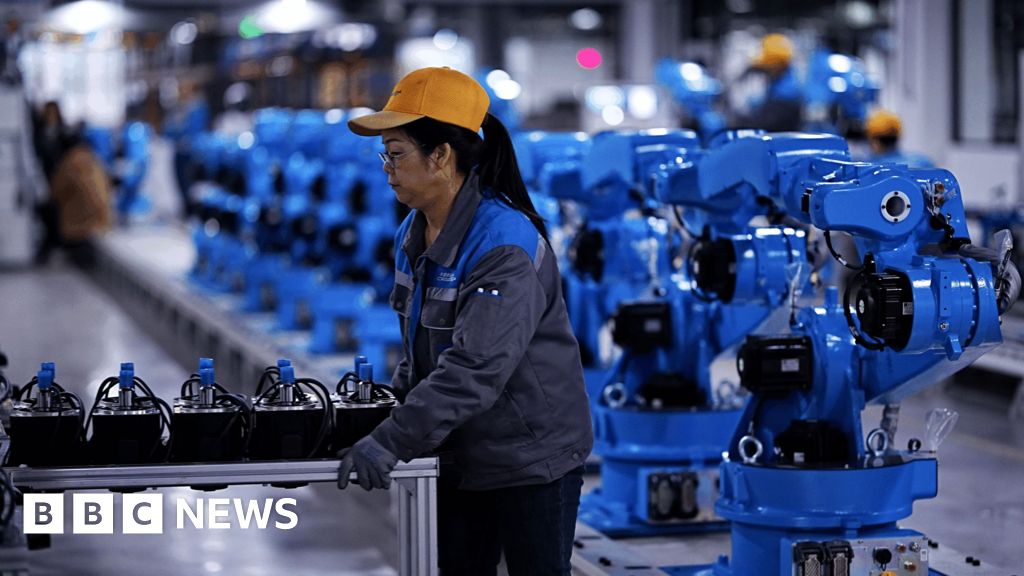
Pang Kai wearing a blue shirt with a robot standing behind him The BBC has visited industrial sites where we have been shown robots that do not look human, or dance or leap on stage but weld, paint, lift, assemble and work around the clock without a break or benefits. Some are designed to build more robots. We have also been inside academies where China is training the people who will work alongside its robotic workforce.
This is a front-row seat to what Xi calls China's "new productive forces" - and how they could reshape the country.
A woman operating a machine at a factory in Chengdu.
On a factory floor in the southern city of Chengdu, the old and and the new are working side by side.
New robots, funding, and signals. Every Thursday.
Unsubscribe anytime.
Mentioned in this article