China’s Humanoid Robots Aren’t Smart Enough to Take Your Job – Yet
Xiaomi, which declined to comment for this story, is training humanoid robots for tasks such as installing nuts. When Reuters visited recently, the factory floor had few workers.
Key takeaways
- China’s latest reports indicate that humanoid robots are still far from being deployed at scale.
- In a 2024 Technology.org analysis, makers admit that their machines “are not job‑ready yet” because their efficiency remains well below that of human workers and they require task‑specific retraining, leaving generalisation capabilities limited.
- The article notes that the U.S.
- Federal Communications Commission has already banned the import of new foreign‑made humanoid robots and power inverters on national‑security grounds, while the Pentagon has added Chinese firm Unitree to a list of companies with military ties.
- Unitree’s founder, at the 2024 World Robot Conference, stressed that the industry is still in a transition phase from technology validation to scaled deployment, with less than 5 % of current robots used in industrial settings and the majority confined to research, education and entertainment applications.
Xiaomi, which declined to comment for this story, is training humanoid robots for tasks such as installing nuts. When Reuters visited recently, the factory floor had few workers.
Geely’s Zeekr brand partnered with UBTech last year to test humanoids at its Ningbo factory on tasks including sorting materials, moving boxes and handling components. But for now, Geely told Reuters, robotic arms and automated vehicles “handle all key tasks on the active assembly line.”
Picking Pill Bottles From Shelves
Early commercial cases for humanoids are emerging. Humanoid maker Galbot is deploying robots in pharmacies across more than two dozen Chinese cities to address staffing constraints and meet medicine-delivery demand. Despite China’s infrastructure advantage, humanoid robots remain too slow and error-prone for broad commercial adoption.
At the Liuzhou training center, Reuters observed a humanoid struggle to carry crates. The robots can complete simple tasks at just 20% of a human’s speed or output, one staffer said.
But they might catch up in two to three years, the staffer added.
(Reporting by Laurie Chen in Liuzhou and Eduardo Baptista and Jumin Park in Beijing; additional reporting by Kevin Yao and Xiuyuan Ning; editing by Kenneth Li and David Crawshaw.)
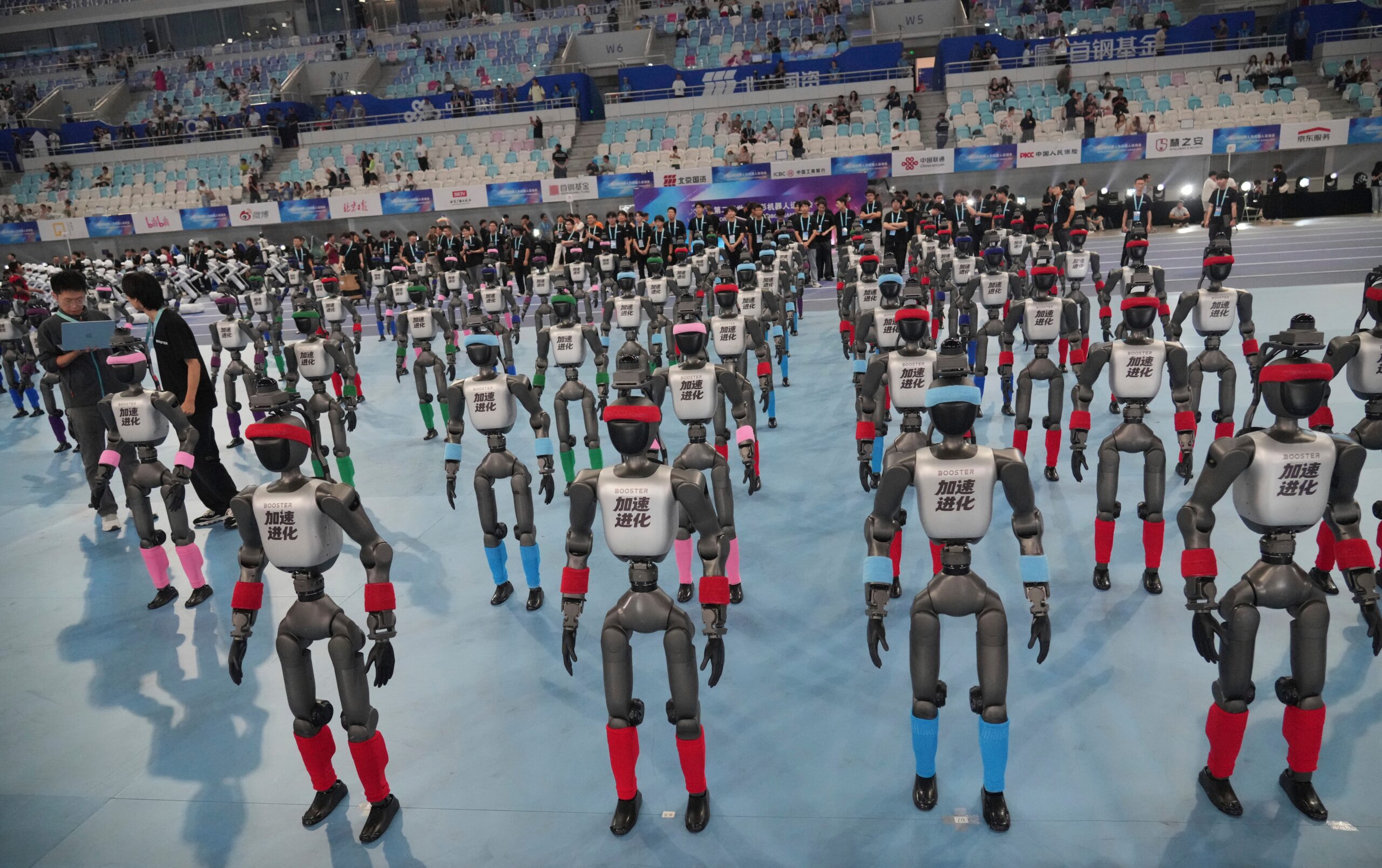
Photograph: Robots are prepared ahead the opening ceremony of the World Humanoid Robot Games in Beijing, Saturday, Aug. 22, 2026. (AP Photo/Achmad Ibrahim)
New robots, funding, and signals. Every Thursday.
Unsubscribe anytime.
Mentioned in this article