Chinese humanoid robots smash human records in 100m sprint, high jump at Beijing robot games
Last month, the U.S. Federal Communications Commission announced a ban on imports of new foreign-made humanoid robots. The FCC cited national security reasons in a move that targeted China.
Key takeaways
- The second World Humanoid Robot Games opened in Beijing on 22 August 2026, drawing more than 2,000 robots from 16 nations across 51 events and 1,301 individual competitions. Chinese teams dominated the opening ceremony, with a X‑Humanoid robot sprinting 100 metres in 9.39 seconds—faster than Usain Bolt’s 9.58‑second world record—and another Chinese robot clearing a standing high jump of 2.88 metres, surpassing the human record of 2.45 metres. Unitree’s “Superman” model also set a new speed benchmark of 12.66 metres per second, again outpacing Bolt’s average pace.
- At the same time, the industry is confronting regulatory headwinds: the U.S. Federal Communications Commission’s recent ban on imports of new foreign‑made humanoid robots—targeting Chinese manufacturers such as Unitree—has been noted, though analysts say the restriction has limited immediate impact because few humanoids are deployed in the United States.
- Beyond the competitions, commercial momentum is building. Agility Robotics reported that its Digit robot moved more than 100,000 totes in a GXO fulfillment centre and secured contracts with Toyota Motor Manufacturing Canada and Mercado Libre, marking a shift from demos to measurable service deployments. Nvidia, in partnership with Hyundai Motor Group and LG, is rolling out a standardized Robot Reference Platform and an “Physical AI” framework that combine advanced hardware, Isaac simulation tools and synthetic‑data factories to accelerate research and startup development.
- Overall, the August 2026 events showcase rapid advances in humanoid speed, agility and collaborative capabilities, while also highlighting the regulatory and economic challenges that will shape how quickly these machines move from showcase arenas into everyday industrial and consumer roles.
Last month, the U.S. Federal Communications Commission announced a ban on imports of new foreign-made humanoid robots. The FCC cited national security reasons in a move that targeted China. The Pentagon recently also added Unitree, one of China's leading humanoid robot makers, to its list of companies that it deemed have ties with the Chinese military. Beijing has hit back at the accusations.
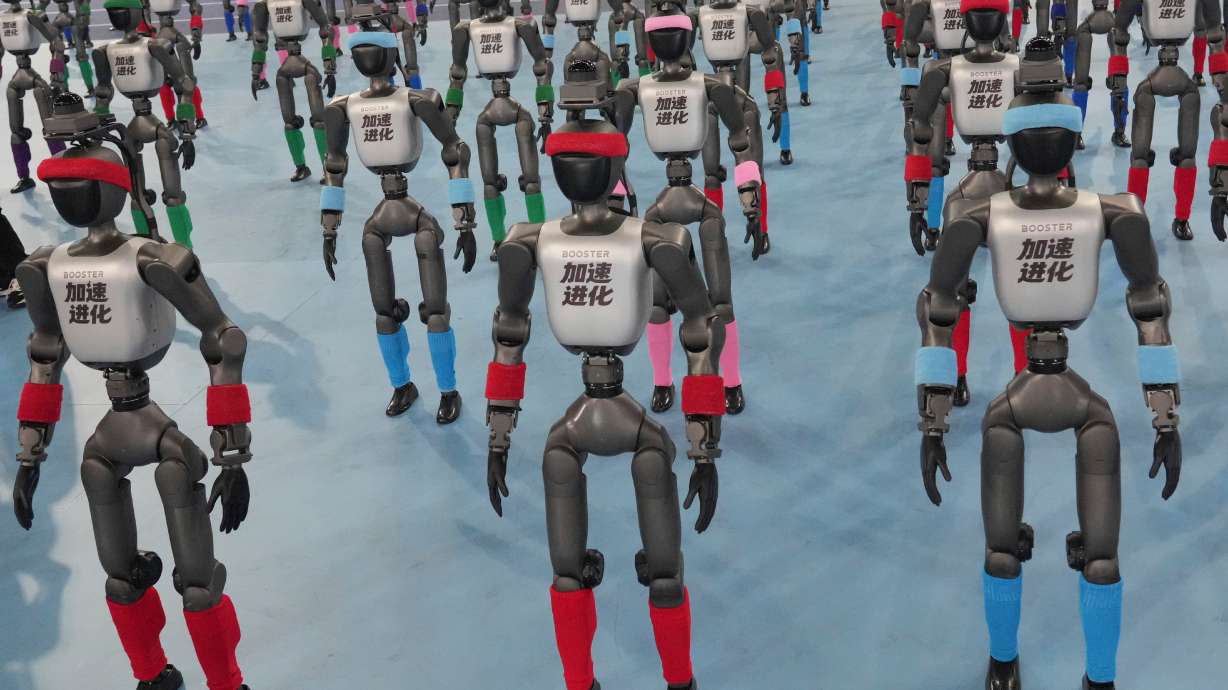
At Saturday's opening of the robot games, the organizer and robot makers said that Chinese humanoid robots defeated human world records, as hundreds of humanoid robots marched in formation onto the field in a massive display of synchronized coordination. Both robots were from Beijing-based X-Humanoid.
Before the opening, a humanoid robot from Chinese smartphone company Honor completed a 100-meter sprint in a record of 9.32 seconds during a trial of the games, the company said, at a peak speed of 14.5 meters per second.
Still, experts say humanoid robots are still mostly used for demonstrations, performances and research — at least for now — and it will still take time to achieve mass real-world deployment.
Some spectators at the robot games said they were excited about the humanoid robots' quickly improving abilities.
Humanoid robots are "evolving rapidly," said Li Yanfeng, an education worker and a Beijing resident. At a 100-meter sprint, a humanoid robot achieved a result of 9.39 seconds, beating the human record of 9.58 seconds set by Jamaican athlete Bolt in 2009.
Spectator looking robots perform during the opening ceremony of the World Humanoid Robot Games in Beijing, Saturday. (Photo: Achmad Ibrahim, Associated Press)
In a standing high jump, a humanoid robot was able to reach 2.88 meters, well above the 0.95 meters best result by a humanoid in last year's first edition of the games. It surpassed the human high jump record of 2.45 meters set by Cuba's Javier Sotomayor in 1993.
Both robots were from Beijing-based X-Humanoid.
New robots, funding, and signals. Every Thursday.
Unsubscribe anytime.
Mentioned in this article