Developing Humanoid Robot That Learns Construction ...
The research breakthrough, developed by professor Yizhi Liu and Ph.D. student Yanxi Liu, is believed to be among the first of its kind in the construction field. Alex Dunbar Aug.
Key takeaways
- The most recent developments in humanoid robotics show a surge of commercial, industrial, and policy activity.
- In August 2026, Chinese EV maker BYD announced it will debut functional humanoid robots at its Di Space event, positioning itself to compete directly with Tesla’s Optimus and other entrants such as Xpend, which plans a 1,000‑unit rollout in 2027.
- Meanwhile, Italian startup Generative Bionics has launched Gene.01, a fully sensorized humanoid with smart skin that can detect touch, temperature, force and the approach of nearby workers, aiming to reduce collisions in industrial settings.
- China’s 28th China Robot and Artificial Intelligence Competition (CRAIC) held its national humanoid finals in Beijing, drawing over 350 robots from 213 teams and featuring the first full‑size humanoids operating without remote control in realistic industrial scenarios.
- In the United States, Walden Robotics announced a partnership with Toyota to develop practical, wheel‑based humanoids for human‑centric workplaces, while a New York high‑school pilot of a silicone‑skinned teaching robot named Sally was paused amid privacy concerns, prompting state legislators to introduce a bill banning humanoid robots in schools.
The research breakthrough, developed by professor Yizhi Liu and Ph.D. student Yanxi Liu, is believed to be among the first of its kind in the construction field.
Alex Dunbar Aug. 5, 2026
Estimated Reading Time:
Video Player
Civil and Environmental Engineering Professor Yizhi Liu and his Ph.D. student Yanxi Liu have developed a system that allows a humanoid robot to observe construction workers and replicate their physical techniques, a breakthrough Liu believes is among the first of its kind in the construction field.
They published their findings in Computer-Aided Civil and Infrastructure Engineering, one of the leading peer-reviewed journals covering construction automation and robotics. In the study, Yizhi Liu’s team built what they call a vision-based “perception-and-action” system, which enables a humanoid robot to watch, process and reproduce the motions of skilled construction workers. Using the system, the robot successfully learned and executed 30 distinct construction skills and tasks demonstrated directly by human workers on-site.
The research comes as the U.S. construction industry faces a projected shortfall of nearly 350,000 additional workers in 2026, according to estimates from Associated Builders and Contractors. Construction accidents, meanwhile, account for roughly 30% of all work-related deaths worldwide, according to the International Labour Organization. Yanxi Liu, the study’s first author, says humanoid robots—machines built to approximate the human form—are particularly well-suited for construction work because job sites are designed around the human body. Unlike industrial robots confined to controlled factory floors, humanoid robots can navigate scaffolding, ladders and irregular terrain that more conventional machines cannot.
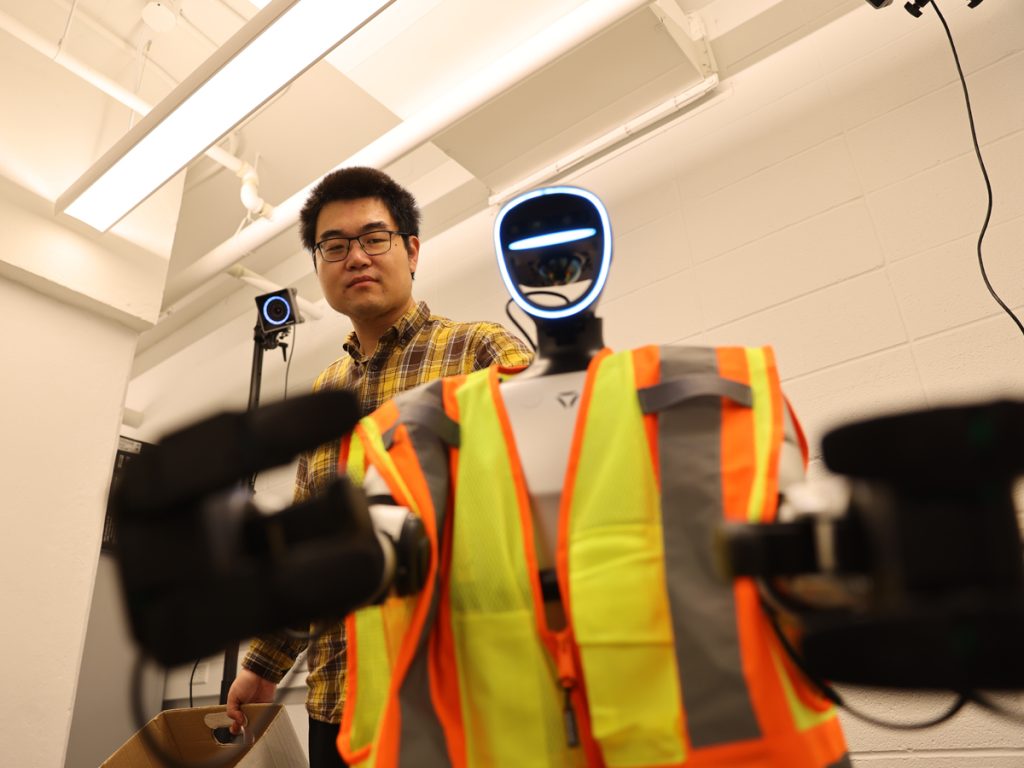
A person smiles while adjusting a humanoid robot in a safety vest.
Yanxi Liu is the study’s first author.
The system goes beyond remote control or pre-programmed routines. Instead, the robot uses the perception-and-action framework to interpret a worker’s body movements in three dimensions, translate those motions to fit its own physical proportions, and then carry out the task.
New robots, funding, and signals. Every Thursday.
Unsubscribe anytime.
Mentioned in this article