Europe's first humanoid robot mass-production base begins production in China-Serbia joint project - Global Times
The robots are gradually being deployed in industrial settings for loading and unloading, material handling and inspection, replacing workers in dangerous and repetitive tasks while improving manufacturing efficiency and safety.
Key takeaways
- The most recent headlines show humanoid robots moving quickly from competition labs into commercial use.
- In August 2026 Beijing hosted the second World Humanoid Robot Games, drawing more than 2,000 robots from 600 teams and setting new records such as an 8.64‑second 100‑meter sprint and a 9.45‑foot standing high jump, while social media also highlighted numerous crashes and mishaps.
- At the same time, Chinese startup Tau Robotics began renting its humanoid cleaners to San Francisco households for $30 an hour, offering services that include vacuuming, counter wiping and trash removal, with human operators currently supervising each task.
- Chinese electric‑vehicle maker Xpeng announced that its IRON humanoid will enter series production by the end of 2026, initially for use in its own stores and facilities, and aims for a broader commercial launch in 2027 after securing more than $900 million in financing.
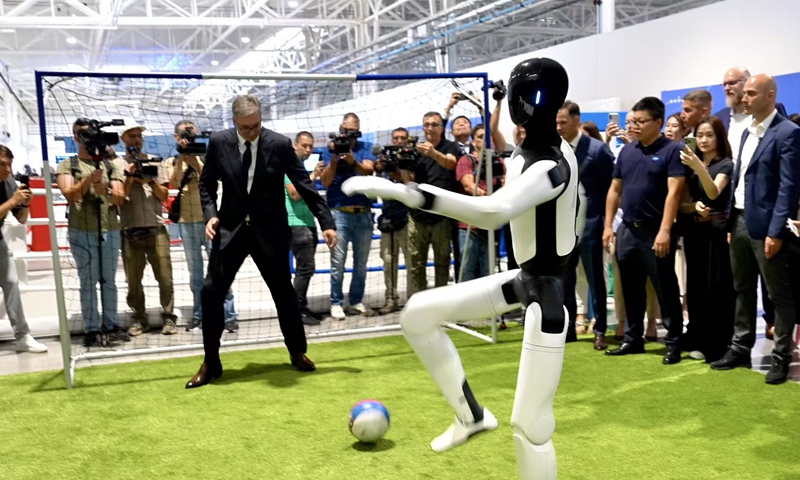
- In Europe, a joint China‑Serbia project led by Minth Group launched the continent’s first mass‑production base for humanoid robots and robotic dogs, targeting an annual capacity of up to 20,000 units once fully built.
The robots are gradually being deployed in industrial settings for loading and unloading, material handling and inspection, replacing workers in dangerous and repetitive tasks while improving manufacturing efficiency and safety. In the future, they are also expected to expand into home and elderly-care applications, providing companionship and intelligent assistance as human-robot collaboration becomes more natural and integrated into daily life, according to the company.
Minth Group's cooperation with Serbia is not a recent development, but part of a relationship built over years. The company first entered the Serbian market in 2018 and has since maintained an eight-year presence in the country, where it has established 10 factories. According to the plan, the project will later include a robotics industrial park in Serbia, with total investment expected to reach about 200 million euros. Once fully completed, annual production capacity for humanoid robots and robotic dogs is projected to reach up to 20,000 units, targeting markets in Europe and beyond.
The company told the Global Times that the mass-produced embodied-intelligence robots are equipped with multimodal perception systems, with tactile and sensing technologies integrated into their fingertips for precise force control and flexible grasping. Powered by AI deep-learning algorithms, they can adapt autonomously to complex environments and continuously improve their capabilities. At the end of May, during Serbian President Aleksandar Vucic's visit to East China's Zhejiang Province, Serbia and Minth Group signed two new investment agreements. The Loznica project involves an investment of 135 million euros and is expected to create 600 jobs, while the Sabac project will involve 91 million euros in investment and create 220 jobs.
Serbia has a history of pioneering robotics research, including work on bionic hands and bipedal exoskeletons. The launch of the new production base marks a fresh step in the country's participation in the global humanoid robotics industry.
New robots, funding, and signals. Every Thursday.
Unsubscribe anytime.
Mentioned in this article