From sci-fi to reality: Humanoid robots could soon be as big as auto industry - Consulting.us
# From sci-fi to reality: Humanoid robots could soon be as big as auto industry 30 April 2026 Consulting.us 4 min. read Development of humanoid robots is picking up pace, and if current trajectories hold, robotics manufacturers could reach revenues of $300...
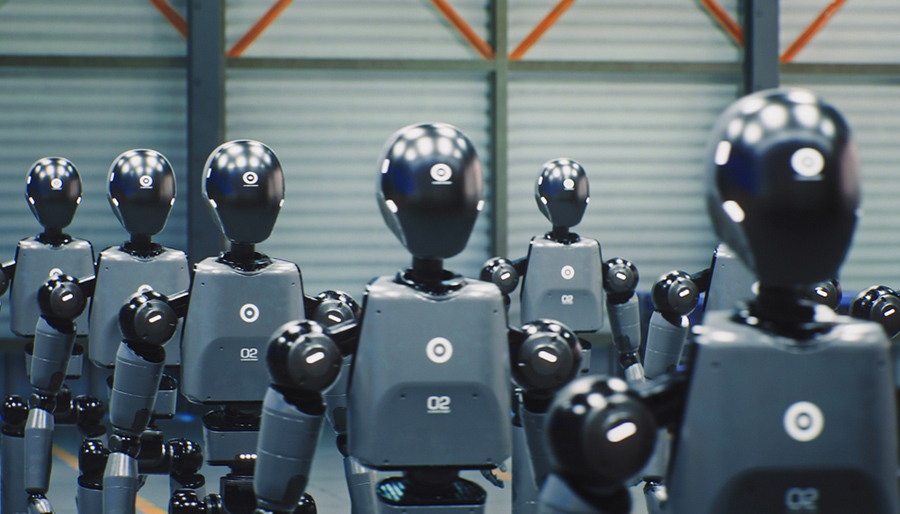
Key takeaways
- Humanoid robotics is accelerating across both consumer and industrial fronts.
- In the United States, Palo Alto‑based 1x announced that its NEO humanoid, priced at $20,000, will begin shipping later this year and that the company has booked its full 10,000‑unit annual capacity for 2026, with a goal of scaling to 100,000 units per year by the end of 2027.
- Meanwhile, Meta has bolstered its humanoid AI ambitions by acquiring Assured Robot Intelligence (ARI), a startup that builds foundation models enabling robots to understand and adapt to human behavior in dynamic settings; the ARI team will join Meta’s Superintelligence Labs.
- In parallel, Genesis AI unveiled the GENE‑26.5 brain, a foundation model that combines large‑scale egocentric video data with a dexterous glove interface to give robots human‑like precision in manipulation tasks, and the company has already raised $105 million to commercialize the technology.
- Tesla confirmed that its Optimus humanoid will move into mass production at the Fremont plant in Q2 2026, retooling existing lines to target a million‑unit annual capacity, although analysts note that actual market demand may be limited to internal factory use.
From sci-fi to reality: Humanoid robots could soon be as big as auto industry
30 April 2026 Consulting.us 4 min. read
Development of humanoid robots is picking up pace, and if current trajectories hold, robotics manufacturers could reach revenues of $300 billion by 2035, or in more optimistic scenarios, up to $750 billion. A new report from Roland Berger found that running costs could be as low as $2 per hour, making humanoid robotics huge for competitiveness, growth, and tackling labor shortages. "The key question is no longer whether humanoid robots will emerge as a viable technology, but how quickly they will scale – and which companies position themselves early enough to capture the opportunity," says Damien Dujacquier, managing partner at Roland Berger.
AI & Gen AI news
Cognizant acquires IT managed services firm Astreya LSL CPAs picks Fieldguide to integrate agentic AI into audit practice Recalibrate AI launches ‘Identity Platform’ to help leaders navigate AI change
Manufacturing news
Accenture invests in General Robotics to advance physical AI in manufacturing and logistics Deloitte US invests in Kihomac to scale domestic drone manufacturing EFESO Management Consultants launches interim management offering in North America
Follow us
About Consulting.us Source: UN Population Division, World Bank
Unlike fixed industrial arms, humanoid robots can operate within infrastructure designed for humans, performing varied tasks without requiring expensive facility redesigns. This flexibility is critical for high-variance tasks such as kitting, machine loading, and handling flexible materials like cables or hoses.
While some hardware like sensors and structural components are quite mature, the primary bottleneck in advanced robotics has now shifted to AI architecture and data strategy. Developers are now focusing on vision-language models and end-to-end learning to connect perception directly to action.
New robots, funding, and signals. Every Thursday.
Unsubscribe anytime.
Mentioned in this article