Galbot brings in $300M to scale mobile manipulator deployments
Other companies, like Sunday Robotics and Weave Robotics, are creating semi-humanoid robots for home deployments. Meanwhile, more established robotics players have released mobile manipulators that look more like traditional warehouse robots.
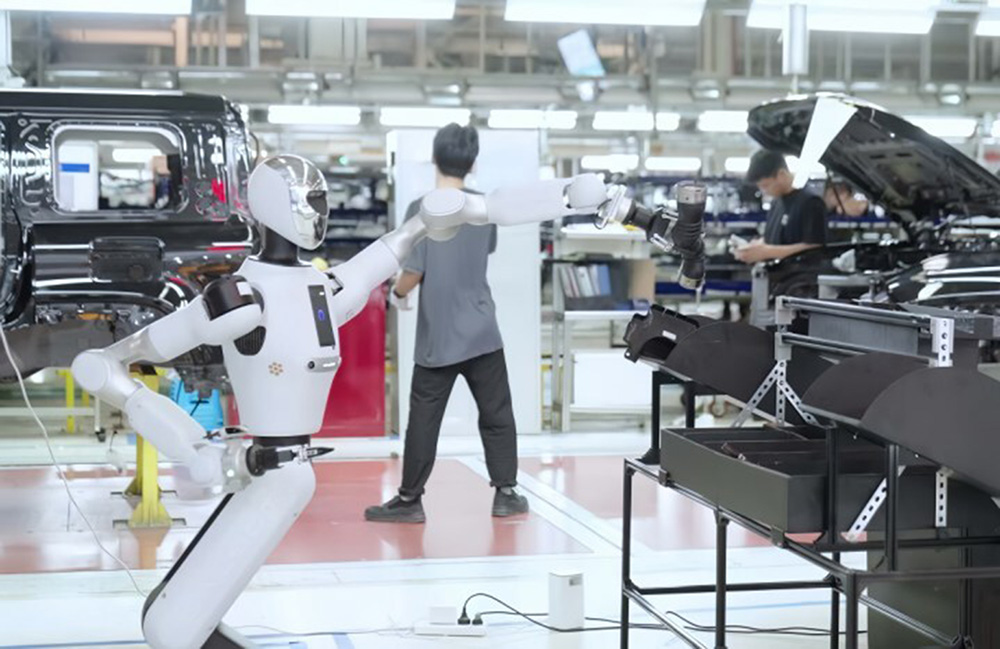
Key takeaways
- The most recent headlines show that humanoid robots are moving from prototype showcases into large‑scale industrial deployment and rapid commercial scaling.
- In late December, Chinese robotics firms announced aggressive production targets: UBTech plans to ship 5,000 industrial humanoids this year and increase output to 10,000 units by 2027, while AgiBot reported its 5,000th humanoid robot rolling off the Shanghai line, and electric‑vehicle maker Xpeng unveiled its second‑generation “Iron” robot with mass‑production slated for next year.
- Meanwhile, European chipmaker STMicroelectronics has partnered with Italy’s Oversonic Robotics to roll out the RoBee cognitive humanoid across its global semiconductor fabs, marking what industry observers call the first integration of humanoid robots directly into semiconductor manufacturing lines.
- In China’s battery sector, CATL has become the world’s first battery manufacturer to employ humanoid robots at scale, deploying its “Xiaomo” units in Luoyang to autonomously handle tasks such as battery‑connector insertion and flexible‑harness placement, reportedly tripling the productivity of a human worker.
- At the same time, analysts and journalists are warning that the hype may outpace technical readiness: the Wall Street Journal and IEEE Spectrum note ongoing challenges in manipulation dexterity, safety certification, and real‑world autonomy, while a recent security demonstration showed that commercial humanoid platforms like Unitree can be compromised via voice commands, raising concerns about cyber‑risk as these machines proliferate.
Other companies, like Sunday Robotics and Weave Robotics, are creating semi-humanoid robots for home deployments.
Meanwhile, more established robotics players have released mobile manipulators that look more like traditional warehouse robots. For example, Mobile Industrial Robots (MiR) last year introduced its MC600 mobile manipulator. Other developers taking this route include Kinisi Robotics. Kinisi offers the KR1, a dual-armed robot with a mobile base. The company has so far focused on warehouse and storeroom applications with its robot.
RoboForce earlier this year unveiled its Titan mobile manipulator, which it says works in demanding outdoor environments. Additionally, U.K.-based Humanoid unveiled its HMND 01 Alpha mobile manipulator for industrial facilities in September. This latest round of funding included investors from China, Singapore, and the Middle East, said Galbot.
Mobile manipulators emerge as a humanoid alternative
Galbot is part of a larger trend in the robotics industry around semi-humanoid mobile manipulators. These robots offer some of the flexibility of humanoids while maintaining a more stable wheeled base.
New robots, funding, and signals. Every Thursday.
Unsubscribe anytime.
Mentioned in this article