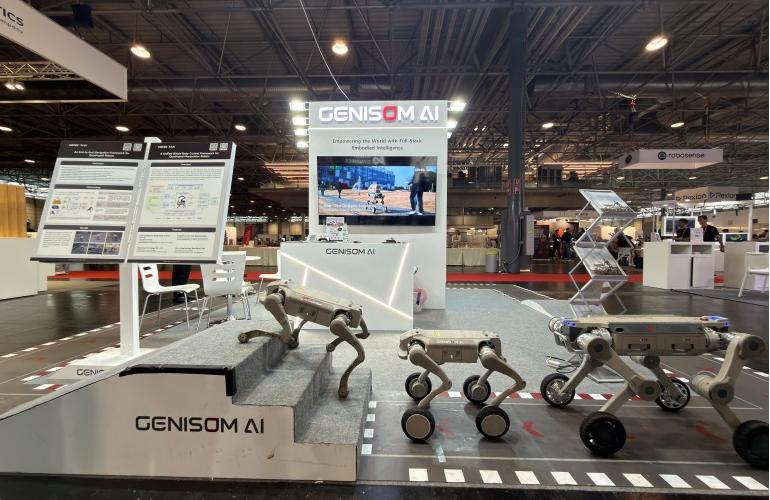
GENISOM AI debuts deployable robotics platforms at ICRA 2026
### Tell Us What You Think! Cancel reply This site uses Akismet to reduce spam. Learn how your comment data is processed. #### Related Articles Read More > ##### How humanoids learn to read the room ##### GMSL and the growing ecosystem around robotic vision...
robot
ai
robotics
Key takeaways
- The most recent developments show a rapid shift from prototype demonstrations toward large‑scale manufacturing and commercial deployment of humanoid robots. In China, Lingyi iTech’s new Beijing factory has already built 300 units and is targeting 10,000 this year, with a long‑term goal of 500,000 annually by 2030, a scale that could cut the typical $30,000 price tag dramatically. Meanwhile, the Chinese market shipped more than 13,000 humanoids in 2025, and analysts expect sales to more than double to around 28,000 units in 2026, with a possible million‑unit annual volume by the early 2030s, although demand still trails production capacity.
- Outside China, Standard Bots secured a $200 million Series C round that lifted its valuation to $1 billion, underscoring investor confidence in mass‑producing humanoids. Figure AI announced an accelerated manufacturing line and a logistics partnership with Catalyst Brands to field its humanoid platforms in distribution centers.
- On the technology front, Sharpa integrated its Wave tactile robot hands into Unitree’s H2 Plus humanoid reference design, creating the first dexterous humanoid built on Nvidia’s Isaac GR00T framework. This move highlights a broader industry emphasis on manipulation and tactile sensing rather than just locomotion.
- In Europe, the UK‑based company Humanoid sealed a proof‑of‑concept partnership with Bosch, positioning the venture for scaled production, while Agile Robots unveiled its AgileONE humanoid and a suite of force‑control systems at the Robot Technology Japan event, demonstrating advanced embodied AI and collaborative capabilities.
- Academic research is also progressing: MIT researchers introduced a wearable ultrasound wristband that captures fine hand‑muscle movements in real time, providing a new source of training data that could help future humanoids achieve human‑level dexterity.
Buyer next steps
Compare source-backed options on HumanoidHub
Use HumanoidHub catalog records and buyer guides to verify robot availability, source links, and shortlist fit before contacting manufacturers.
Tell Us What You Think! Cancel reply
This site uses Akismet to reduce spam. Learn how your comment data is processed.
How humanoids learn to read the room
GMSL and the growing ecosystem around robotic vision systems
The Convergence in Perception Systems from Cars to Robots
How humanoids learn to read the room
Search The Robot Report
Weekly Robotics Brief
New robots, funding, and signals. Every Thursday.
Unsubscribe anytime.