GENISOM AI steps into the global robotics spotlight at ICRA 2026 with real-world-ready robots - Robotics & Automation News
Its dual hot-swappable batteries support continuous operation, with battery life of up to five hours. These features make it practical for fieldwork where reliability, endurance, and adaptability are important.
Key takeaways
- Humanoid robots are shifting from science‑fiction demos to commercial products, with several manufacturers now shipping thousands of units and pricing approaching that of cars and high‑end equipment.
- The Unitree G1 is available online for about $16,000, while Agility Robotics’ Digit, priced around $250,000, is already deployed with Amazon, GXO and other industrial customers.
- 1X’s Neo Gamma is opening pre‑orders for home use at $20,000 or $499 per month, with shipping slated for later in 2026, and the company expects to produce more than 10,000 robots this year.
- Boston Dynamics announced a commitment to deliver roughly 25,000 Atlas humanoids to factories and is scaling production capacity to 30,000 units per year by 2028, with a new end‑to‑end demonstration planned for CES 2025.
- Genesis AI, backed by former Google CEO Eric Schmidt, unveiled a non‑humanoid wheeled robot, Eno, arguing that functional design can outperform humanoid form for logistics and manufacturing, and raised $105 million in seed funding to accelerate its rollout.
Buyer next steps
Compare source-backed options on HumanoidHub
Use HumanoidHub catalog records and buyer guides to verify robot availability, source links, and shortlist fit before contacting manufacturers.
Its dual hot-swappable batteries support continuous operation, with battery life of up to five hours. These features make it practical for fieldwork where reliability, endurance, and adaptability are important.
In power grid inspections, the GENISOM M1 can support teams working around substations, power lines, and other infrastructure.
In industrial environments, it can assist with routine inspection tasks in areas that may be difficult, dangerous, or time-consuming for human workers to access.
For emergency response, the robot’s mobility and payload capacity can help carry sensors, communication tools, or other equipment into challenging locations. ### Real-World Applications Across Industry and Infrastructure
Technology remains an important part of GENISOM AI’s story, but the focus is on practical value rather than complex algorithmic explanations.
The MATRiX simulation platform helps robots train and validate capabilities in simulation before entering real-world environments. This allows developers to test movement, navigation, and operational behavior before physical deployment.
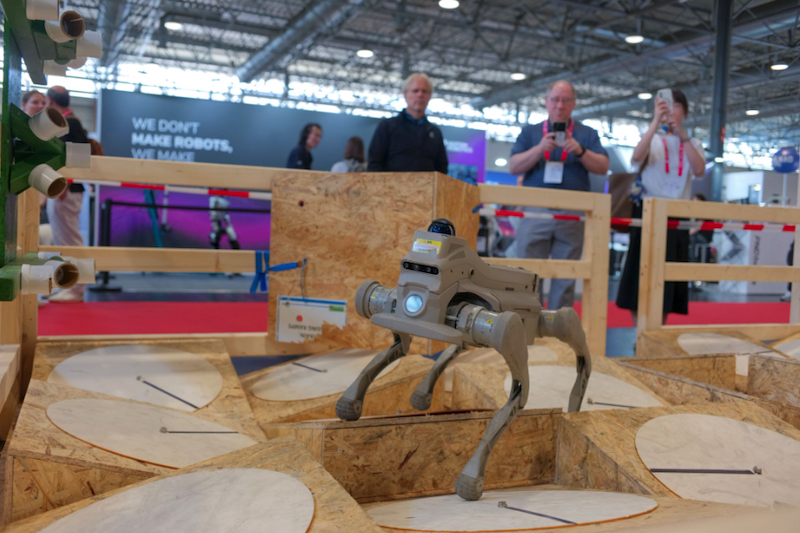
RoamerX, GENISOM AI’s autonomous navigation system, supports mapping, path planning, and obstacle avoidance. In simple terms, it helps robots understand where they are, plan where they need to go, and respond to obstacles along the way. The GENISOM L1-W features a hybrid wheeled-legged mobility system, combining the terrain adaptability of legged robots with the movement efficiency of wheels. This makes it useful in environments where robots may need to move across both flat surfaces and more complex terrain.
The University of Manchester team won first place in the IROS 2025 Quadruped Robot Challenge using GENISOM L1 EDU, showing the platform’s effectiveness in a demanding robotics environment.
GENISOM L1 EDU supports SLAM, 3D mapping, and open-source development, making it relevant for universities, laboratories, and developers exploring robotics applications. For education and research users, this provides a platform for testing ideas, developing software, and studying real-world robotic behavior.
New robots, funding, and signals. Every Thursday.
Unsubscribe anytime.