Humanoid Robot Battery Production — CATL Achieves A World First
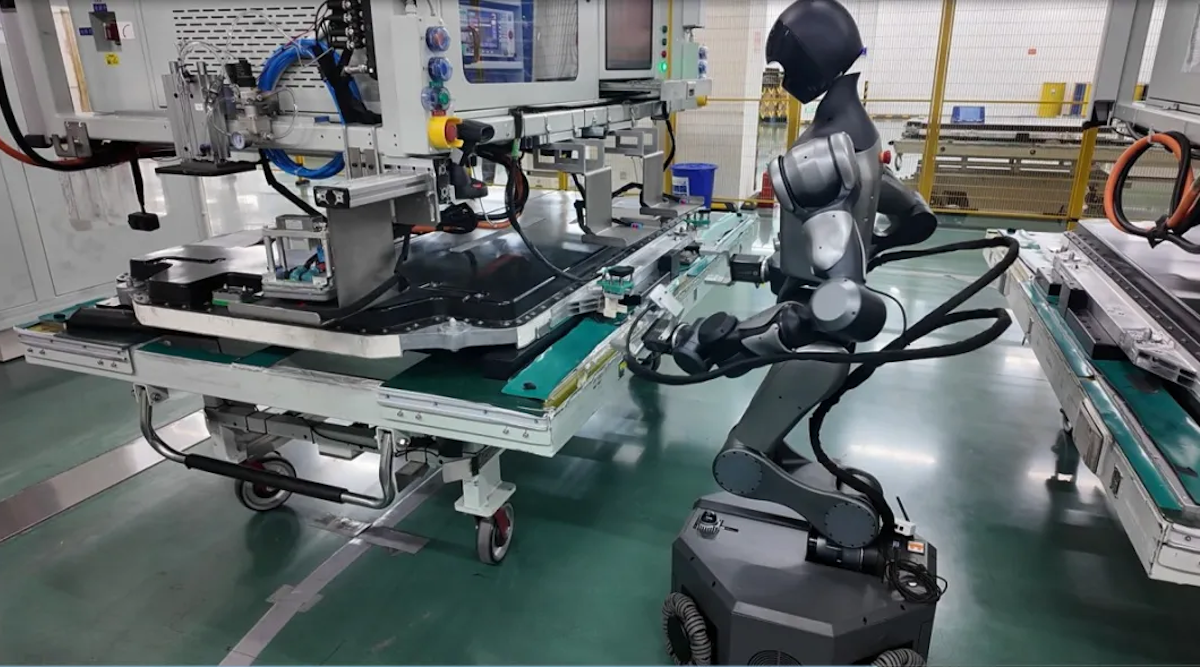
First of all, yes, these humanoid robots have apparently replaced human workers. In fact, one robot’s daily workload is reportedly triple that of a human worker…. These humanoid robots are being deployed at CATL’s battery factory in Luoyang, Henan.
Key takeaways
- The most recent developments show humanoid robots moving from prototypes to large‑scale industrial use and public demonstrations.
- In December 2025 European chipmaker STMicroelectronics announced a partnership with Italy’s Oversonic Robotics to roll out its cognitive humanoid, RoBee, across its global semiconductor plants, marking what is believed to be the first integration of humanoid robots directly into semiconductor manufacturing.
- At the same time, Chinese battery giant CATL has become the world’s first battery producer to deploy humanoid robots at scale in its Luoyang factory, where the “Xiaomo” units now handle complex tasks such as battery connector insertion and adaptive force control, reportedly delivering three times the workload of a human worker.
- Chinese companies are also scaling production: UBTech plans to ship 500 industrial robots this year and increase its humanoid output to 5,000 units in 2026, while AgiBot celebrated the rollout of its 5,000th humanoid robot from its Shanghai line.
- Xpeng unveiled a second‑generation humanoid called “Iron” at the IAA auto show in Munich and said mass production will start next year.
First of all, yes, these humanoid robots have apparently replaced human workers. In fact, one robot’s daily workload is reportedly triple that of a human worker….
These humanoid robots are being deployed at CATL’s battery factory in Luoyang, Henan. “CATL (HKG: 3750, SHE: 300750) has become the world’s first battery manufacturer to deploy humanoid robots at scale in battery pack production, replacing human labor in several critical processes,” CnEVPost writes. “Named ‘Xiaomo’ (or Little Mo), the humanoid robot can now precisely execute complex tasks like battery connector insertion, marking a milestone breakthrough in applying embodied intelligence to manufacturing, the company said.” (Note that another Chinese site, CarNewsChina, “The humanoid robot autonomously handles uncertainties like material position deviations and connection point variations, dynamically adjusting its operational posture in real time. When inserting or removing flexible wiring harnesses, it dynamically modulates force to ensure reliable connections without damaging components.”
CarNewsChina adds: “According to CATL, the robot excels in three key areas:
New robots, funding, and signals. Every Thursday.
Unsubscribe anytime.
Mentioned in this article