Humanoid robots need these key technologies to work like humans
According to the report, many next-generation humanoids are being designed to recharge autonomously or even replace their own battery packs. Developers are also exploring solid-state batteries, which promise higher energy density and improved safety by repl...
Key takeaways
- The U.S. has just banned new imports of Chinese‑made humanoid and quadruped robots, citing national‑security concerns, while Chinese manufacturers continue to dominate the market: AgiBot overtook Unitree as the world’s largest vendor, shipping 8,400 units (44 % of global shipments) in the first half of 2026; Unitree shipped about 5,900 units.
- Global shipments rose 272 % year‑on‑year to 19,100 units in H1 2026, with 97 % of the volume coming from China.
- In the U.S., Tesla is still testing its Optimus line internally, and Boston Dynamics is pushing its Atlas robot toward commercial production, though industrial‑scale deployment remains limited.
- A San Francisco‑based start‑up, Tau Robotics, has launched a pilot that lets residents pay $30 per hour for a 50‑k‑dollar robot to clean their homes.
- Meanwhile, New York legislators have introduced a bill that would ban schools from employing humanoid robots as classroom assistants after a local district’s pilot.
According to the report, many next-generation humanoids are being designed to recharge autonomously or even replace their own battery packs. Developers are also exploring solid-state batteries, which promise higher energy density and improved safety by replacing flammable liquid electrolytes with solid materials.
The guide notes that the commercial humanoid robotics market is expanding rapidly, with dozens of new models entering development worldwide. Alongside robot manufacturers, demand is also growing for suppliers of AI chips, sensors, actuators, precision gearing, and advanced battery technologies. It also highlights the rapid growth of the humanoid robotics market, with new commercial models and supporting technologies expanding opportunities for developers, manufacturers, and investors.
Humanoid robot guide
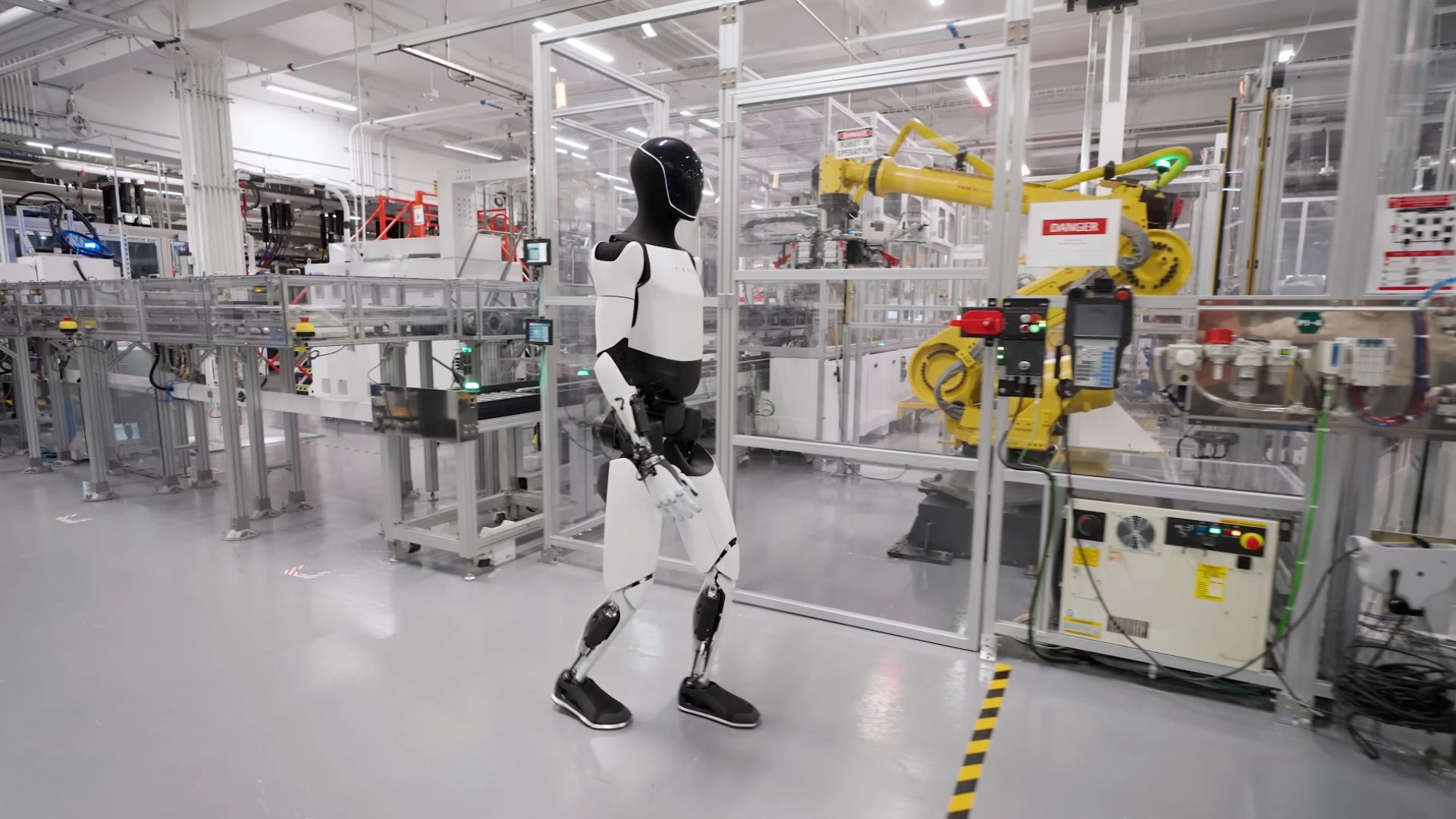
Advances in AI, robotics hardware, and battery technology are making it increasingly feasible to build humanoid robots, according to the new guide released by ROBO. The guide outlines the essential technologies needed to create a humanoid robot, describing the system in terms of three core elements: the “brain,” the “body,” and the “energy” source. The technology behind humanoid robots explained in the new industry guide (representational image).Tesla/YouTube
Building a humanoid robot is becoming more achievable as advances in AI, actuators, sensors, and battery technology make sophisticated components increasingly accessible.
A new guide from the ROBO Global Robotics and Automation Index outlines the core technologies required, grouping them into three key systems: the robot’s “brain,” “body,” and “energy” source.
The guide explains how AI processors, cameras, precision actuators, and next-generation solid-state batteries work together to enable human-like movement, perception, and autonomy.
New robots, funding, and signals. Every Thursday.
Unsubscribe anytime.
Mentioned in this article