Humanoid robots step up their game: how useful are the latest droids?
In November, Chinese firm UBTECH announced that it had made “the world’s first mass delivery of humanoid robots”. More than 1,000 of its Walker S2 model humanoids were sent to factories in 2025, says Yu Zheng, a roboticist and vice-dean of the UBTECH Resear...
Key takeaways
- The most recent coverage shows that humanoid robots are moving from laboratory demos toward industrial and consumer deployments, but significant technical and labor challenges remain.
- At CES 2026 Boston Dynamics unveiled a new version of its Atlas humanoid, and Hyundai announced that it will pair Atlas with its own AI strategy to roll out up to 30,000 units a year beginning in 2028, starting at its Georgia EV Metaplant, while the company’s labour union has warned that any deployment must be negotiated with workers.
- In Europe, Ford’s Innovation Centre in Cologne completed a proof‑of‑concept with the UK‑based Humanoid company, using NVIDIA’s Omniverse digital twins to have a wheeled Alpha HMND 01 robot perform complex logistics tasks such as tote handling and dual‑arm manipulation of large car body parts.
- Meanwhile, the AI startup 1X revealed its Neo robot, claiming a new “world model” lets the machine learn directly from its own video feed and eliminates the need for large teams of human tele‑operators to train it for household chores.
- OpenAI has quietly re‑established a humanoid robotics lab in San Francisco, scaling up data‑collection teams to teach robotic arms household tasks and keeping a prototype humanoid on site, although most work still focuses on tele‑operated arms.
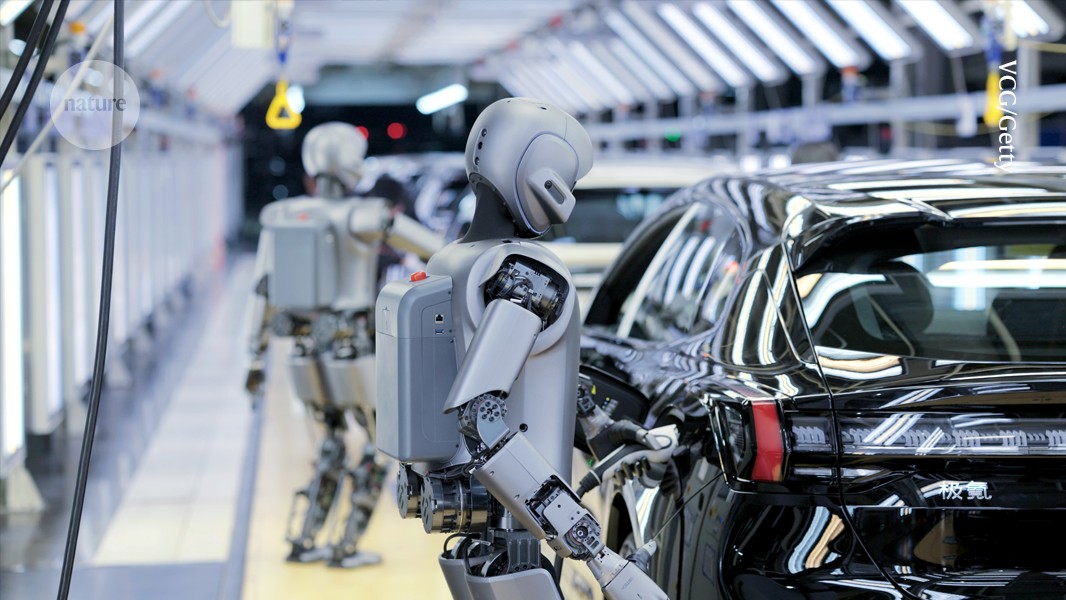
In November, Chinese firm UBTECH announced that it had made “the world’s first mass delivery of humanoid robots”. More than 1,000 of its Walker S2 model humanoids were sent to factories in 2025, says Yu Zheng, a roboticist and vice-dean of the UBTECH Research Institute in Shenzhen. The silver-white humanoid can walk autonomously and stably, as well as grab and move objects, but deployment “is still at an early stage”, says Zheng. Search author on: PubMed Google Scholar
Email Bluesky Facebook LinkedIn Reddit Whatsapp X
Humanoid robots are on the brink of being commercially useful, say Chinese and US firms that have announced plans to produce them at scale in the past three months.
Many researchers agree that there has been a step change in humanoid capability over the past five years, owing to cheaper parts as well as innovations such as improved battery power and artificial-intelligence algorithms, which allow for better perception and autonomy. ## Car makers
Humanoids first application could be in car factories. Some US robotics developers, including Boston Dynamics and Tesla, are running pilots of humanoid robots in their parent company's industrial plants. The automotive industry is “an ideal setting” in which to apply humanoids, says Carolina Parada, based in Boulder, Colorado, who leads the robotics team at Google DeepMind, which last week announced a partnership with Boston Dynamics. Their factories host diverse and complex tasks and “in a semi-structured environment that is built for robots”, she says.
New robots, funding, and signals. Every Thursday.
Unsubscribe anytime.
Mentioned in this article