IFR names top 5 global robotics trends of 2026
Boston Dynamics unveiled a new version of Atlas at CES 2026. | Credit: Hyundai The field of humanoid robotics is expanding rapidly, noted the IFR.
Key takeaways
- The most recent coverage shows that humanoid robots are moving from laboratory demos toward industrial and consumer deployments, but significant technical and labor challenges remain.
- At CES 2026 Boston Dynamics unveiled a new version of its Atlas humanoid, and Hyundai announced that it will pair Atlas with its own AI strategy to roll out up to 30,000 units a year beginning in 2028, starting at its Georgia EV Metaplant, while the company’s labour union has warned that any deployment must be negotiated with workers.
- In Europe, Ford’s Innovation Centre in Cologne completed a proof‑of‑concept with the UK‑based Humanoid company, using NVIDIA’s Omniverse digital twins to have a wheeled Alpha HMND 01 robot perform complex logistics tasks such as tote handling and dual‑arm manipulation of large car body parts.
- Meanwhile, the AI startup 1X revealed its Neo robot, claiming a new “world model” lets the machine learn directly from its own video feed and eliminates the need for large teams of human tele‑operators to train it for household chores.
- OpenAI has quietly re‑established a humanoid robotics lab in San Francisco, scaling up data‑collection teams to teach robotic arms household tasks and keeping a prototype humanoid on site, although most work still focuses on tele‑operated arms.
Boston Dynamics unveiled a new version of Atlas at CES 2026. | Credit: Hyundai
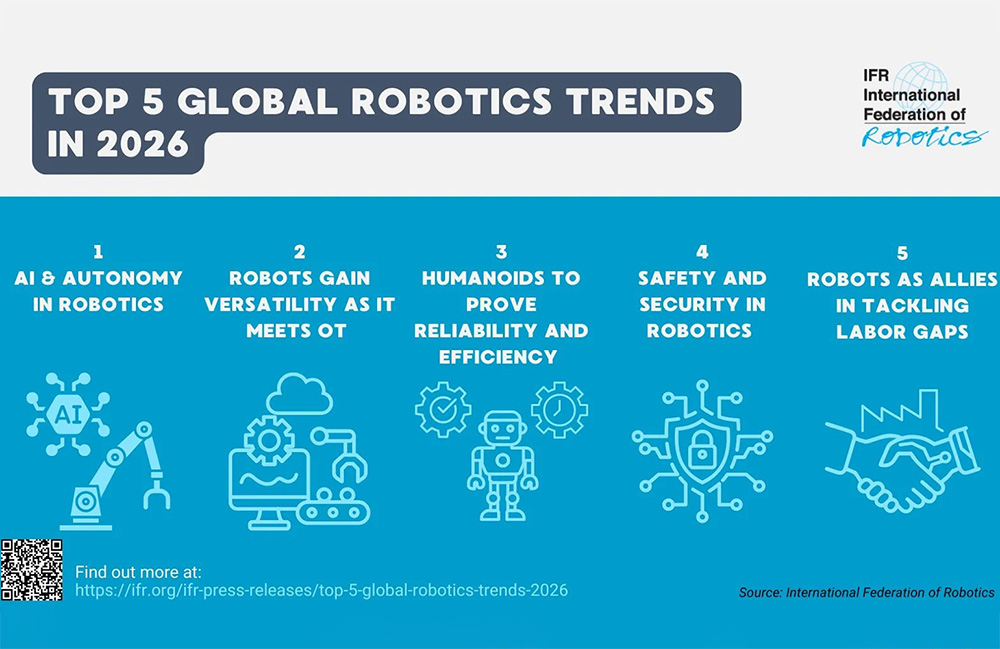
The field of humanoid robotics is expanding rapidly, noted the IFR. Many see humanoid technology as promising for industrial applications where flexibility is required, typically in environments designed for humans. Pioneered by the automotive industry, applications in warehousing and manufacturing are coming into focus worldwide.
Today, companies and researchers are moving beyond prototypes to deploy humanoids in real life. Reliability and efficiency are key to industrial success. In competing with traditional automation, these robots need to match stringent requirements for cycle times, energy consumption, and maintenance costs. Industry standards also define safety levels, durability criteria, and consistent performance for humanoid robots on the factory floor. Humanoids intended to fill labor gaps need to achieve human-level dexterity and productivity, key measures to prove real-world efficiency.
4. Safety and security remain concerns for developers, users
As robots increasingly operate alongside humans in factories and service settings, ensuring they operate safely is not just important; it’s essential for the robotics industry. The AI-driven autonomy fundamentally changes the safety landscape, which makes testing, validation, and human oversight much more complex—but also more necessary. The need for such validation and control becomes particularly clear in the intended use of humanoids, the IFR acknowledged. Robots need to be designed and certified in line with ISO safety standards and clearly defined liability frameworks.
In the context of AI in robotics and the convergence of IT and OT, a spectrum of safety and security concerns arises that demand robust governance and clear assignment of liability. The rapid expansion of robotics systems into cloud-connected and AI-driven environments is exposing industrial production to a growing array of cybersecurity threats. Experts have cited a rise in hacking attempts targeting robot controllers and cloud platforms, enabling unauthorized access and potential system manipulation.
New robots, funding, and signals. Every Thursday.
Unsubscribe anytime.
Mentioned in this article