Inside China’s race to dominate humanoid robotics industry - NBC News
But it’s not just the human-sized or the cute dog-sized robots that Chinese companies have unveiled. On Tuesday, China’s Unitree Robotics unveiled a nearly 9-foot-tall humanoid robot with a cockpit capable of carrying a human inside — a real-world nod to th...
Key takeaways
- The most recent headlines show a surge in large‑scale deployments and performance milestones for humanoid robots.
- British startup Humanoid has signed a phased supply agreement with German motion‑technology giant Schaeffler to roll out a four‑digit fleet of its wheeled HMND 01 Alpha units across Schaeffler’s global factories, with the first sites in Herzogenaurach and Schweinfurt slated to go live between December 2026 and June 2027; the contract also includes a seven‑digit order for actuators that hints at a potential total of 100 000 robots over the next five years.
- In the United States, California‑based Figure AI extended an eight‑hour autonomous package‑sorting test into a continuous 24‑hour run, during which three Helix‑02 humanoids sorted more than 28 000 parcels without failure, underscoring progress toward round‑the‑clock warehouse operation.
- Meanwhile, China’s Unitree Robotics unveiled a 9‑foot, 1 100‑pound humanoid called GD01 that can carry a human passenger and transform into a quadruped, priced at $650 000, illustrating the country’s push to dominate the high‑profile, human‑sized segment of the market.
- In Japan, the Institute of Science Tokyo opened an unmanned laboratory staffed by ten robots—including the Maholo LabDroid humanoid—to automate medical experiments, reflecting a broader trend of integrating autonomous humanoids into research environments.
But it’s not just the human-sized or the cute dog-sized robots that Chinese companies have unveiled. On Tuesday, China’s Unitree Robotics unveiled a nearly 9-foot-tall humanoid robot with a cockpit capable of carrying a human inside — a real-world nod to the mecha machines that many sci-fi fans have long dreamed of, or feared.
Standing beside the towering robot, Unitree’s chief executive, XingXing Wang, barely reached the end of its arm, a video posted by the company on X showed.
Unitree Robotics says its machine, priced at $650,000, is the first of its kind. Typically walking on its two legs, the GD01 can also transform into a quadruped machine, weighing more than 1,100 pounds with a person inside. Elon Musk, whose company Tesla also makes humanoid robots, has called the Chinese bots “cool.” Musk was in Beijing this week as part of President Donald Trump’s state visit. Trump said his meeting with President Xi Jinping went well and expressed hope for more American collaboration with China.
But there is still much room for improvement in what these robots can do physically and autonomously, meaning without remote direction.
“Where all of the robotics industry needs to improve is in the brains of these robots, in the software that allows these robots to actually do the things we want, whether they be in a house or an industrial setting,” said Joanna Stern, NBC News’ chief technology analyst. Before these robots can wash dishes or fold laundry, manufacturers need vast amounts of real-world data to train them. Several companies, including U.S. firms, are now offering cash to people willing to strap iPhones to their bodies and record their every move.
Over at X-Humanoid, Gao said, though their robots are powerful, the company doesn’t want its robots to be militarized but added that there was real value in emergency or dangerous tasks.
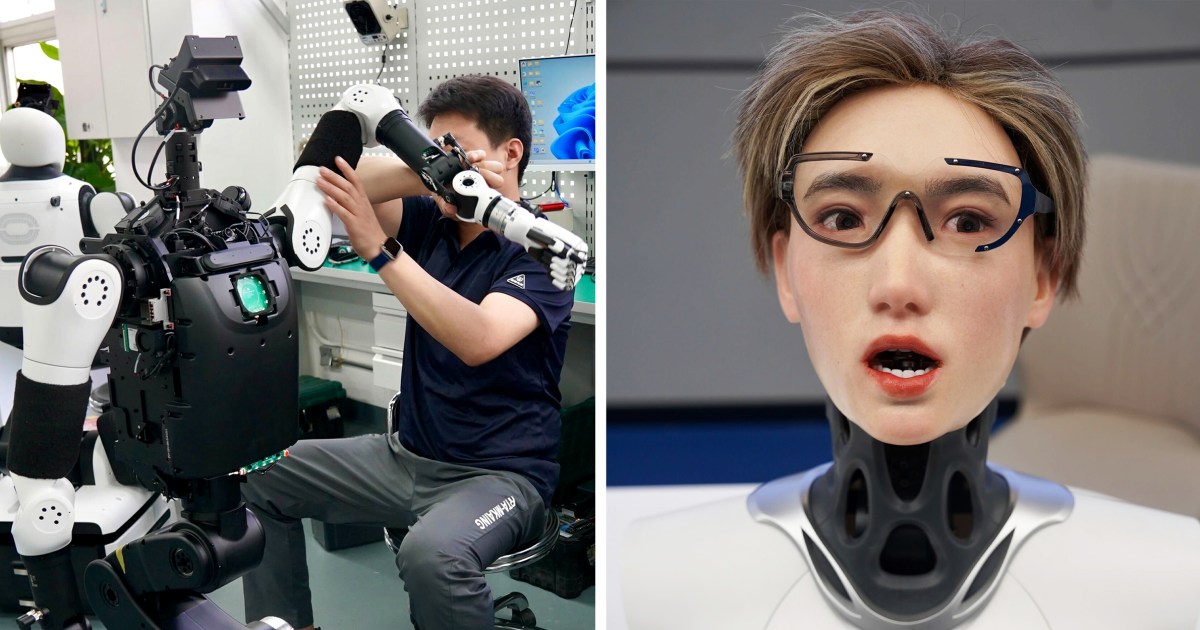
At its facility, the robots move through each stage of production: assembled, tested and programmed. Designed to crawl through tight crevices or trudge across rough terrain, X-Humanoid says they’re being built for jobs that humans would rather not do. The company stresses that displacement is not the goal.
New robots, funding, and signals. Every Thursday.
Unsubscribe anytime.
Mentioned in this article