Is this the year domestic robots come in our homes?
The industry for humanoid robots in general in China is in fact so hot that the government recently warned there was a risk of a bubble building that might burst if the robots aren't as successful or popular as they hope.
Key takeaways
- Humanoid robots are moving from prototype to early commercial use.
- In November 2025 Chinese firm UBTECH announced the world’s first mass delivery of its Walker S2 humanoid, shipping more than 1,000 units to factories and demonstrating autonomous walking, object handling and stable locomotion, though deployment remains in its infancy.
- In January 2026 a UK‑based AI‑robotics company, Humanoid, completed a proof‑of‑concept with Siemens at the Siemens Electronics Factory in Erlangen, where its wheeled HMND 01 Alpha robot achieved a throughput of 60 tote moves per hour, handled two tote sizes, ran autonomously for over 30 minutes at a time and logged more than eight hours of uptime.
- US‑based AGIBOT debuted at CES 2026 after shipping more than 5,100 robots in 2025, including a mix of full‑size bipedals and mobile manipulators, and the company projects annual global shipments could reach 2.6 million units by 2035.
- At the same CES, Boston Dynamics showcased a new version of its Atlas humanoid, underscoring IFR’s view that humanoid technology is expanding rapidly for industrial flexibility.
Buyer next steps
Compare source-backed options on HumanoidHub
Use HumanoidHub catalog records and buyer guides to verify robot availability, source links, and shortlist fit before contacting manufacturers.
The industry for humanoid robots in general in China is in fact so hot that the government recently warned there was a risk of a bubble building that might burst if the robots aren't as successful or popular as they hope.
The International Federation of Robotics thinks it could take 20 years before domestic bots become truly useful and accepted.
There are questions too about how much demand there will actually be for the bots. Will they just be the play things of the rich or will they become cheap enough for mainstream use in the same way that robot hoovers have become?
But for the engineers at the forefront of this technology there appears to be a confidence that they are truly building a future that all of us will want in our homes. Engineers are using all sorts of different robotic arms, hands and bodies to develop AI software for any robot hardware.
"We want to be able to breathe intelligence into any sort of physical embodiment, whether that's a humanoid robot or even something that looks closer to an appliance," says co-founder Chelsea Finn.
Their approach is being excitedly backed by investors including Amazon founder Jeff Bezos and OpenAI.
There's a huge amount of investment going into this technology and although Silicon Valley is once again an epicentre, it is facing tough competition from Chinese rivals. Skip to content
Watch Live
Watch Live
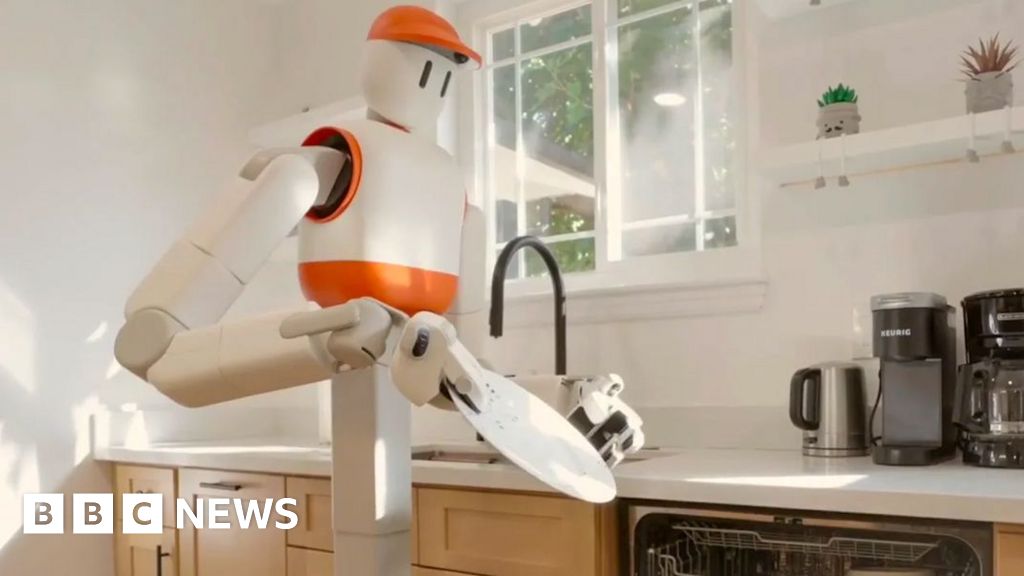
Eggie, Neo, Isaac and Memo are domestic robots. But would you let them load your dishwasher?
The idea of having a friendly robot butler that can do all the dull duties of running a home has existed for decades.
But now, thanks to AI, it's genuinely happening and this year the first truly multi-purpose domestic bots will start to enter homes.
In Silicon Valley, they're being trained at speed to fold laundry, load the dishwasher, and clean up after us.
Their excitable human creators are making big promises but I wanted to see how realistic the idea of a robot housekeeper really is.
So I went to meet Eggie, NEO, Isaac and Memo.
It is impossible not to smile when one of these humanoid or partly humanoid (no legs) bots enters a room.
New robots, funding, and signals. Every Thursday.
Unsubscribe anytime.
Mentioned in this article