New Generation of Robotic Cells to Drive Flexible, Zero-Emission Aerospace Manufacturing
Image 11 Leave your feedback Login (Logout) Your comment type Public Comment Private Feedback to AZoRobotics.com Submit Trending Stories Editorial Highlight Featured Equipment Image 12: AI-Powered Solar Robot Detects Crop Diseases in Real Time1 ### AI-Power...
Key takeaways
- The most recent coverage shows that humanoid robots are moving from prototype hype toward modest commercial roll‑out, but significant technical and economic hurdles remain.
- A McKinsey report cited in January 2026 notes that public demos still fall short of delivering reliable, cost‑effective performance, citing safety, limited battery life, dexterity and price as key barriers, and warns that even if Tesla reaches its goal of a million Optimus units by the end of 2027, the robots must prove they can work alongside humans for less than a human wage.
- Meanwhile, global installations of humanoid robots hit 16,000 units in 2025, with Chinese firms leading the market: Shanghai‑based AgiBot topped the list with over 5,000 units and a 31 % share, Unitree held 27 % and is pushing lower‑cost platforms, while UBTech, Leju and Tesla each hold roughly 5 % of installations.
- New business models such as robot‑as‑a‑service are gaining traction, especially for entertainment and retail deployments.
- At CES 2026, the British startup Humanoid displayed its HMND 01 biped, reporting about 25,000 pre‑orders and pilot programs with six Fortune 500 firms, while Boston Dynamics demonstrated its Atlas robot operating on Hyundai’s Georgia plant, underscoring a “sea change” in how the industry talks about physical AI.
Buyer next steps
Compare source-backed options on HumanoidHub
Use HumanoidHub catalog records and buyer guides to verify robot availability, source links, and shortlist fit before contacting manufacturers.
Image 11
Leave your feedback
Login
(Logout)
Your comment type
Public Comment
Private Feedback to AZoRobotics.com
Submit
Trending Stories Editorial Highlight Featured Equipment
Image 12: AI-Powered Solar Robot Detects Crop Diseases in Real Time1
AI-Powered Solar Robot Detects Crop Diseases in Real Time
Image 13: Detachable Robotic System for Non-Anthropomorphic Grasping2
Detachable Robotic System for Non-Anthropomorphic Grasping
Image 14: Engineers Combine Origami and Electrohydraulics to Unlock High-Speed Soft Robotics3
Engineers Combine Origami and Electrohydraulics to Unlock High-Speed Soft Robotics
Image 15: New Tech Bridges the Gap Between Human Intuition and Robot Control4
New Tech Bridges the Gap Between Human Intuition and Robot Control Image 9: EmailSign in with email
Nidec Drive Technology’s Omnidirectional Drive Unit to be Adopted for Use in Honda’s New “UNI-ONE” New Firmware Enables Faster drive-to-drive Communication and More Flexible Exchange of CANopen Process Data Zero Zero Robotics Debuts First Autonomous Flying Camera
Medical Robots eBook
Image 10: Medical Robots
Compilation of the top interviews, articles, and news in the last year.
Download a free copy
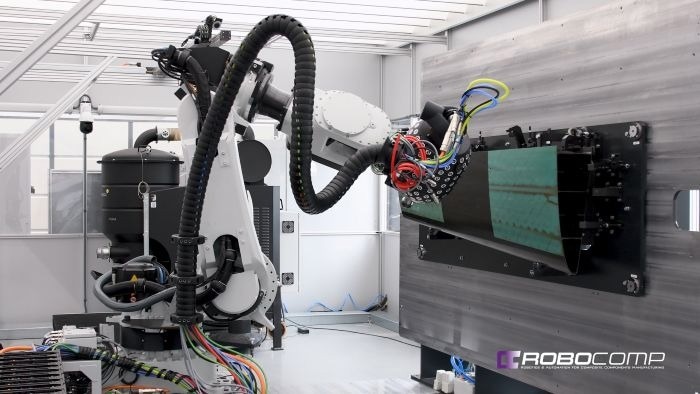
This technological transition responds to specific operational limitations of current machinery. While large traditional equipment usually machines parts in a horizontal position, restricting access to many components with complex geometries, ROBOCOMP's proposal introduces the ability to work on parts placed vertically. Using the advantages of the phased array technology, Olympus has designed a powerful inspection system for seamless pipe inspections well-adapted to the stringent requirements of the oil and gas markets. This phased array system is flexible and can be used to match inspection performances and the product requirements of customers.
From EVIDENT Europe GmbH
Thought Leaders
Robot Chef: The Future of Automated Meal Preparation
28 Sep 2022
Tiny Robotic Crab: The Smallest-Ever Remote-Controlled Walking Robot
23 Sep 2022
Resurrecting Ancient Cephalopods with Robots
23 Aug 2022
Newsletters you may be interested in
New robots, funding, and signals. Every Thursday.
Unsubscribe anytime.
Mentioned in this article