RealSense unveils autonomous humanoid navigation at GTC 2026
“Humanoids operate in three dimensions, alongside people, in environments that are constantly changing,” stated Nadav Orbach, CEO of RealSense. “If robots are going to work safely beside humans, perception carries responsibility beyond raw sensors.
Key takeaways
- Humanoid robots are moving from experimental labs into real‑world settings across several sectors.
- In manufacturing, BMW has begun testing Hexagon’s Aeon humanoid at its Leipzig plant, while Mercedes‑Benz is trialling Apptronik’s robots for part handling and inspections, and Figure AI’s Digit and Apollo platforms are being piloted for logistics and material movement.
- Researchers at Google DeepMind are advancing vision‑language‑action models that let robots interpret spoken commands and generate whole‑body motion plans, a capability highlighted in a March 13 2026 Quanta Magazine analysis of why small‑object manipulation remains difficult.
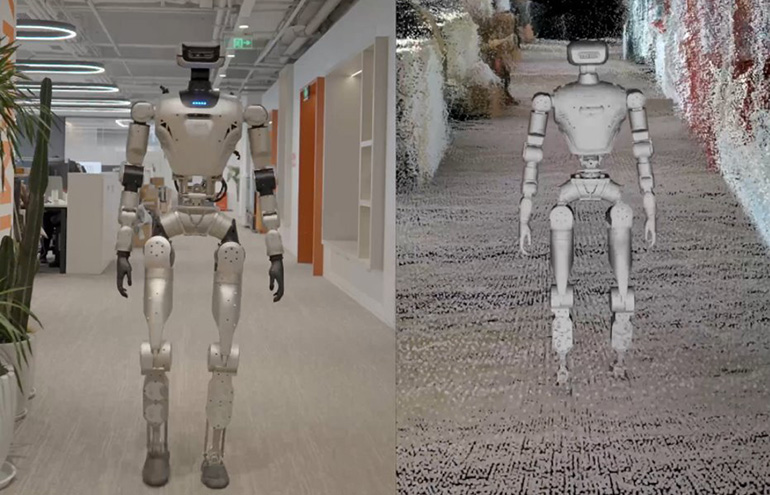
- At the same time, RealSense demonstrated autonomous humanoid navigation using dense 3D depth perception, vSLAM and NVIDIA’s Isaac Lab at the GTC 2026 conference, showing that legged robots can now localise, map and move safely in unstructured environments.
- On the commercial front, the San‑Francisco‑based startup Sunday raised $165 million in a Series B round, valuing the company at $1.15 billion as it prepares its household humanoid “Memo” to handle chores such as laundry and clearing tables.
“Humanoids operate in three dimensions, alongside people, in environments that are constantly changing,” stated Nadav Orbach, CEO of RealSense. “If robots are going to work safely beside humans, perception carries responsibility beyond raw sensors. It must function as the robot’s visual cortex, enabling accurate localization, collision avoidance, terrain understanding, and stable, predictable motion in unstructured environments.” The company claimed that its demonstration of autonomous humanoid navigation at GTC in San Jose, Calif., is the first of its kind. LimX Dynamics plans to demonstrate how dense 3D depth perception enables legged robots to localize, map, and navigate autonomously, safely and predictably. Its system will use RealSense depth cameras and vSLAM (visual simultaneous localization and mapping) and be integrated with odometry from NVIDIA CuVSLAM. NVIDIA Isaac Lab accelerated the development of this stack and served as a high-fidelity digital proving ground for reinforcement learning and policy training.
New robots, funding, and signals. Every Thursday.
Unsubscribe anytime.
Mentioned in this article