Robot development, from actuators to AI
### Humanoid developer LimX closes $200M Series B round Humanoid robotics companies are continuing to get capital to bring their systems to market. LimX Dynamics this week completed a $200 million financing round.
Key takeaways
- Humanoid robots have moved from showcase demos to early commercial deployments across industry, consumer, and entertainment sectors.
- At CES 2026, multiple firms demonstrated fully functional walkers: Figure AI’s Figure 02 ran 10‑hour shifts on BMW’s X3 line, handling tens of thousands of parts, while Unitree displayed its modular G1, H2 and R1 platforms and performed dynamic balance feats.
- Boston Dynamics unveiled a production‑ready Atlas that can now execute complex acrobatic moves such as a backflip combined with a cartwheel, and announced a partnership with DeepMind’s Gemini Robotics AI to boost perception and task execution; Hyundai plans to scale Atlas to tens of thousands of units per year by 2028.
- Tesla began training its Optimus prototype at the Austin Gigafactory using imitation learning, with more advanced capabilities slated for later this year.
- Siemens and a major manufacturer completed a logistics proof‑of‑concept using humanoids for destocking and tote transport, and Schaeffler signed a five‑year deal to field hundreds of humanoids in production sites starting in 2026‑27.
Humanoid developer LimX closes $200M Series B round
Humanoid robotics companies are continuing to get capital to bring their systems to market. LimX Dynamics this week completed a $200 million financing round. The company said it plans to use its latest funding to further accelerate research and development and market expansion.
LimX is integrating high-level cognitive planning with whole-body motion control in limbed robots. The company claimed that its TRON 2 and LimX COSA systems have attracted attention across the industry in recent months.
The company will be bringing its humanoid to the Robotics Summit & Expo in Boston. Humanoids were also a topic of recent proposed legislation, as well as The Robot Report‘s “State of the Robotics Industry 2026” report.
--- The goal is to develop intelligent swarm systems that can make decisions on the edge in extreme environments such as mines, outer space, or battlefields, where they may be cut off from traditional communications with operators.
Show timeline
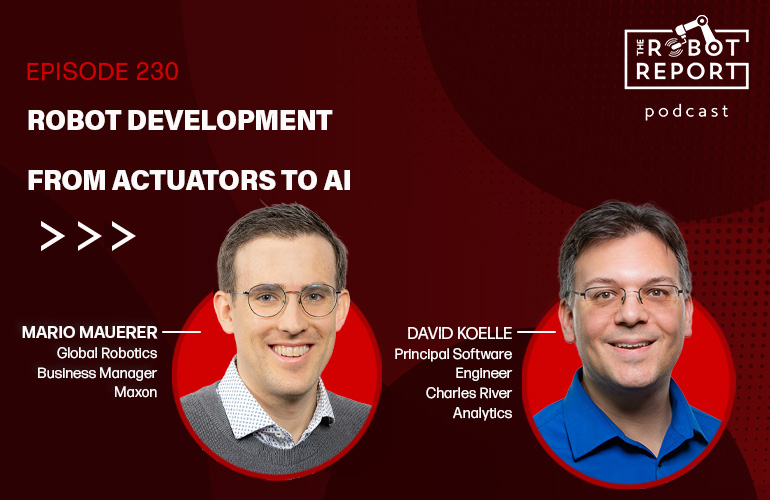
8:12 – News of the week 16:09 – Interview with maxon’s Marco Maurer 34:34 – Interview with Charles River Analytics’ David Koelle
News of the week
Waymo is coming to Boston and Sacramento
Waymo, which this week raised $16 billion, bringing its total valuation to $126 billion, also announced plans to bring its robotaxis to two more cities. The company had previously mapped Boston without specifying when it would offer service in the currently snowy Northeast.
Humanoid developer LimX closes $200M Series B round In 2024, Maurer left his role as chief technology officer of hardware to join maxon motor, where he now works as global business development manager for robotics with the aim of bringing advanced drive systems to modern robotics applications.
David Koelle, principal software engineer and director of engineering, Charles River Analytics.
Our featured interview this week is with David Koelle. He is director of engineering for the Human-Centered AI division and principal software engineer at Charles River Analytics, where he develops multi-robot collaborative autonomy systems for clients including DARPA, NASA, and the U.S. Air Force.
Koelle and his Charles River team are building autonomous platforms that enable robot teams to work together to complete objectives.
New robots, funding, and signals. Every Thursday.
Unsubscribe anytime.
Mentioned in this article