Schaeffler plans to deploy 1,000 Hexagon humanoids by 2032
## Hexagon moves from pilot to deployment Building on the successful pilot, the companies now plan to deploy the robots across multiple sites, with additional applications, such as automated parts inspection, targeted for rollout starting at the end of 2026.
Key takeaways
- Humanoid‑robot news this month shows the field moving from prototype to mass‑production and large‑scale investment.
- Palo Alto‑based 1x is ramping up its NEO line, a $20,000 consumer robot that can learn chores, and has already booked its full 10,000‑unit annual capacity for 2026; the company says it will scale to 100,000 units per year by the end of 2027.
- Meta has bolstered its humanoid‑AI program by acquiring Assured Robot Intelligence (ARI), a startup that builds foundation models for whole‑body robot control and self‑learning, adding the team to its Superintelligence Labs division.
- A Roland Berger analysis released on 30 April projects humanoid‑robot revenues could reach $300 billion by 2035 and up to $750 billion in an optimistic scenario, with operating costs falling to about $2 per hour.
- Hyundai remains frustrated by Boston Dynamics’ limited Atlas output—about four units a month—but expects a new manufacturing plant to lift production soon.
Hexagon moves from pilot to deployment
Building on the successful pilot, the companies now plan to deploy the robots across multiple sites, with additional applications, such as automated parts inspection, targeted for rollout starting at the end of 2026.
A key focus of the partnership is the generation and use of real-world production data to enable faster deployment of AEONs across new use cases and production settings.
“Our innovative actuator platform is the technology backbone for the next generation of humanoid robots,” said Dr. Jochen Schröder, chief operating officer of Schaeffler. “In other words, we are creating the foundation for making humanoid robotics fit for widespread use.” Schaeffler also signed a memorandum of understanding with VinDynamics, another humanoid developer. The companies established a strategic partnership focused on joint research and development, where Schaeffler will supply the key components to VinDynamics for the production of humanoid robots. These will include actuator systems and related motion technology components.
VinDynamics said it will conduct technical assessments and optimization of its control software to ensure compatibility with Schaeffler actuators. The Robot Report
Schaeffler plans to deploy 1,000 Hexagon humanoids by 2032
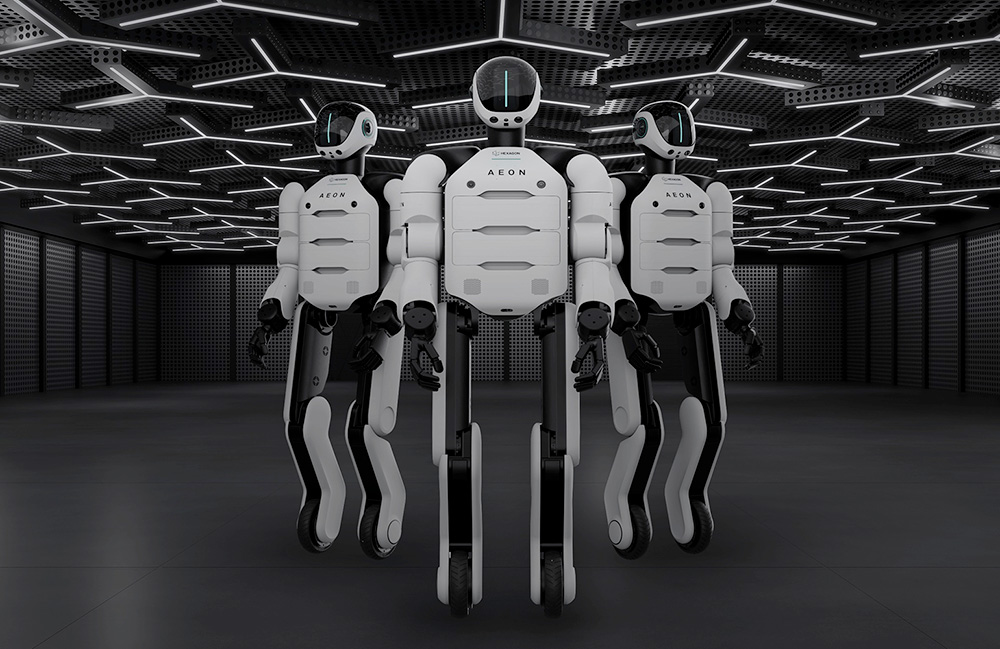
The AEON humanoid from Hexagon features two legs that end in wheels, providing more flexibility than a typical bipedal robot. | Source: Hexagon
Schaeffler AG last week said it is expanding its partnership with Hexagon Robotics Division. The company said it will deploy at least 1,000 of the AEON humanoid robots across its global production system by 2032.
Schaeffler will also provide its high-precision actuators for AEON, further strengthening the technological alignment with Hexagon.
New robots, funding, and signals. Every Thursday.
Unsubscribe anytime.
Mentioned in this article