The power of the open-source community in robotics: Collaboration and shared innovation - Robotics & Automation News
Technology giants, sovereign wealth funds, industrial manufacturers, and venture capital firms are collectively investing tens of billions of dollars into humanoid robotics, warehouse automation, autonomous vehicles, defense robotics, and AI infrastructure.
Key takeaways
- Figure announced that its BotQ facility has boosted output of the Figure 03 humanoid from one unit per day to one unit per hour—a 24‑fold increase achieved in under 120 days—while reporting more than 350 third‑generation robots produced and a first‑pass yield above 80 percent, along with new “System 0” whole‑body control that fuses visual and proprioceptive data to navigate stairs and uneven terrain without real‑world fine‑tuning.
- Boston Dynamics demonstrated that its Atlas robot can now sense its own body, lifting loads up to 45 kg and performing cable‑free joint rotations that enable continuous, unrestricted movement, a capability built on millions of simulated reinforcement‑learning runs.
- Singapore‑based Doozy Robotics expanded its physical‑AI platform to the United States, GCC and Asia, pairing an industrial super‑humanoid with autonomous mobile robots and forklifts under its Eywa‑OS orchestration layer, with the super‑humanoid slated for launch later this year.
- Humanoid (formerly SKL Robotics) secured a phased partnership with Schaeffler Technologies and Bosch to integrate its HMND platform into German manufacturing sites before the end of 2026, marking one of the largest disclosed humanoid rollouts and committing Schaeffler to supply over half of its joint actuators through 2031.
- In China, government‑backed humanoid robot learning centers such as the Beijing‑based Humanoid Robot Data Training Center are training machines on a wide range of workplace scenarios, with industry leaders saying autonomous operation is only a matter of time.
Technology giants, sovereign wealth funds, industrial manufacturers, and venture capital firms are collectively investing tens of billions of dollars into humanoid robotics, warehouse automation, autonomous vehicles, defense robotics, and AI infrastructure.
The likely winners may not necessarily be the companies building the cheapest robot hardware.
Instead, some of the most strategically valuable firms could be those controlling:
development ecosystems simulation infrastructure AI training data robotics operating platforms interoperability layers
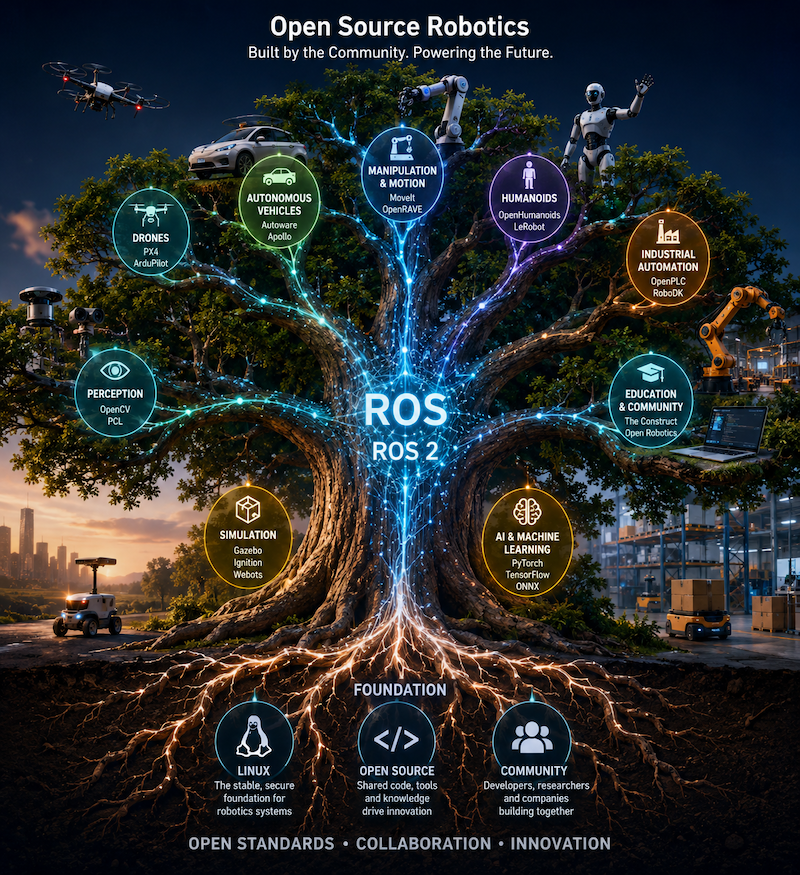
This partly explains the growing importance of companies such as Intrinsic and the continued strategic relevance of ROS-based ecosystems. Governments are pouring billions into automation, manufacturers are racing to digitize operations, AI companies are building “physical AI” systems for real-world machines, and venture capital firms are funding everything from warehouse robots and humanoids to autonomous tractors and delivery systems.
At the heart of much of this transformation lies an idea that once seemed almost idealistic: open-source collaboration.
Increasingly, the robotics industry is being built not by isolated companies working behind closed doors, but by global communities sharing software, simulation environments, AI frameworks, and development tools.
Modern robotics may still depend on motors, sensors, and actuators, but its real engine is collaborative software development. | Drone autonomy | PX4, ArduPilot | Enables autonomous flight control, mission planning and unmanned aerial systems development. | | Autonomous driving | Autoware, Apollo | Provides open software stacks for perception, localization, planning and vehicle control. | | Industrial automation | OpenPLC, RoboDK | Helps connect robotics software with factory automation, offline programming and industrial control. | | Robot learning | LeRobot, Open X-Embodiment | Supports data-driven robot training, imitation learning and embodied AI research. | | 3D visualization and worlds | RViz, Blender, Unity, Unreal Engine | Provides visualization, synthetic environments, digital twins and training worlds for robotics and AI. |
Mentioned in this article