Trends and outlook for actuators: The muscles behind ...
by David Edwards The humanoid robotics industry is transitioning from prototype development and demonstrations toward structured pilot deployments and early commercial adoption.
Key takeaways
- The Federal Communications Commission has just barred Chinese robotics firm Unitree from deploying its humanoid robots in North America, a move that follows heightened U.S. scrutiny of Chinese AI‑enabled machines and comes as the agency prepares an initial public offering filing for the company later this week.
- At the same time, New York state legislators have introduced Senate Bill S10671, which would prohibit school districts from using humanoid robots for classroom instruction, a proposal prompted by a recent investigative report on AI use in schools.
- In a separate incident, a Qualcomm‑powered humanoid robot collapsed onstage during a live keynote, prompting the chip maker to attribute the failure to a communication glitch and to promise software upgrades aimed at improving reliability.
- Industry analysts note that 2026‑2027 are pivotal transition years for humanoid robotics, with a projected 47 percent compound annual growth rate for unit sales and a surge in actuator development as manufacturers move from prototypes to pilot deployments and early commercial roll‑outs.
- Finally, the Korea Healthcare Forum 2026 highlighted Chinese company Galbot, which recently secured 2.5 billion yuan in state‑backed funding and showcased its embodied‑AI humanoid platforms for manufacturing, retail and healthcare applications.
by David Edwards
The humanoid robotics industry is transitioning from prototype development and demonstrations toward structured pilot deployments and early commercial adoption.
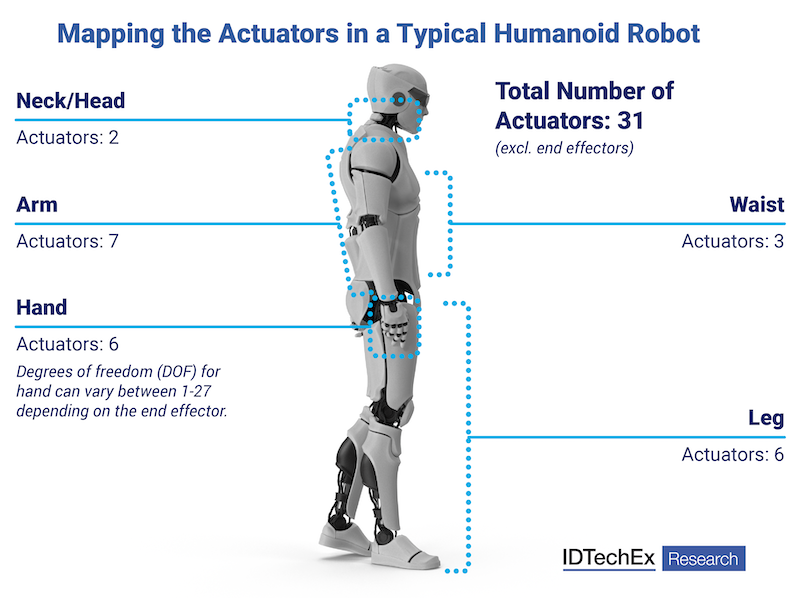
The new IDTechEx report Materials for Humanoid Robots 2026-2036: Technologies, Players, Forecasts expects 2026-2027 to represent key transition years, with more players moving from pilot testing toward production readiness and early-scale rollout. A major component at the heart of humanoid hardware is the actuator, which is responsible for the physical motion of the humanoid robot, allowing humanoids to walk, lift objects, handle tools, and interact with the environment.
With a 47 percent CAGR for humanoid unit sales expected over the next decade, there are emerging opportunities for materials manufacturers and component suppliers to enter the supply chain of this rapidly growing market.
Current state of humanoid actuators
Actuators can be linear and rotary, and use pneumatic, electric or hydraulic power to generate movement, with electric actuators being the most popular among current humanoid robots.
New robots, funding, and signals. Every Thursday.
Unsubscribe anytime.
Mentioned in this article