Boston Dynamics trains Atlas humanoid robot to pick up and place washing machine - Robotics & Automation News
The release comes amid growing competition in the humanoid robotics sector, with companies including Tesla, Figure AI, Agility Robotics, and 1X Technologies all accelerating efforts to commercialize humanoid systems for logistics, manufacturing, and warehou...
Key takeaways
- Boston Dynamics unveiled new footage of its Atlas humanoid robot lifting and transporting heavy objects such as a mini‑fridge and a washing‑machine‑sized load, highlighting advances in whole‑body control and AI‑driven manipulation that aim to move the platform from locomotion demos toward real‑world industrial work.
- Industry analysts report that the market for humanoid robots is shifting from prototype validation to early commercial deployment, with IDTechEx forecasting shipments to near 1.8 million units by 2036 and payback periods as short as six months in high‑utilisation scenarios.
- Apptronik, highlighted in CNBC’s Disruptor 50 ranking, announced a strategic partnership with Google DeepMind that equips its Apollo robots with advanced reasoning capabilities and a pilot program with Jabil to integrate these units into production lines.
- In Europe, the startup Humanoid signed a phased agreement with Schaeffler and a joint effort with Bosch to scale robot production and deploy its HMND platform in German factories by the end of 2026, using a robot‑as‑a‑service model that includes fleet management and 24/7 support.
- Chinese firms are accelerating workforce integration, with government‑backed learning centres training humanoids for a variety of workplace scenarios, while Shanghai‑based Agibot claimed roughly 39 % of the global market, surpassed 10,000 cumulative units in 2026 and now offers robots‑as‑a‑service in over 17 countries.
The release comes amid growing competition in the humanoid robotics sector, with companies including Tesla, Figure AI, Agility Robotics, and 1X Technologies all accelerating efforts to commercialize humanoid systems for logistics, manufacturing, and warehouse operations.
While many humanoid robots can already walk, climb, or balance impressively, Boston Dynamics’ latest demonstration highlights what many researchers increasingly view as the industry’s biggest remaining challenge: reliable manipulation and physical interaction in real-world environments.
The new Atlas footage suggests Boston Dynamics is now concentrating heavily on that next stage – building robots capable not only of moving through the world, but working within it.
Share this: Skip to primary navigation
Skip to primary sidebar Skip to secondary sidebar
Robotics & Automation News
Where Innovation Meets Imagination
Boston Dynamics trains Atlas humanoid robot to pick up and place washing machine
by David Edwards
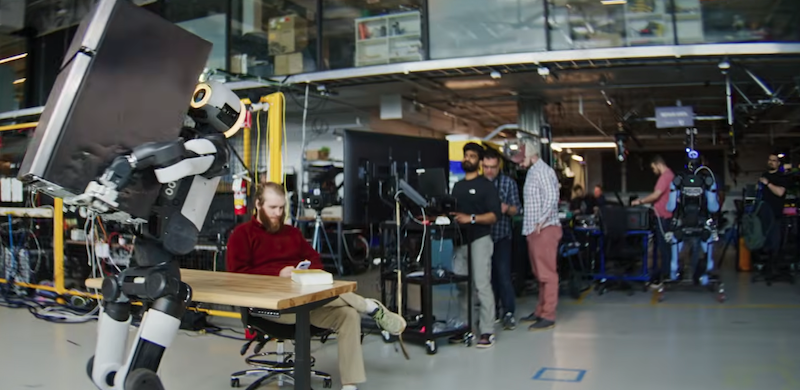
Boston Dynamics has released new behind-the-scenes footage showing its latest electric humanoid robot, Atlas, performing heavy lifting and manipulation tasks that the company says are designed to prepare the system for real industrial work. (See video below.)
The demonstration centers on Atlas lifting and carrying a mini-fridge weighing roughly 50 pounds, although Boston Dynamics says the robot successfully handled a loaded fridge weighing more than 100 pounds during testing. The company says the breakthrough is not simply the robot’s physical strength, but the development of AI-driven control systems capable of adapting to “real world adaptability: handling heavy objects by bracing and accounting for the mass and inertia; using whole-body control, not just hands to maneuver”.
The latest Atlas system represents a major shift in humanoid robotics development, where companies are increasingly focused on teaching robots how to perform practical physical work in unpredictable industrial environments rather than simply demonstrating locomotion.
New robots, funding, and signals. Every Thursday.
Unsubscribe anytime.
Mentioned in this article