Global humanoid robot installations reach 16,000 units as commercial deployments accelerate - Robotics & Automation News
Counterpoint pointed to aggressive automation plans by companies including Tesla and Figure AI, suggesting that humanoid robots may increasingly be used in the production of other robots and industrial systems.
Key takeaways
- Humanoid robots have moved from high‑profile demos to early‑stage commercial use in early 2026.
- At CES 2026, companies such as Figure AI demonstrated that its Figure 02 units can run 10‑hour shifts on BMW’s X3 line, having already handled 90 000 parts for 30 000 vehicles, while Boston Dynamics unveiled a production‑ready Atlas that will be built in tens of thousands of units per year for Hyundai’s Savannah plant.
- Tesla began training its Optimus Gen 2 models at the Austin Gigafactory using imitation learning, and the company now ranks among the top five humanoid suppliers with roughly 5 percent of global installations.
- A market‑tracking report shows that total humanoid deployments reached 16 000 units in 2025, dominated by Chinese firms—AgiBot (31 % share with more than 5 000 X2/G2 units), Unitree (27 %) and UBTech (just over 5 %).
- Hyundai and Siemens reported a proof‑of‑concept logistics deployment, and Schaeffler signed a five‑year plan to place hundreds of humanoids in factories beginning in 2026‑27.
Counterpoint pointed to aggressive automation plans by companies including Tesla and Figure AI, suggesting that humanoid robots may increasingly be used in the production of other robots and industrial systems.
While large-scale adoption remains several years away, the data suggests that humanoid robots are beginning to move beyond demonstrations and pilot projects, with industrial use cases likely to define the market’s near-term growth.
Share this: ### Chinese suppliers dominate early market
Shanghai-based startup AgiBot ranked first globally by annual installations in 2025, capturing around 31 percent of the market.
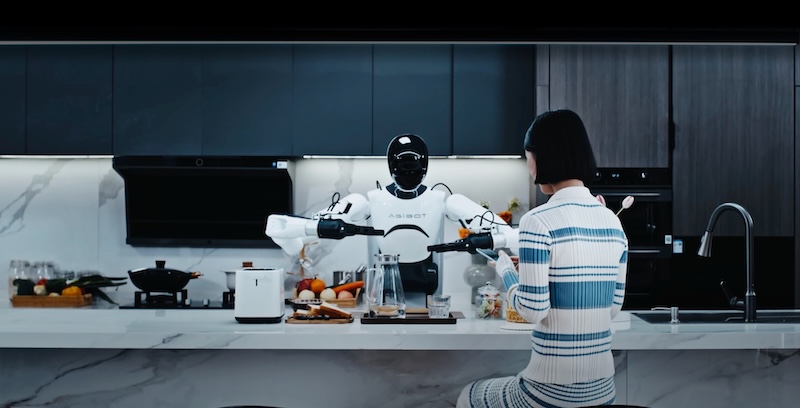
The company began mass production of its X2 and G2 humanoid robots last year and has deployed more than 5,000 units from its Shanghai factory across sectors including hospitality, entertainment, manufacturing, and logistics.
Unitree placed second with a 27 percent share, building on its background in quadruped robotics and motion control. The company has focused on developing lower-cost humanoid systems by producing key components such as motors, reducers, and sensors in-house. UBTech ranked third with a share slightly above 5 percent. Its Walker-series humanoid robots are already being used on automotive factory floors, with a focus on collaborative industrial tasks.
Shenzhen-based Leju followed closely, also capturing around 5 percent of installations, supported by cloud-based training and software upgrades developed in partnership with Huawei Cloud.
Tesla entered the top five in 2025 with nearly 5 percent market share, driven by increased production of its Optimus Gen 2 and Gen 2.5 humanoid robots.
Counterpoint said Tesla’s involvement has had a broader impact on the humanoid robot supply chain, particularly in automotive manufacturing.
Together, the top five humanoid robot suppliers accounted for approximately 73 percent of global installations in 2025.
New robots, funding, and signals. Every Thursday.
Unsubscribe anytime.
Mentioned in this article