Back to News
Therobotreport Com
May 30, 2026

NIST proposes a baseline performance benchmark for humanoid robots - The Robot Report

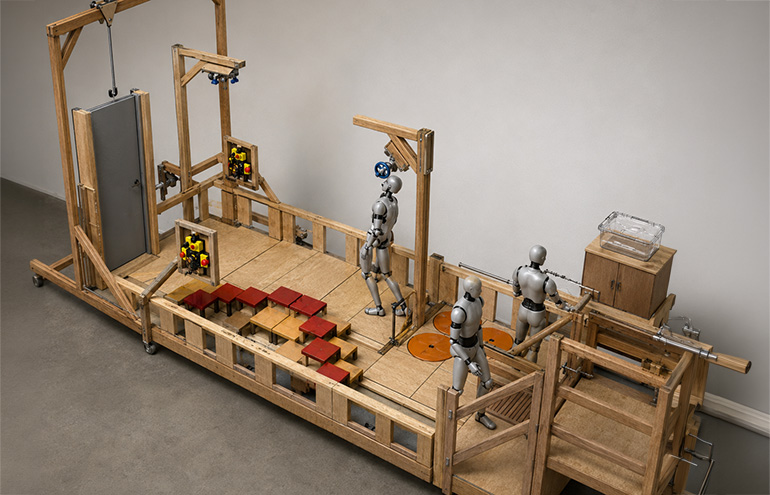
“NIST is proposing the first standardized performance benchmark for humanoid robots since the 2015 DARPA Robotics Challenge,” noted Aaron Prather, director of the Robotics & Autonomous Systems Program at ASTM International, on LinkedIn.

NIST proposes a baseline performance benchmark for humanoid robots - The Robot Report - Image 1
humanoid
robot

Key takeaways

Figure AI announced that its BotQ factory has accelerated production of the Figure 03 humanoid from one unit per day to one unit per hour—a 24‑fold increase achieved in under 120 days—bringing total output to more than 350 third‑generation robots, with a battery line first‑pass yield of 99.3 percent and overall robot first‑pass yields now above 80 percent; the company also rolled out internal fleet‑management tools, over‑the‑air updates, field‑service platforms and fault‑recovery “fallback ladders.” In a separate test, three Figure 03 units ran continuously for more than 24 hours on a package‑sorting task that was originally slated for eight hours, demonstrating sustained autonomous operation in a logistics setting. The U.S. National Institute of Standards and Technology has proposed the first standardized performance benchmark for humanoid robots since the 2015 DARPA Robotics Challenge, aiming to provide a common metric for the many platforms that have emerged in the past decade. BMW plans to deploy two Hexagon Robotics humanoids in its Leipzig plant beginning this summer, marking the first use of humanoid robots on a European car‑production line and underscoring the industry view that human‑shaped machines can be placed wherever a human worker currently operates. At the Humanoids Summit in Tokyo on 28 May 2026, Japanese developers displayed dancing robots, needle‑threading hands and other dexterous demos, many powered by Chinese Unitree components, highlighting intense competition between Japan and China in advanced humanoid technology. Meanwhile, a fashion show in Seoul featured humanoid robots strutting the catwalk in custom‑designed clothing, illustrating the growing cultural visibility of these machines. Together, these developments point to rapid scaling of manufacturing, longer autonomous runtimes, emerging performance standards, and expanding use cases across industry, logistics and public events.

“NIST is proposing the first standardized performance benchmark for humanoid robots since the 2015 DARPA Robotics Challenge,” noted Aaron Prather, director of the Robotics & Autonomous Systems Program at ASTM International, on LinkedIn. “In a decade that’s seen [Tesla‘s] Optimus, Figure, Agility, Apptronik, Unitree, and a dozen other humanoid platforms attract billions in investment, there is still no agreed-upon way to measure what any of them can actually do. Marketing videos have filled the gap.” ### Tell Us What You Think! Cancel reply

This site uses Akismet to reduce spam. Learn how your comment data is processed.

A guide to Day 1 of the 2026 Robotics Summit & Expo
IntBot and Certis Group partner to scale physical AI for enterprises across Singapore
The future of physical AI isn’t humanoid; it’s task-specific and cost-efficient
Humanoid partners with Bosch, Schaeffler to scale robot production

Search The Robot Report - RBR50 Winners 2024

  • RBR50 Winners 2023
  • RBR50 Winners 2022
  • RBR50 Winners 2021

Resources

  • Automated Warehouse Research Reports
  • Digital Issues
  • eBooks
  • Publications
  • Automated Warehouse
  • Collaborative Robotics Trends
  • Search Robotics Database
  • Videos
  • Webinars / Digital Events

Events

  • RoboBusiness
  • Robotics Summit & Expo
  • DeviceTalks
  • R&D 100
  • Robotics Weeks

Podcast

  • Episodes

Advertise

Subscribe

Mentioned in this article

Read full sourceMore robotics news