What’s behind the humanoid robot hype? - Automotive World
Tesla has deployed a couple of Optimus robots within its car assembly operations, while BYD has used the humanoid Walker S1 model, but applications remain limited.
Key takeaways
- The most recent coverage shows a surge of activity across both industrial and consumer sectors.
- Apptronik, the Austin‑based startup behind the Apollo prototype, announced a $520 million funding round that lifted its valuation above $5 billion and brought Google DeepMind on board, underscoring investor confidence that humanoid robots could reshape labor costs in manufacturing and other repetitive‑task environments.
- In Japan, telecom operator KDDI expanded its alliance with digital‑avatar maker Avita, committing its cloud and communications infrastructure to support remote‑controlled humanoids and targeting commercial trials by autumn, with the aim of deploying the robots in its retail outlets.
- Meanwhile, researchers at Georgia Tech unveiled a new “thinking” system that improves balance and agility for two‑legged robots, a step that could make walking stability a reliable foundation for future humanoid deployments.
- At Mobile World Congress, Chinese smartphone maker Honor debuted a consumer‑focused humanoid that performed a choreographed dance, including a moonwalk and a back‑flip, and highlighted plans to use the robot for shopping assistance, workplace inspections and companionship.
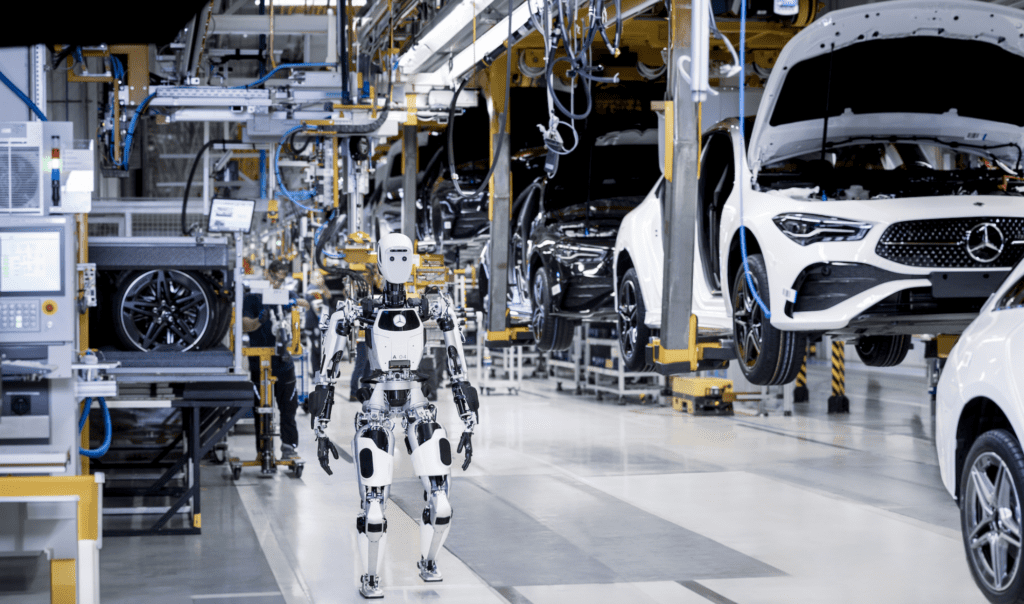
Tesla has deployed a couple of Optimus robots within its car assembly operations, while BYD has used the humanoid Walker S1 model, but applications remain limited. Mercedes-Benz signed an agreement with US robotics company Apptronik in March 2024 to develop new applications for humanoid robots in a logistics and production environment jointly. In 2025, the automaker invested an unspecified “low double-digit million-euro amount” in the partnership. While nothing has yet to materialise on the plant floor, Mercedes confirmed to Automotive World that “as part of this cooperation, a deployment of humanoid robots is planned for intra-logistic areas in production over the next few years.” “Robots are a physical manifestation of AI on the manufacturing floor,” observes CJ Finn, PwC US Automotive and Mobility Leader. Anything related to AI is attracting investment and headline space. McKinsey Partner Kersten Heineke describes robots and physical AI as “the hidden heartbeat of the auto industry” as “cars are no longer just assembled—they’re created in adaptive, intelligent factories.”
While this applies to all AI-powered robots, the past few months have seen particular interest in humanoids. Tesla unveiled its Optimus robot in 2021. Powered by AI, it can walk, climb stairs, and carry and manipulate objects. Chief Executive Elon Musk announced in December 2025 that sales of Optimus units to other parties would finally begin in 2026. Where Tesla leads, others are keen to follow. CES 2026 featured a dedicated Robot Pavillion from the K-Humanoid Alliance, a coalition devoted to humanoid robot research and development. Among the automotive players, such big names as Hyundai, Nvidia, and Qualcomm are all keen to get in on the action as well. For instance, Qualcomm unveiled an end‑to‑end general‑purpose robotics architecture designed for full‑size humanoids. Both Tesla and Qualcomm have highlighted the crossover between automated driving technology and automated robots.
New robots, funding, and signals. Every Thursday.
Unsubscribe anytime.
Mentioned in this article