World humanoid robot games show runners breaking records, bursting into flames - Ars Technica
The robotic races and other flashy events provide for an entertaining spectacle that can lead to easy news headlines and viral video clips. They also give robotics companies an opportunity to attract more publicity and investor money by potentially standing...
Key takeaways
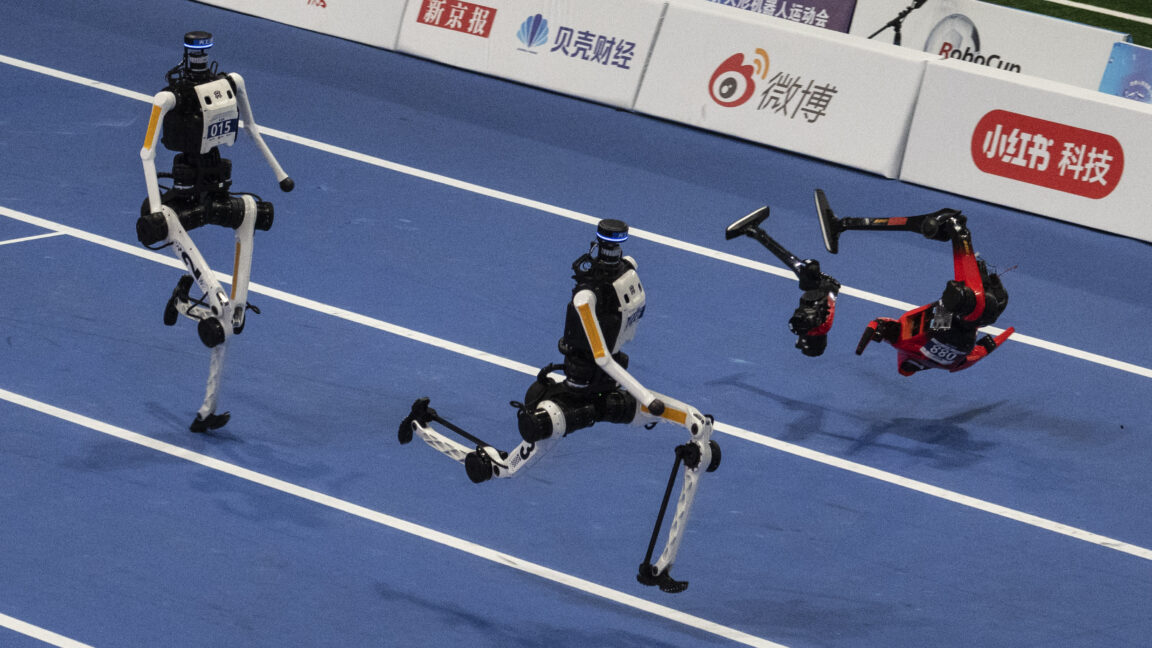
- China remains the global leader in humanoid robotics, accounting for roughly 90 percent of shipments last year and dominating the high‑profile World Humanoid Robot Games in Beijing, where a Beijing‑based “Tiangong Ultra” model sprinted 100 metres in 9.39 seconds—faster than Usain Bolt’s record—and shattered the 400‑metre record with a time of about 38.15 seconds.
- The Games, featuring over 2,000 robots from 666 teams across 16 countries, are being used as a showcase for both athletic feats and emerging applications in factories, homes and even potential military roles; a developer at the event told CBS News that fully autonomous humanoid soldiers could appear within five to ten years.
- Meanwhile, Silicon Valley’s Actuate conference highlighted a hardware shortage exacerbated by recent FCC restrictions on foreign‑made advanced robotic devices, prompting U.S. manufacturers to call for domestic supply chains while investors poured a record $15 billion into robotics globally in 2025 and another $18.8 billion so far in 2026.
- Analysts project the worldwide humanoid market could be worth $7.5 trillion by 2050, with China’s domestic market expected to reach $2.2 billion this year and grow at least 60 percent into 2027 as mass production ramps up.
- Despite the excitement, many experts caution that true general‑purpose, human‑like robots remain years away and that commercial viability will hinge on scaling hardware and delivering practical, non‑spectacle use cases.
The robotic races and other flashy events provide for an entertaining spectacle that can lead to easy news headlines and viral video clips. They also give robotics companies an opportunity to attract more publicity and investor money by potentially standing out from the competition, Patel said.
One type of humanoid robot developed by the Beijing-based company X-Humanoid gained viral online fame for winning the small-group 400-meter race with an unusual “shy person hiding behind their hands” posture. The robot’s developers told the Global Times that the robot learned through reinforcement learning trials in simulation to shift from a human-style runner’s arm swing to holding its arms up near its face and swinging them back and forth through hip rotations. Even the more autonomous robots competing in the World Humanoid Robot Competition still rely heavily on cloud computing to help run intensive AI models, rather than running the AI computing directly on their own onboard hardware, according to the South China Morning Post. It described robots being equipped with 5G modules to transmit data to an “embodied-intelligence system” and then receiving instructions on what to do next.
The real test for humanoid robots’ capabilities will necessarily take place in the real world beyond the demonstrations at the World Humanoid Robot Games. Investors have poured more than $6 billion into humanoid robot companies in 2025 alone, with Chinese companies being especially aggressive in testing and deploying such robots. Meanwhile, US companies like Boston Dynamics and Agility Robotics are also ramping up their own commercialization and deployment plans in factories and warehouses. The US government has even banned the import of foreign-made robots, including China’s most popular humanoid robots.
But not all robotics researchers are convinced that humanoid robots are necessary, especially when the most useful robots currently doing productive work usually come in other shapes and sizes. For his own part, Patel is focused on developing software algorithms that allow many different types of robots to seamlessly switch between tasks.
Jeremy Hsu Tech Reporter
Jeremy Hsu Tech Reporter
New robots, funding, and signals. Every Thursday.
Unsubscribe anytime.
Mentioned in this article