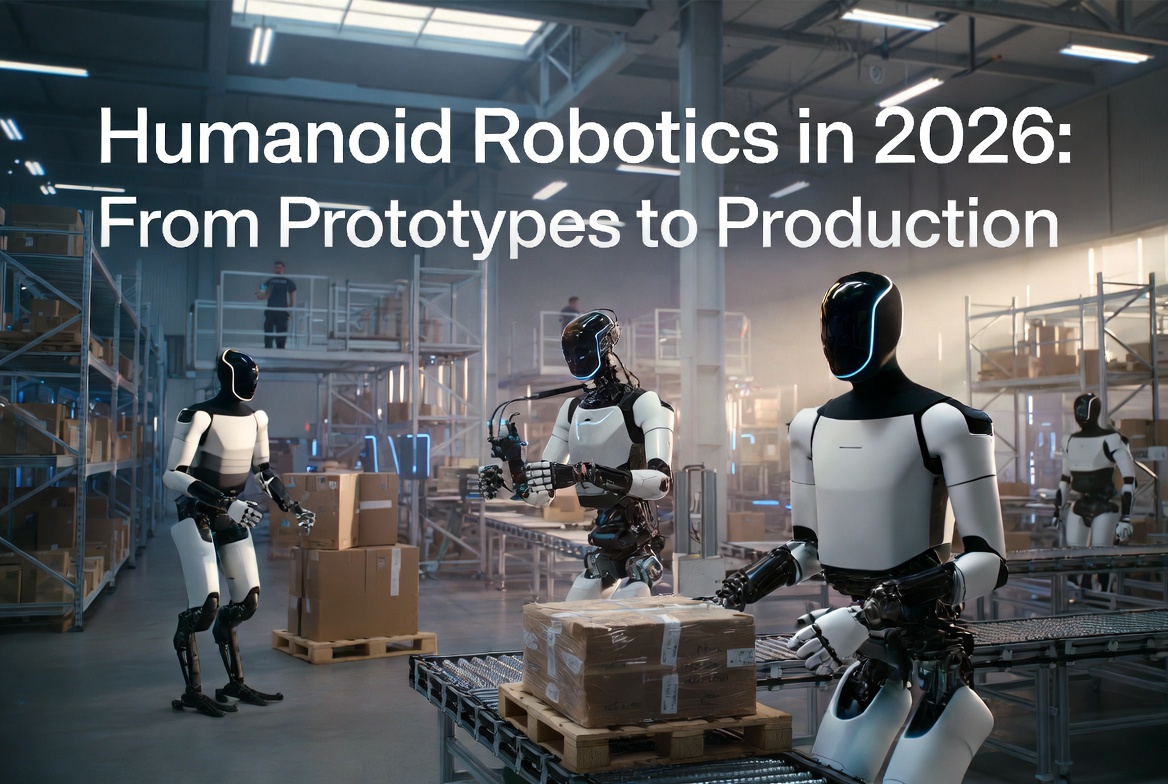
Recent headlines in humanoid robotics are increasingly framed around production and deployment rather than lab milestones. Updates aggregated by Humanoid Robotics Technology include announcements about “mass production,” new humanoid launches, and funding rounds; a LinkedIn post also highlights AGIBOT’s claim of a 5,000th “mass-produced” humanoid rollout. Together, these signals point to rising commercialization pressure—but the operational details that matter to buyers (uptime, safety case, task performance, total cost) are often not disclosed.
Quick answer
Humanoid robotics coverage in 2025–2026 is showing more manufacturing and scale language—including AGIBOT’s reported rollout of its 5,000th mass-produced humanoid and multiple “mass production” announcements tracked in the Humanoid Production category at Humanoid Robotics Technology. It matters because it suggests some vendors are moving from prototypes into repeatable builds and broader pilots. However, unit counts and “mass production” labels don’t automatically mean real-world, revenue-generating deployments. The key unknowns remain: where the robots are operating, what tasks they do end-to-end, what reliability looks like over weeks/months, and what commercial terms exist.
What happened (as reported)
Several recent items in the provided sources collectively emphasize scale and commercialization:
-
AGIBOT: “5,000th mass-produced humanoid” rollout. A LinkedIn post by Humanoid Robotics Technology states that AGIBOT “announced the roll-out of its 5,000th mass-produced humanoid robot,” and links to an external announcement via a shortened URL. The LinkedIn post itself does not include operational details such as customer sites, tasks, pricing, or runtime statistics. (Source: LinkedIn post)
-
Humanoid Production category: multiple “mass production” and launch items. The Humanoid Robotics Technology “Humanoid Production” category page lists items such as:
- “UBTECH’s Walker S2 Begins Mass Production”
- “Kepler Announces Mass Production of its K2 ‘Bumblebee’”
- “Agile Robots Launches Humanoid Robot, Agile ONE”
- “NVIDIA Accelerates Humanoid Robotics Development” These are headlines on the category page; without opening each specific article, the category listing alone does not provide verified numbers, customers, or performance. (Source: https://humanoidroboticstechnology.com/category/news/humanoid-production)
-
Agile Robots: Agile ONE launch claim. In the Humanoid Production RSS feed excerpt, Humanoid Robotics Technology describes “Agile ONE” as designed for industrial settings and mentions manufacturing in-house in Germany. The excerpt does not provide verified specs, pricing, customer deployments, or certification details. (Source: https://humanoidroboticstechnology.com/category/news/humanoid-production/feed)
-
Funding signal: “Humanoid” raises $152M Series A at $1.35B post-money (as reported). A Humanoid Robotics Technology post states that a company named “Humanoid” announced a $152M Series A at a $1.35B post-money valuation, bringing “total raised” to $270M, led by Prime Movers Lab with participation from Schaeffler, Bosch, Fubon Financial Holding VC, and Aglaé Ventures. We have not been provided independent primary documentation (press release, SEC filing, or investor post) in this brief; treat it as reported by the outlet. (Source: https://humanoidroboticstechnology.com/industry-news/humanoid-raises-152-million-in-series-a-financing/ via the tag RSS feed: https://humanoidroboticstechnology.com/tag/humanoid/feed)
Context: why the language is changing
In earlier cycles, humanoid updates tended to emphasize locomotion demos, teleoperation, or single-task proofs-of-concept. The content in the provided feeds and category pages increasingly uses phrases like “mass production,” “deployment,” and “commercially available.” That shift matters because it changes how operators should evaluate vendors:
- A demo can be impressive but not repeatable.
- A “mass production” claim suggests the company believes it can build many units consistently.
- A “deployment” claim suggests robots are intended to be used in real environments—yet deployment can still mean “placed on-site for a pilot” rather than “running a production process.”
The Humanoid Robotics Technology category page is effectively a signal board of what companies want the market to believe they can do next: ship more units, put robots into facilities, and finance the ramp.
The numbers, in plain English (and what they don’t tell you)
“5,000th mass-produced humanoid” (AGIBOT)
What it tells you:
- If accurate, “5,000th” suggests AGIBOT has built and/or allocated thousands of units—well beyond the tens-to-low-hundreds scale typical of many humanoid programs.
What it does not tell you:
- Where those robots are: factory floors, labs, classrooms, internal test sites, or customer facilities.
- How they are used: supervised demos vs. autonomous work.
- Utilization: hours/day, days/week, and mean time between failures.
- Commercial reality: whether units are sold, leased, or deployed under R&D agreements.
Evidence constraint:
- In this brief, the claim is captured via a LinkedIn post, not a primary announcement with full details. (Source: LinkedIn post)
“$152M Series A at $1.35B post-money” (Humanoid)
What it tells you:
- Investors (as reported) are willing to fund humanoid companies at large valuations, potentially enabling hiring, supply chain commitments, and pilot programs.
What it does not tell you:
- Whether the company has a shipping product, meaningful revenue, or validated unit economics.
- The scope of the go-to-market: specific industries, pricing model, or deployment targets.
Evidence constraint:
- In this brief, we only have the outlet’s report; validate via primary sources before using as a financial benchmark. (Source: https://humanoidroboticstechnology.com/tag/humanoid/feed)
Why it matters (operators, buyers, and investors)
1) Scale claims change the procurement conversation
When a vendor claims “mass production,” you can shift due diligence from “is it real?” to:
- Can they deliver spares and service?
- Do they have revision control and stable BOMs?
- Can they support fleet management, not just a single unit?
2) The market is converging on a few near-term task families
The provided sources emphasize “industrial settings” (e.g., Agile ONE being positioned for industry in the RSS excerpt). Industrial tasks tend to be:
- repetitive,
- environment-controlled,
- measurable (cycle time, defect rate),
- and already instrumented for safety.
That’s good news for humanoids—but only if vendors can show they can operate safely around people and machinery.
3) Funding and “deployment” headlines can outpace operational truth
A high valuation or a big unit-count claim can be consistent with either:
- genuine commercial momentum, or
- aggressive pilot placement and marketing.
Your job as an operator/buyer is to force clarity on metrics: throughput, downtime, intervention rate, and cost per completed task.
Practical implications: how to evaluate “production” and “deployment” claims
Use this checklist when a humanoid vendor (or headline) says “mass production” or “deployed.”
Ask for deployment-grade evidence
- Task definition: What is the full task boundary (start condition → end condition)?
- Intervention rate: How often does a human need to step in per hour or per 100 cycles?
- Uptime: Over a week, what fraction of scheduled time is the robot available?
- Safety case: What risk assessment method is used, and what guarding/procedures are required?
Ask for production-grade evidence
- Build rate and yield: How many units/week, and what % pass acceptance tests?
- Spare parts lead times: What fails most often, and how quickly can you replace it?
- Revision policy: How are hardware and software changes communicated to customers?
Translate “unit count” into operational capacity
Even if a company has built thousands of units, the operational question is:
- how many are running production shifts today,
- and what’s the effective labor displacement/augmentation per robot.
Competitive/context snapshot (only what’s supported here)
Based on the sources provided, we can cautiously say:
- Multiple companies are publicly using “mass production” language (as aggregated in Humanoid Robotics Technology’s Humanoid Production category page). (Source: https://humanoidroboticstechnology.com/category/news/humanoid-production)
- AGIBOT is being associated with a specific unit milestone (“5,000th”), which is unusually concrete compared to many announcements. (Source: LinkedIn post)
What we cannot verify from this brief:
- Which company has the highest revenue-generating deployment count.
- Comparative performance across robots (payload, cycle time, autonomy level).
- Whether “mass production” refers to steady-state manufacturing or a one-time batch.
What we are not concluding (uncertainties to avoid over-reading)
- We are not concluding that a “5,000th rollout” means 5,000 robots are working daily in customer facilities.
- We are not concluding that “mass production” equals “commercial availability at scale”; availability depends on ordering process, lead times, service coverage, and export controls.
- We are not concluding that recent fundraising (as reported) guarantees technical readiness or near-term profitability.
What to watch next
If the market is truly transitioning into deployment, expect more of the following to become public—and treat their absence as a risk signal:
- Named customer sites and task scopes (even if anonymized by industry)
- Fleet metrics: robot-hours, intervention rates, safety incidents (ideally zero), and MTBF
- Service model details: on-site support, spare parts programs, training requirements
- Regulatory and safety alignment: how deployments meet local workplace safety requirements
- Repeat orders: the strongest proof of value is a second purchase order for the same task
Where to go next (HumanoidHub)
- Browse current vendor and platform landscape: /explore
- Research manufacturers before shortlisting: /brands
- Compare robots side-by-side (when you have candidates): /compare
If you’re evaluating a humanoid for an industrial pilot, align your internal team on: task selection, safety ownership, integration scope (WMS/MES), and what metrics define success by week 2 and week 8.
FAQ
What does “mass production” mean in humanoid robotics?
“Mass production” in humanoid robotics typically implies a company believes it can manufacture many units with repeatable processes, stable components, and consistent acceptance testing. It does not, by itself, prove that robots are operating reliably in customer facilities.
Does a claim like AGIBOT’s “5,000th humanoid rollout” prove real deployments?
AGIBOT’s reported “5,000th mass-produced humanoid” rollout suggests scale intent or manufacturing progress, but it does not prove how many robots are actively performing production work, what tasks they run, or what uptime they achieve without more operational disclosure. (Source: https://www.linkedin.com/posts/humanoid-robotics-technology_agibot-announces-deployment-of-5000th-humanoid-activity-7404443841119805441-LcIm)
What operational metrics should buyers require before a pilot?
Humanoid robot buyers should require task-level success rate, human intervention frequency, uptime over multi-week periods, safety procedures, and clear definitions of the task boundary (start-to-finish). These metrics determine whether a pilot can convert into a scaled deployment.
Why are humanoid funding rounds relevant to operators and integrators?
Humanoid funding rounds can indicate whether a vendor has runway to support deployments, maintain spare parts inventory, and provide field service. Funding does not guarantee product readiness, so operators should still validate performance and support commitments.
How should an industrial team interpret “deployment” announcements?
An industrial team should interpret “deployment” announcements as a lead to investigate, not proof of capability. Ask whether the robot is running production shifts, what environment it runs in, what humans must do to keep it running, and what the commercial terms are.
Sources
- https://humanoidroboticstechnology.com/category/news/humanoid-production/feed
- https://humanoidroboticstechnology.com/category/news/humanoid-production
- https://humanoidroboticstechnology.com/tag/humanoid/feed
- https://www.linkedin.com/posts/humanoid-robotics-technology_agibot-announces-deployment-of-5000th-humanoid-activity-7404443841119805441-LcIm