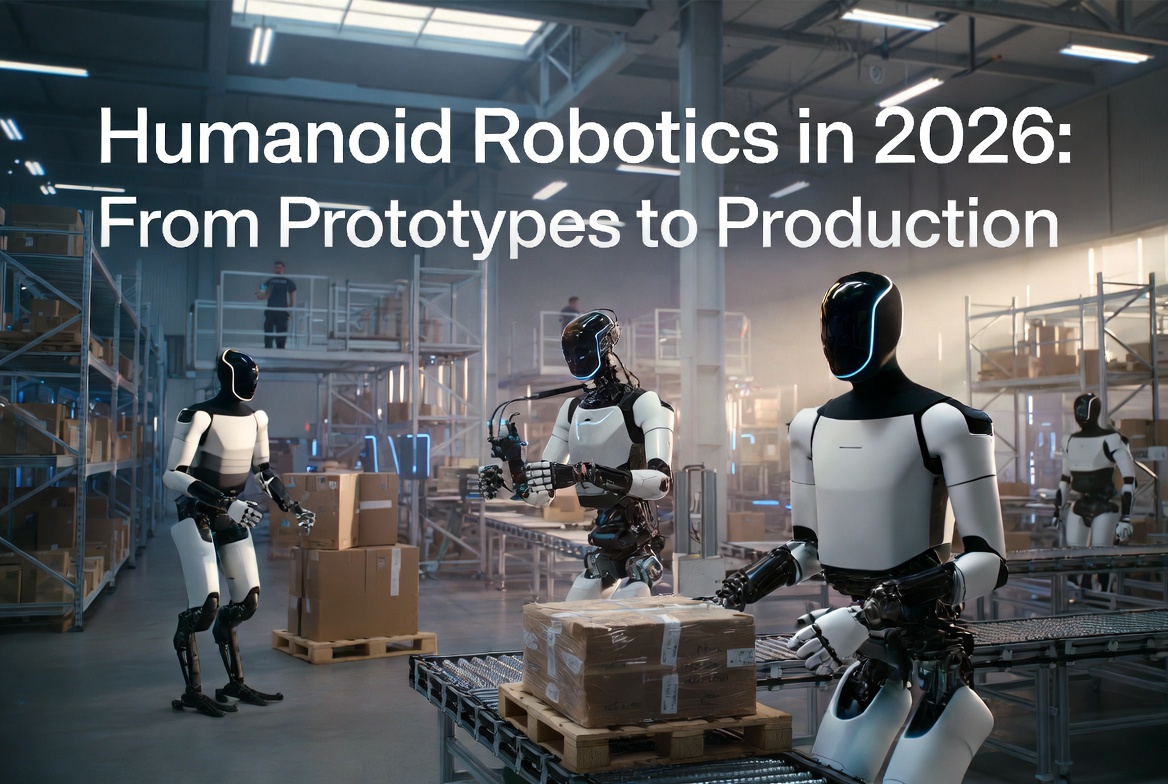
Humanoid robotics is getting louder in 2026—not just in demos, but in factory and logistics pilot announcements and in market reports trying to quantify what’s real.
Two signals stand out in the available sources:
- BMW Group says it will deploy humanoid robots in production in Germany for the first time, tied to a pilot at Plant Leipzig and a new internal “Center of Competence for Physical AI in Production.” (BMW press release, 27 Feb 2026)
- Interact Analysis reports a sharp jump in global humanoid robot production in 2025 (over 20,000 units), while stating that commercially viable real-world deployments remain limited. (Interact Analysis, June 2026)
For operators, investors, and buyers, the key question is no longer “can a humanoid walk and pick?” but “what is deployable, under what constraints, and with what verification artifacts (safety case, uptime, cost, and support)?”
Quick answer
Humanoid robotics in 2026 shows rising production and more credible factory pilots, but the deployment gap remains: analysts report that production volumes increased dramatically in 2025 while only a minority of units were used in real-world applications. BMW’s announcement of a first-time Germany production deployment is a concrete enterprise signal—but the sources do not fully disclose unit counts, tasks, performance, or economics. The practical takeaway is to treat “production” headlines as the start of procurement diligence, not the end.
What happened (and what we can verify)
1) BMW: a named plant, a pilot framing, and an internal competence center
BMW Group’s press release (dated 27.02.2026) states it will deploy humanoid robots in production in Germany for the first time, describing a pilot project at BMW Group Plant Leipzig and the creation of a “Center of Competence for Physical AI in Production.” The same release references a first pilot deployment successfully completed at Plant Spartanburg (USA).
What’s verifiable from the press release:
- This is positioned as a pilot (not a blanket rollout).
- BMW is explicitly connecting humanoids with “Physical AI” and production integration.
- Two locations are named (Leipzig and Spartanburg), which increases traceability for follow-up.
What remains unclear from the release (and therefore should not be assumed):
- Which humanoid robot vendor/model is used (the excerpt provided does not specify).
- Unit counts (how many robots, how many cells/lines).
- Exact tasks and cycle-time requirements, and whether tasks are continuous production work or staged trials.
- Autonomy level (teleoperation, supervised autonomy, or fully autonomous execution).
- Safety and compliance artifacts (risk assessment approach, guarding strategy, certified functions).
Source: BMW Group press release
2) Interact Analysis: production up, but deployment still constrained
Interact Analysis reports:
- Global humanoid robot production exceeded 20,000 units in 2025, up from fewer than 2,000 units in 2024 (a claimed ~10x increase).
- The growth was highly concentrated in China.
- Only around 10% of units produced were deployed in real-world applications, with many units used for research, data collection, and entertainment.
This is a useful counterweight to optimistic narratives: “units produced” does not equal “units deployed into paid, repeatable, uptime-backed work.”
Source: Interact Analysis
3) Industry framing: maturity is improving, but “market-ready” varies by use case
The 2026 “Humanoid Robot Study” by consult-ing.ag (as summarized in the provided excerpt) argues the field is moving beyond experimental development toward more concrete commercial/industrial scenarios, citing progress in mobility, perception, manipulation, and task execution.
Because we do not have the full details of that PDF in the brief beyond excerpts, we should treat it as directional rather than as a source for precise quantitative claims.
Source: 2026 Humanoid Robot Study (PDF)
4) The readiness debate: teleoperation and “how autonomous is autonomous?”
A practical caution raised in the DROIDS newsletter piece is that some humanoid demonstrations—especially in unstructured home settings—can rely heavily on teleoperation for complex tasks, even if basic behaviors are autonomous. The article uses 1X’s Neo as an example and frames teleop as part of a training strategy, while noting that this changes what “ready to deploy” means.
This matters for enterprise buyers too: a robot can be “deployed” while still requiring substantial remote assistance, on-site support, or scripted environments.
Source: DROIDS: “Are Humanoid Robots Really Ready to Deploy?”
The numbers, in plain English (without hype)
Here’s how to interpret the most concrete quantitative claim in the sources:
-
“Over 20,000 units produced in 2025” (Interact Analysis): This suggests manufacturing capacity and investor-backed scaling efforts are increasing. But production includes robots used for internal R&D, data collection fleets, trade-show/marketing, education, and entertainment—not necessarily revenue-generating deployments.
-
“Only around 10% deployed in real-world applications” (Interact Analysis): Even if taken at face value, this implies that most units are not yet doing sustained commercial work. For operators, that often correlates with gaps in reliability, safety integration, maintenance maturity, application engineering, or cost.
-
BMW’s “pilot deployment” language: A pilot can be meaningful (especially at a top-tier manufacturer), but it does not imply broad rollouts, proven ROI, or stable performance across shifts. Treat it as a signal that procurement teams are actively testing humanoids—and that requirements are becoming less hypothetical.
Sources: Interact Analysis, BMW press release
Why this matters (operator, buyer, and investor view)
For factory and logistics operators
The BMW pilot announcement is important less because “a humanoid showed up,” and more because it hints at:
- Integration ownership (BMW standing up a competence center suggests internal capability building, not just vendor-led trials).
- Pathways to scale (pilots that sit inside production engineering organizations tend to produce clearer specs, acceptance tests, and safety patterns).
But the Interact Analysis deployment gap implies operators should expect:
- High variance between demo performance and shift performance.
- Tooling and workcell engineering to dominate early deployments (end effectors, fixtures, perception aids, and structured workflows).
For founders and engineering teams
The market may reward teams who ship:
- Application packages (task + tooling + verification) rather than general-purpose humanoids.
- Evidence: logs of operating hours, MTBF/MTTR, fault taxonomies, and measurable task success rates.
For investors and distributors
The production surge claim can be interpreted as:
- A rising supply of units that will need channels, service networks, spares, and training.
- A risk that “unit counts” mask a shortage of bankable deployments—meaning near-term winners may be those who can support customers through pilots into renewals.
Sources: Interact Analysis, BMW press release
Practical implications: what to verify before you call it “production-ready”
If you are evaluating humanoids for industrial work, use the current moment (more pilots, louder claims) to demand better diligence artifacts.
1) Deployment definition
Ask vendors and pilot sponsors:
- What counts as “deployed”? (hours per week, tasks per shift, supervised vs unsupervised)
- Is teleoperation used? If yes, how many remote minutes per task hour, and who staffs it?
Related readiness caution source: DROIDS
2) Task envelope and constraints
For each target task:
- Payload at the wrist/end-effector, reach, grasp types
- Required tolerances, cycle time, and rework handling
- Environmental assumptions (lighting, reflective parts, clutter, moving people)
3) Safety case and integration plan
Humanoids in human spaces create non-trivial safety questions:
- What standards or risk assessment framework is used?
- How is speed/force limited, and what’s the validated stop behavior?
- What is the fallback mode when perception degrades?
BMW’s competence center framing is a signal that safety/integration is likely a primary workstream, but the public release does not specify the approach.
Source: BMW press release
4) Serviceability and uptime
Request operational evidence:
- Mean time to repair, spare parts lead times, and field-service coverage
- Battery swap/charge strategy and expected downtime
- Remote monitoring and incident reporting pipeline
5) Economics that match your procurement model
Before ROI slides:
- What is the commercial model (purchase vs lease vs RaaS), and what is included?
- Who owns tooling and workcell modifications?
- What are the acceptance criteria for moving from pilot to expansion?
Competitive/context notes (careful, source-bounded)
The sources provided include market pages and lists of “top humanoid robots,” but many such pages mix editorial judgment with incomplete specs and may not be independently verifiable end-to-end.
What we can responsibly compare from the current set of sources:
- Enterprise pilots are increasingly being announced by major manufacturers (BMW is a clear example with a dated press release).
- Analyst commentary suggests production volume is growing faster than commercial deployment (Interact Analysis), implying the industry is still in a “scale the learning loop” phase.
What we cannot verify from the provided material:
- Which specific humanoid vendors are “winning” commercially across factories.
- True shipment counts by vendor, unit economics, or sustained multi-site deployments.
Sources: BMW press release, Interact Analysis
What we are not concluding (uncertainty you should keep intact)
- We are not concluding that humanoids are broadly “ready” for generalized factory work across plants. The production/deployment gap reported by Interact Analysis argues the opposite.
- We are not concluding BMW has proven ROI or achieved stable, multi-shift operation in Germany; the public information frames this as a pilot.
- We are not concluding that production numbers translate to commercial success; many units may be used for research and data collection.
Sources: BMW press release, Interact Analysis
What to watch next (signals that change the story)
Look for updates that convert “pilot” into “repeatable procurement”:
- Named tasks and acceptance tests
- Example: kitting, tote handling, machine tending, inspection rounds—each with measurable throughput and error rates.
- Unit counts and operating hours
- Even small numbers (10–50 units) can be meaningful if backed by operating-hour evidence.
- Safety disclosures
- Third-party assessments, standards alignment, and documented incident rates.
- Support and maintenance maturity
- Regional service hubs, spares programs, and training for on-site technicians.
- Pilot-to-rollout procurement language
- Framework agreements, multi-site expansions, and clear commercial terms.
Where to go next (HumanoidHub navigation)
- Explore the broader humanoid landscape and track vendors and platforms: /explore
- Browse companies and OEMs: /brands
- Compare robots when you have a shortlist: /compare
- Read more operator-focused briefs: https://www.humanoidhub.ai/blog
FAQ
Are humanoid robots being used in real factories in 2026?
Yes, there are public signals of factory pilots. BMW Group states it will deploy humanoid robots in production in Germany for the first time via a pilot at its Leipzig plant, and it references a completed pilot deployment at Spartanburg in the USA. Source: https://www.press.bmwgroup.com/global/article/detail/T0455864EN/bmw-group-to-deploy-humanoid-robots-in-production-in-germany-for-the-first-time?language=en
Does higher humanoid robot production mean wide commercial deployment?
No. Interact Analysis reports global humanoid robot production exceeded 20,000 units in 2025, but says only around 10% were deployed in real-world applications, with many units used for research, data collection, and entertainment. Source: https://interactanalysis.com/insight/humanoid-robot-production-surges
What should an operator verify when a company says “humanoids are in production”?
An operator should verify the definition of deployment (hours per week, tasks per shift), autonomy level (teleoperation vs supervised autonomy), safety case, uptime evidence, and serviceability (spares, field support, MTTR). These details are often not included in press releases and must be requested during diligence.
Are consumer/home humanoids “ready” in 2026?
Readiness depends on how much remote assistance is acceptable. The DROIDS analysis notes that some home humanoid task demonstrations can rely heavily on teleoperation for complex chores, which changes what “ready to deploy” means for buyers. Source: https://droids.substack.com/p/are-humanoid-robots-really-ready
What is the most important next signal for humanoid robotics commercialization?
The most important signal is repeatable, measurable task performance at scale: published operating hours, unit counts in sustained use, documented safety integration, and pilot-to-rollout procurement patterns. Without these, production headlines can be misleading.
Sources
- BMW Group press release (27 Feb 2026): https://www.press.bmwgroup.com/global/article/detail/T0455864EN/bmw-group-to-deploy-humanoid-robots-in-production-in-germany-for-the-first-time?language=en
- Interact Analysis (June 2026): https://interactanalysis.com/insight/humanoid-robot-production-surges
- 2026 Humanoid Robot Study (PDF): https://consult-ing.ag/uploads/pdfs/2026_ING.-Humanoid-Robot-Study.pdf
- DROIDS newsletter analysis: https://droids.substack.com/p/are-humanoid-robots-really-ready
- HumanoidHub blog index (for further reading): https://www.humanoidhub.ai/blog