BMW says humanoid robots are the future of car production
"When we automised the production of cars in the '70s, everybody said this will lead to a lot of job losses, but the opposite was the case," he says.
Key takeaways
- The most recent wave of humanoid‑robot developments is being driven by a mix of industry partnerships, new reference platforms and commercial rollouts.
- In May 2026 London‑based Humanoid announced collaborations with Bosch and Schaeffler to scale production, while 1X Technologies began full‑scale manufacturing of its quiet‑operating NEO humanoid at a new California facility.
- Nvidia unveiled the Isaac GR00T reference humanoid, built on the Jetson Thor processor and integrating a Unitree H2 Plus body, Sharpa five‑fingered hands and an open software stack, and subsequently selected Unitree as the hardware partner for a research‑focused robotics system that will ship later in the year.
- Unitree itself is preparing an IPO on Shanghai’s STAR board and plans to release the upgraded H2 Plus in October, positioning the platform for university labs worldwide.
- Meanwhile, major tech firms are expanding their robot programs: OpenAI is hiring for a new robotics lab aimed at building a humanoid capable of household tasks; Meta has acquired Assured Robot Intelligence to bolster its AI models for humanoids; and Tesla’s Optimus is slated for limited public sales by the end of 2027 after recent factory trials.
Buyer next steps
Compare source-backed options on HumanoidHub
Use HumanoidHub catalog records and buyer guides to verify robot availability, source links, and shortlist fit before contacting manufacturers.
"When we automised the production of cars in the '70s, everybody said this will lead to a lot of job losses, but the opposite was the case," he says. "There were new jobs created by this new technology, and that's the way we look at [humanoid robots]."
Other carmakers are also taking a keen interest in modern robotics.
Toyota for example, plans to use Digit humanoid robots from Agility Robotics following a successful trial. China's Xiaomi has tested two of its own humanoid robots in electric vehicle production.
Hyundai is using Spot robots for industrial inspection and has announced plans to use Atlas humanoid robots, both made by Boston Dynamics in which Hyundai is a majority shareholder. BMW has also used a Boston Dynamics Spot robot, which is shaped like a dog, as a maintenance watchdog.
"He had to be able to walk stairs," says Nikolaides. "He was able to go down to the basement where a lot of machinery was."
The robots have been welcomed by staff, Nikolaides says. He imagines people will give them names, as they have done for older non-humanoid robots.
"If it doesn't have a name, it's a machine," says Gartner's Ray. "If it gets it wrong, it's broken. If it has a name, then people expect it to make mistakes. People forgive it. One of the things we say to companies is to give your robots names."
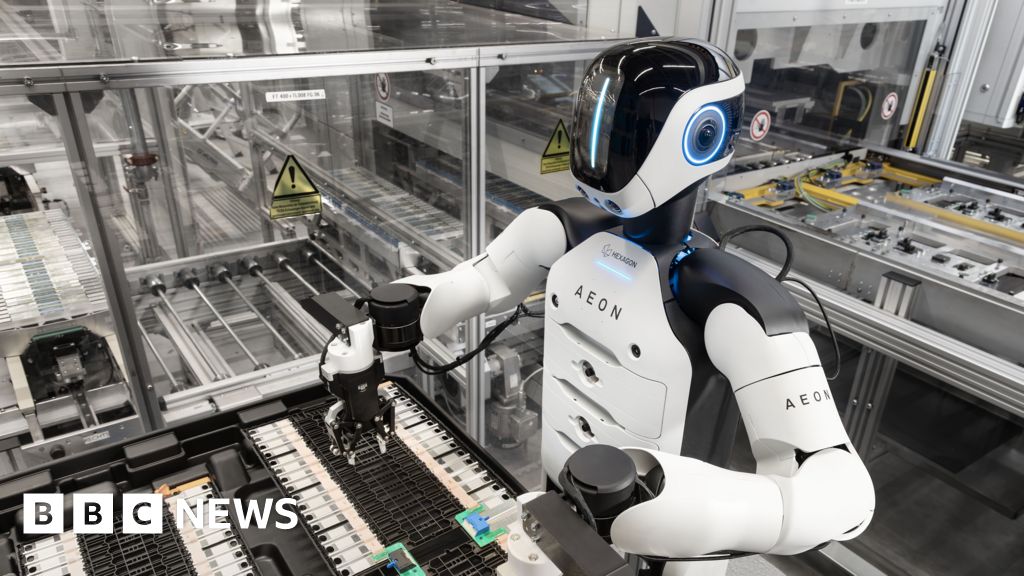
Aeon doesn't have a human face but does have a display area on the front of its head, which shows symbols, such as a line when performing a task and a circle when listening. "We're still working on that [visual language], but we feel very strongly that Aeon needs to be signalling in a way that's natural to humans," says Robert.
Humanoid robots are starting to enter workplaces alongside humans, but Ray believes the robots have been overhyped, especially with high profile demonstrations.
"The primary use case for a humanoid robot today is to walk on stage and artificially inflate your share price," he says. "Robots dancing or whatever: That's not that difficult to do."
There's a risk of people overestimating a robot's capabilities, he says.
New robots, funding, and signals. Every Thursday.
Unsubscribe anytime.
Mentioned in this article