Industry Landscape
Quick Answer
The best humanoid robots for warehousing and logistics in 2025 include the Agility Digit, Apollo by Apptronik, and Figure 02 — each designed for case handling, palletizing, and pick-and-place tasks in existing warehouse infrastructure. These robots operate 20+ hours per day, handle payloads from 15–25 kg, and integrate with standard WMS platforms via RESTful APIs. Deployment ROI typically reaches breakeven within 18–24 months for facilities processing 10,000+ units per day.
The global warehouse automation market is projected to reach $41 billion by 2027, driven by e-commerce growth, labor shortages, and rising fulfillment speed expectations. Traditional fixed automation (conveyors, AS/RS) excels at high-volume, predictable workflows, but struggles with mixed-SKU environments and seasonal demand spikes. Humanoid robots fill this gap — they navigate existing facilities without infrastructure changes, handle diverse package types, and scale up or down with demand. Early adopters in 3PL and e-commerce fulfillment are reporting 2–3x throughput improvements in pick-and-place operations alongside 40–60% reductions in workplace injuries.
$41B
Market Size (2027)
LogisticsIQ 2024
600K+
Labor Shortage Gap
Bureau of Labor Statistics
18–24 mo
Avg. ROI Breakeven
Industry benchmarks
40–60%
Injury Reduction
Early adopter reports
Use Cases
Pick & Place
Autonomous picking of individual items or cases from shelves, conveyors, or bins with vision-guided manipulation.
- +Handles 500–800 picks per hour per robot
- +Works with irregular and deformable items
- +No shelf or racking modifications required
Palletizing & Depalletizing
Stacking and unstacking cases onto pallets following optimized load patterns for mixed-SKU shipments.
- +Supports 15–25 kg payload per lift
- +Adapts to variable case dimensions in real time
- +Eliminates repetitive-strain injury risk for workers
Goods Transport & Kitting
Moving materials between zones — receiving to storage, storage to pack stations, or kitting parts for assembly lines.
- +Navigates dynamic aisles alongside human workers
- +Integrates with WMS for task dispatch
- +Operates 20+ hours between charges
Trailer Loading & Unloading
Entering truck trailers to unload cartons — one of the most physically demanding and high-turnover warehouse tasks.
- +Operates in confined, non-climate-controlled spaces
- +Reduces trailer unload time by up to 30%
- +Addresses #1 warehouse injury source
Source-Checked Deployment Context
Amazon / GXO Logistics
Agility Digit
Deployed in pilot for tote movement and bin handling, achieving 600+ totes/shift with zero lost-time injuries.
BMW Manufacturing
Figure 02
Integrated into Spartanburg plant logistics for parts kitting, reducing ergonomic strain reports by 50%.
Apptronik Partner Sites
Apollo
Multi-site palletizing trials showing 25 kg payload handling across 20-hour shifts with 99.2% uptime.
DHL Supply Chain
Various pilots
Testing humanoid-assisted unloading at distribution centers, targeting 30% faster trailer unload times.
Ocado Group
Research partnership
Exploring humanoid manipulation for mixed-SKU grocery picking in ambient and chilled environments.
Evaluation Checklist
0/20 checked
Payload & Reach
Navigation & Safety
Integration
Uptime & Maintenance
Total Cost of Ownership
Scenario Calculator
Estimate the cost range for warehousing & logistics
Use your own assumptions to compare a monthly labor baseline with an editable deployment and support range. This is a planning scenario, not a guaranteed ROI forecast.
Add positive values for labor cost, schedule, role count, and utilization. Keep utilization at 100% or below.
Featured Catalog Models for Warehousing & Logistics
Full catalogThese cards show source-backed catalog facts. Placement on this solution page is editorial suitability guidance, not a guarantee of deployment readiness, pricing, availability, or ROI.

Omron Robotics
LD-250 AMR
Omron LD-250 is a wheeled autonomous mobile robot (AMR) for moving materials in factories and warehouses with up to 250 kg payload.

Tesla
Tesla Bot
Tesla Bot (Optimus) is a humanoid biped robot Tesla is developing to perform repetitive or unsafe tasks in human environments.

NEURA Robotics
NEURA 4NE1
NEURA 4NE1 is a full-size humanoid robot platform from NEURA Robotics aimed at industrial and logistics tasks, with NVIDIA Thor compute and a reservation-based rollout.

Physical Robotics
Robot Pi
Robot Pi (π) is an upper-body humanoid robot from Physical Robotics built for dexterous, force-controlled manipulation using multi-DOF hands.
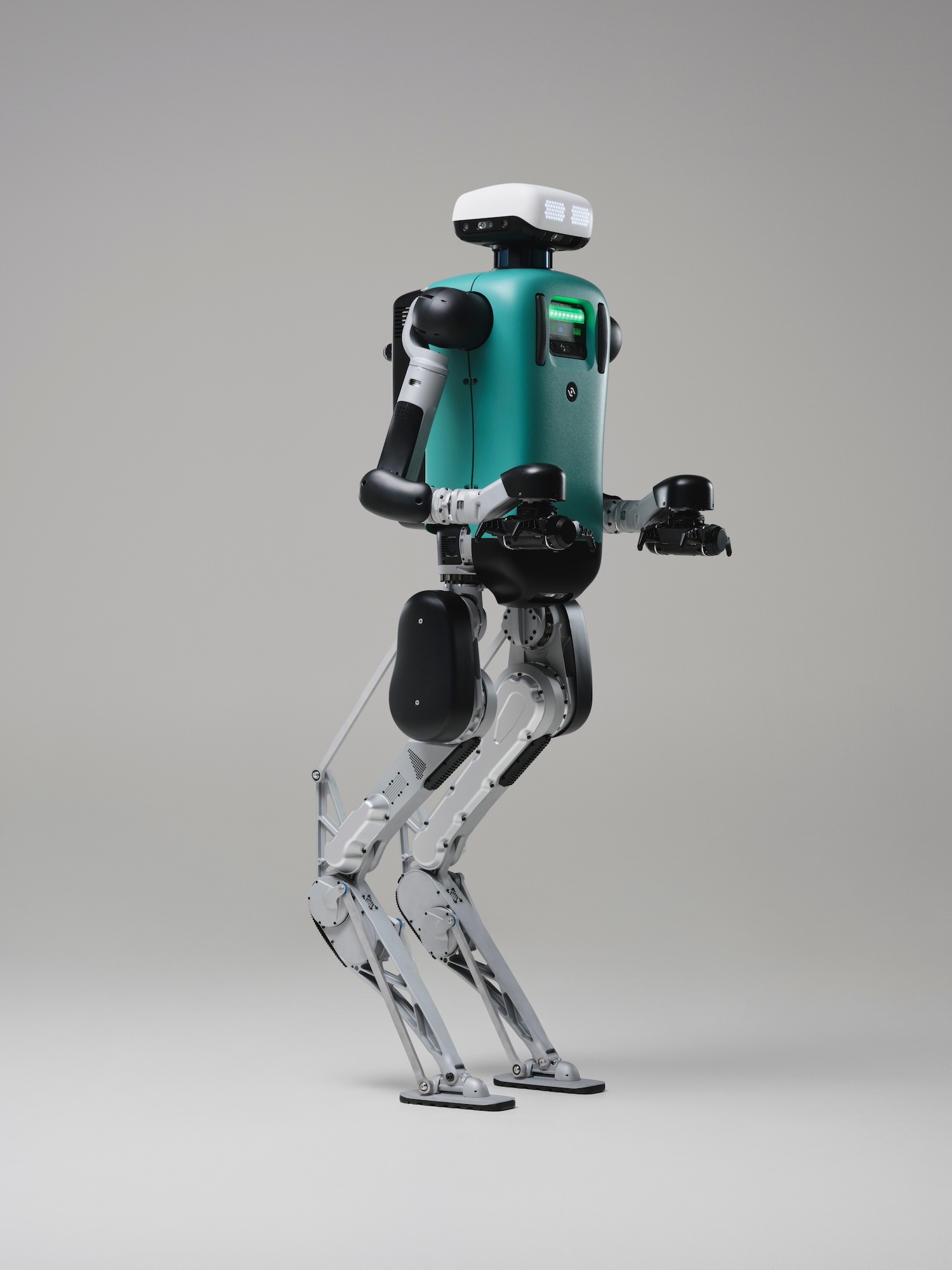
Agility Robotics
Digit
Digit is Agility Robotics' commercially deployed bipedal humanoid for industrial material-handling workflows in facilities designed around people.

1X Technologies
1X EVE
1X EVE is a wheeled humanoid robot from 1X Technologies aimed at mobile service work in institutional and industrial settings.
Connected discovery
Related pages
Humanoid robots for warehousing & logistics
Humanoid platforms targeting warehouse, logistics, and ground-handling deployment — pickers, packers, and movers.
Buyer guides
Best Humanoid Robots for Warehousing & Logistics
A buyer-focused shortlist for warehouse, fulfillment, and logistics teams comparing humanoid robots.
Need help choosing the right robot?
Our team can help you evaluate humanoid robots for warehousing & logistics - from requirements analysis to vendor shortlisting and pilot planning.
Frequently Asked Questions
How much does a warehouse humanoid robot cost?+
Can humanoid robots work safely alongside humans in a warehouse?+
How long does it take to deploy humanoid robots in a warehouse?+
What warehouse tasks are NOT suitable for humanoid robots today?+
How do humanoid robots compare to AMRs and robotic arms?+
Sources and verification
Robot facts come from catalog/manufacturer records. Market, deployment, ROI, and suitability guidance is separated below so buyer-context claims can be checked independently.
Robot and manufacturer records
Official product or manufacturer pages used for catalog-backed robot facts.