The short answer: Every industrial revolution follows the same 3M sequence: new raw materials enable new machines, which demand new business models — and the models are where the value concentrates. In humanoid robotics, the raw material is embodied training data, the machine is the general-purpose humanoid, and the business model — led by Robotics-as-a-Service — is still forming. That gap is the opportunity.
Every major industrial transformation in history has followed the same three-step sequence. New raw materials unlock new possibilities. New machines convert those materials into capability. New business models convert that capability into economic value — and reshape entire industries in the process.
Call it the 3M framework. It has repeated at least three times, and it is repeating again right now with humanoid robots. Understanding where we are in the sequence is the single most useful lens for anyone evaluating this market — whether you're deploying robots in a warehouse or deciding which manufacturer deserves your attention.
The pattern, proven three times
The first industrial revolution ran on coal and iron. Those raw materials enabled a new class of machines — the steam engine, the power loom — and those machines demanded a new business model: the factory system. Work moved from cottages to centralized production floors because the machines made it economically irresistible.
The second ran on steel, oil, and electricity. The machines were the assembly line and the electric motor. The business model was mass production — the vertically integrated corporation that could make a car affordable to the workers who built it.
The third — the digital revolution — ran on silicon. Refined sand became transistors, transistors became computers, and computers connected into the internet. The business models took decades to mature: packaged software licensing, then e-commerce, then SaaS and platform economics. The companies that mastered the model, not just the machine, captured most of the value.
Notice something important in each cycle: the three M's never arrive at the same time. The raw material comes first. The machines follow. The business models lag — often by decades. Economists studying the electrification of factories found that productivity gains took roughly thirty years to materialize, because factory owners initially just swapped steam engines for electric motors without redesigning the factory around the new machine. The value only arrived when the business model caught up with the technology.
That lag is where fortunes are made and lost. And it's exactly where humanoid robotics sits today.
M1 — Raw materials: data is the new coal
The physical inputs to a humanoid robot are real constraints — rare-earth magnets for actuators, high-density battery cells, precision reduction gears, cameras and force sensors. Supply chains for these components are a genuine strategic battleground, and they explain a good portion of the cost curves and regional dynamics in this industry.
But the defining raw material of this cycle isn't physical. It's embodied training data — recordings of how a body moves through and manipulates the real world. Unlike text, which the internet supplied in abundance for language models, motion data barely exists at scale. That's why manufacturers are investing so heavily in teleoperation programs, motion-capture pipelines, and large-scale simulation: they are, quite literally, mining the raw material of physical AI.
This is the first signal buyers should watch. A manufacturer's data strategy — how they collect it, how much they have, whether it transfers across tasks — is as predictive of long-term viability as any spec sheet.
M2 — New machines: the general-purpose form factor
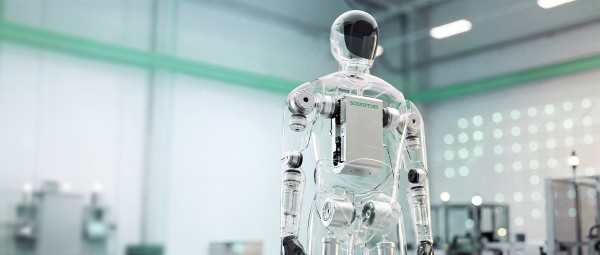
The machines are arriving now. What distinguishes this generation from the industrial arms and AMRs of the last thirty years is generality: a humanoid form factor that fits into environments built for humans — stairs, shelves, door handles, existing workflows — without retrofitting the facility around the robot.
That's the entire economic argument for the humanoid shape. Previous automation required redesigning the workplace around the machine. Humanoids invert this: the machine adapts to the workplace. It's the same shift that made the PC more transformative than the mainframe — general-purpose hardware that slots into existing human contexts.
The machines are real, improving fast, and commercially shipping in early deployments. But history says the machine alone doesn't create the revolution. Which brings us to the M that matters most right now.
M3 — Business models: where the actual transformation happens
If the pattern holds, the biggest open question in humanoid robotics isn't payload capacity or battery runtime. It's this: what is the business model that makes deployment irresistible?
The early answer emerging across the industry is Robotics-as-a-Service (RaaS) — robots priced as an operating expense rather than a capital purchase, often benchmarked against the fully loaded cost of the labor they augment. Early enterprise deployments in logistics have leaned heavily on this structure, and it makes sense for the same reason SaaS beat packaged software: it moves risk from buyer to vendor, aligns incentives around uptime and outcomes, and lowers the barrier to a first deployment.
Further out, the models get more interesting: outcome-based pricing (paying per pallet moved, not per robot-hour), fleet orchestration as a service, and eventually labor marketplaces where capacity is provisioned the way cloud compute is today. None of this is settled. That's the point — we're in the equivalent of the early SaaS era, where the winning model exists in fragments but hasn't standardized.
What the framework tells you to do
For buyers, the 3M lens reframes the evaluation. Don't just compare machines — compare all three M's:
- Raw materials: Does the manufacturer have a credible data flywheel and a resilient component supply chain?
- Machines: Does the hardware fit your environment as it exists today, or does it quietly require you to redesign your facility?
- Business models: Can you deploy as OpEx with vendor-carried risk, or are you being asked to make a capital bet on immature technology?
A brilliant machine attached to a weak model — or a strong model wrapped around undercooked hardware — both fail. The electrification lesson applies directly: value arrives when the deployment model is redesigned around the machine, not when the machine is bolted into the old process.
For anyone watching the industry, the framework predicts where value concentrates next. In every prior cycle, the machine-makers mattered early, but the largest returns went to those who mastered the business model layer — Ford over the engine builders, Microsoft and Salesforce over the box makers. Expect the same stratification here: hardware manufacturers, foundation-model providers, and deployment/orchestration layers will separate into distinct competitive games.
Where we are in the cycle
Raw materials: being solved, with data as the bottleneck. Machines: arriving and improving on steep curves. Business models: forming, unstandardized, and wide open.
That combination — capable machines ahead of mature models — is historically the most volatile and most opportunity-rich phase of any industrial transition. It's when pilots either become fleets or become cautionary tales, and when today's evaluation decisions compound for a decade.
The companies and operators who internalize all three M's — not just the impressive machine in the demo video — will be the ones standing when the model standardizes. History doesn't repeat exactly. But it has run this exact play three times, and humanoid robotics is running it again.
Frequently asked questions
What is the 3M framework in technology revolutions? The sequence every major industrial transformation follows: new raw materials (coal, oil, silicon, data) enable new machines (steam engines, automobiles, computers), which demand new business models (factories, mass production, SaaS) — where most economic value is ultimately captured.
What is the raw material of the humanoid robotics revolution? Embodied training data — recordings of how a body moves through and manipulates the physical world, gathered via teleoperation, motion capture, and simulation. Unlike text for language models, motion data barely exists at scale, which makes a manufacturer's data strategy a key indicator of long-term viability.
What is Robotics-as-a-Service (RaaS)? A model that prices robots as an operating expense rather than a capital purchase — typically a subscription or per-hour rate benchmarked against fully loaded labor cost. It shifts deployment risk from buyer to vendor and is the leading early business model for humanoid deployments in logistics.
Why the humanoid form factor instead of industrial arms or AMRs? Humanoids fit environments built for humans — stairs, shelves, door handles, existing workflows — without retrofitting the facility around the robot. Previous automation redesigned the workplace around the machine; the humanoid form factor inverts this.
How should businesses evaluate humanoid robot manufacturers? Evaluate all three M's, not just the machine: the manufacturer's data flywheel and component supply chain (raw materials), whether the hardware fits your environment as-is (machines), and whether you can deploy as OpEx with vendor-carried risk rather than a capital bet (business models).
Evaluating humanoid platforms for your operation? Explore the catalog of 110+ robots across 70+ manufacturers, or talk to an expert about which platforms fit your deployment.