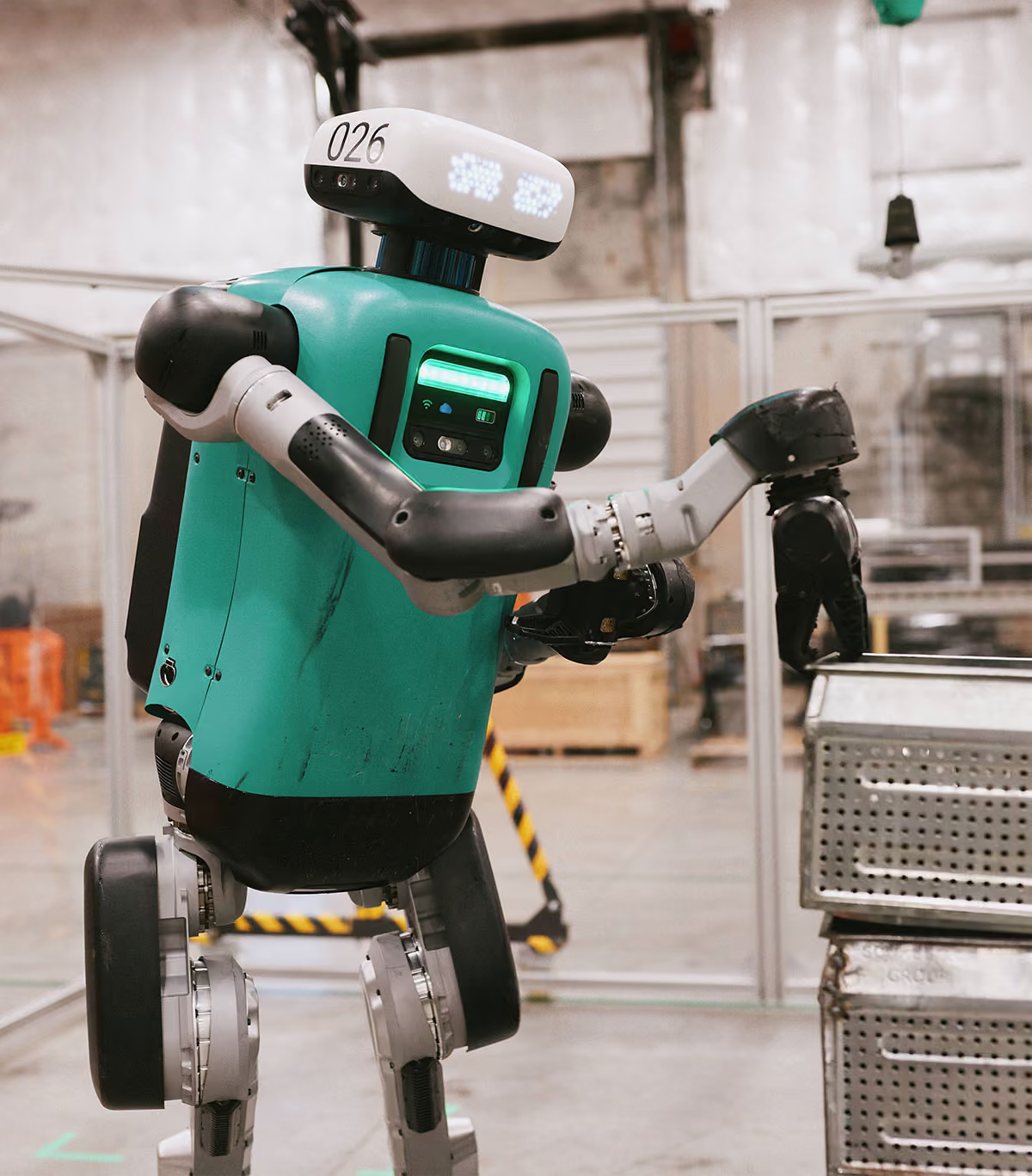
Humanoid robotics is entering a phase where announcements are frequent—new pilots, new tasks, new videos—but operators and buyers still struggle to answer the same question: which programs convert from pilot to production, and on what timeline.
Recent public signals help frame that question: BMW says it will run a humanoid pilot in production in Germany for the first time (Plant Leipzig), following a prior pilot in the US (Plant Spartanburg) and the creation of a “Center of Competence for Physical AI in Production” (BMW Group press release). Meanwhile, Agility Robotics markets Digit as having 65,000 hours of real production experience and describes a structured deployment process (Agility Robotics site, deployment process page). And industry voices are increasingly explicit that the key metric is not pilots—but what happens 6–18 months later (repeat orders, recurring revenue) (Aaron Prather on LinkedIn).
Quick answer
What happened: BMW publicly announced a first humanoid-robot pilot “in production” in Germany (Leipzig), positioning it under its “Physical AI” initiative and referencing a previously completed pilot in Spartanburg, USA (BMW). Separately, Agility Robotics continues to emphasize Digit’s accumulated operating hours and a repeatable deployment process (Agility, deployment process).
Why it matters for humanoid robotics: These are operator-grade signals: OEMs are testing humanoids inside real production systems, and at least one vendor is prioritizing deployment playbooks and longitudinal metrics (hours, fleet operations) rather than one-off demos. The industry conversation is shifting toward conversion rates—how many pilots become sustained operations that buyers will renew and expand (Prather).
What remains unclear: The public sources do not provide full details on unit counts, uptime, safety case, cost per hour, or procurement terms for BMW’s pilot(s), and they do not provide independently audited definitions behind some marketing metrics. Treat these announcements as directional evidence of momentum, not proof of widespread production adoption.
What the sources actually say (and don’t)
BMW: “pilot project” in Leipzig, following Spartanburg
BMW’s newsroom statement is explicit about three points:
- A pilot in Germany (Leipzig): BMW says it is “launching a pilot project with humanoid robots at the Leipzig plant,” with an aim to integrate humanoid robotics into existing series production and explore additional applications (including batteries) (BMW).
- A prior pilot in the US: The same release states a “first pilot deployment … successfully completed” at Plant Spartanburg in the USA (BMW).
- Process intent (Physical AI + competence center): BMW frames this under “Physical AI” and notes a new “Center of Competence for Physical AI in Production” meant to accelerate integration globally (BMW).
What BMW does not publicly specify in the excerpted material: robot manufacturer/model, number of robots, exact tasks, cycle times, how safety and risk were managed, KPIs, duration, or whether the pilot implies a purchase order. For operators, that means you should interpret it as a serious trial inside production operations, but not yet as evidence of scaled deployment.
Agility Robotics: hours and a deployment playbook
Agility Robotics’ public positioning focuses on two measurable-adjacent ideas:
- Operating hours: Agility states Digit has “65,000 hours of real production experience” (Agility). This is useful because hours are closer to operational truth than a short demo, but the source does not provide a third-party audit, breakdown by site, or how “production experience” is defined.
- Deployment process: Agility also publishes a “field-tested process for deploying humanoid automation” (deployment process page). Even without every metric disclosed, the existence of a process narrative is a signal that the vendor expects repeat deployments and fleet operations—important for buyers assessing integration cost and timeline.
Industry-wide “pilot inflation” and the demand for follow-through
Aaron Prather’s LinkedIn post captures a widely felt operator complaint: the industry is good at announcing the beginning of the story—but buyers should ask how many pilots become production deployments, how many robots are purchased next, and what recurring revenue exists (Prather).
That aligns with broader market commentary that frames humanoids as a potentially large trend, while also raising second-order risks such as cybersecurity (for connected robots operating in sensitive workplaces) (Recorded Future).
Context: why “humanoid” is showing up in factories now
Two structural reasons repeatedly appear across market commentary:
- Labor and flexibility pressure: Research-oriented market pieces argue that aging populations and labor availability push companies toward automation that can operate in human environments (Recorded Future).
- General-purpose promise vs. integration reality: Humanoids are often framed as “general purpose,” but in practice most deployments start with narrow, high-frequency tasks that are safe to trial and easy to measure (material handling, tote movement, kitting, line-side replenishment). The sources here don’t enumerate BMW’s tasks, but BMW’s phrasing—“integrated into … series production”—implies the pilot is meant to touch real operational work, not a showroom demonstration (BMW).
Why it matters (operators, buyers, investors)
1) The KPI is no longer “can it do the task once?”
If you operate a warehouse or plant, the decision threshold is typically: repeatability, recoverability, and cost.
Prather’s framing is blunt: “Demos don’t pay. Deployments do.” The practical translation is that you should evaluate vendors on:
- Pilot → production conversion: Did the pilot lead to a second PO?
- Time-to-value: Weeks vs. quarters to reach stable throughput.
- Ongoing revenue model: Support, maintenance, fleet software, and continuous improvement loops.
(Prather)
2) BMW’s announcement is a “tier-1 operator signal,” not a scale signal
When a major OEM publicly ties humanoids to a production roadmap and creates internal organizational structure (“Center of Competence”), it suggests:
- There is a pipeline of use cases being formally evaluated.
- There are budgets and ownership pathways to move beyond a one-off experiment.
But because unit counts, performance and economics are not disclosed, it does not confirm that humanoids are ready for broad rollouts across multiple plants.
3) Security is not optional once humanoids touch production networks
Recorded Future emphasizes the likelihood of cyber risk to humanoid robots (hijacking, data leaks, botnets) and the need to treat them like any connected system (Recorded Future).
For operators, this translates into procurement requirements:
- Network segmentation and device identity
- Patch and vulnerability management commitments
- Logging and incident response integration
- Clear data-handling policies for onboard cameras and microphones (if present)
The numbers (plain-English) and how to interpret them
“65,000 hours of real production experience” (Agility)
Agility’s headline metric—65,000 hours—is best interpreted as an attempt to move the discussion from staged demos to accumulated runtime (Agility).
What you should ask to make that number decision-useful:
- How many robots contributed to the total?
- Over what time period?
- What fraction of time was autonomous task execution vs. supervised testing?
- What were the top failure modes and mean time to recovery?
Absent those details, the number is still a positive signal (someone is tracking runtime), but not enough to compare vendors apples-to-apples.
“Pilot project” and “successfully completed pilot” (BMW)
BMW’s press release uses pilot language, which usually implies bounded scope and explicit learning objectives (BMW).
What “pilot completed” does not necessarily mean:
- It does not guarantee ROI was achieved.
- It does not confirm safety certification beyond the specific pilot conditions.
- It does not imply a fleet purchase or long-term deployment.
Competitive/context view (what’s verifiable)
The provided sources support only limited comparison without drifting into speculation:
- Operator adoption signal: BMW’s announcement is a strong signal that top-tier manufacturers are actively testing humanoids in production contexts (BMW).
- Vendor operationalization signal: Agility’s emphasis on hours and deployment process indicates focus on repeatable deployment and fleet lifecycle (Agility; deployment process).
- Breadth of ecosystem: Humanoid.guide maintains a directory of manufacturers, illustrating how crowded the field is and how many entrants describe availability as prototype vs. production (Humanoid.guide manufacturers list).
What we cannot verify from these sources alone: relative performance benchmarks (speed, payload, uptime), pricing, real shipment volumes, and true “production” scale across the broader vendor landscape.
Practical implications: a checklist for pilot-to-production readiness
If you’re an operator or buyer evaluating a humanoid pilot in 2026, use these questions to force clarity:
- Define the job: exact pick/place, lift, carry distances, and tolerated error rates.
- Define the operating envelope: lighting, floor conditions, aisle widths, and human-robot interaction zones.
- Safety case: how the system handles proximity to people, e-stops, recovery, and abnormal events.
- Data + integration: WMS/MES touchpoints, logging, and who owns the integration work.
- Reliability metrics: uptime definition, MTBF/MTTR targets, and maintenance responsibilities.
- Commercial pathway: what triggers expansion—hours, throughput, cost per task, or injury reduction.
This aligns with the broader industry push to ask what happens after the pilot announcement—renewals and repeat orders—not just technical feasibility (Prather).
What to watch next (next 6–18 months)
Based on the gaps in public disclosures, the highest-signal updates to track are:
- BMW Leipzig pilot details: robot vendor/model, task list, duration, and whether the program expands within Leipzig or to another BMW plant (BMW).
- Post-pilot procurement: any indication of repeat purchases, longer contracts, or multi-site deployments (the “scoreboard” Prather points to) (Prather).
- Deployment maturity signals: more vendors publishing deployment playbooks, safety frameworks, and measurable uptime/cost metrics similar to Agility’s positioning (Agility).
- Security posture: explicit cybersecurity requirements and certifications becoming standard in RFPs, consistent with risk warnings in market research (Recorded Future).
What we are not concluding (uncertainties and limits)
- We are not concluding that humanoids are broadly deployed at scale in automotive production; BMW’s announcement is about pilots and organizational readiness, with limited disclosed metrics (BMW).
- We are not concluding that “hours in production” equals high autonomy or high uptime; Agility’s figure is not broken down publicly and is best treated as a directional operating signal (Agility).
- We are not ranking “best humanoid robots” or claiming cost trajectories; the provided sources include market and blog commentary, but without consistent, audited benchmarks across vendors.
Where to go next
- Browse the broader ecosystem of humanoid makers to understand how many vendors exist and how they describe availability: /brands and /explore (HumanoidHub navigation)
- If you’re actively evaluating vendors: use /compare to structure shortlists around payload, reach, autonomy claims, and deployment requirements.
- To stay current on operator-facing announcements and deployments: track reputable industry outlets (and verify primary sources).
FAQ
Are humanoid robots being used in BMW factories today?
BMW has publicly announced a humanoid-robot pilot project at its Leipzig plant in Germany and stated a prior pilot deployment was successfully completed at Plant Spartanburg in the USA. BMW’s announcement does not disclose unit counts, tasks, or whether the pilots have become long-term production deployments (BMW).
What does “pilot” mean in humanoid robotics deployments?
In humanoid robotics, a “pilot” typically means a time-bounded trial with defined tasks and learning goals to validate safety, integration, and performance in a real facility. A pilot does not automatically imply a purchase order, fleet rollout, or positive ROI.
What metric matters most after a humanoid pilot announcement?
A key metric after a humanoid pilot announcement is conversion: whether the customer expands the deployment with a second purchase order, longer contract, or additional sites. Industry commentary highlights that pilots generate data, but deployments and repeat business generate revenue (Prather).
What does Agility Robotics mean by “65,000 hours of real production experience”?
Agility Robotics states that its Digit humanoid robot has 65,000 hours of real production experience. The public claim signals accumulated runtime, but it is not accompanied (in the cited page) by an audited breakdown of how many robots contributed, what tasks were run, or what autonomy and uptime levels were achieved (Agility).
Why is cybersecurity a concern for humanoid robots?
Cybersecurity is a concern for humanoid robots because they are connected systems operating in sensitive workplaces and can be targets for hijacking, data leakage, or disruption. Market research argues humanoid robots should be secured like any other networked system, with rigorous controls and monitoring (Recorded Future).
Sources
- BMW Group Newsroom: “BMW Group to deploy humanoid robots in production in Germany for the first time” — https://www.press.bmwgroup.com/global/article/detail/T0455864EN/bmw-group-to-deploy-humanoid-robots-in-production-in-germany-for-the-first-time?language=en
- Agility Robotics (Digit / solutions overview) — https://www.agilityrobotics.com
- Agility Robotics: “Agility’s humanoid deployment process” — https://www.agilityrobotics.com/content/agilitys-humanoid-deployment-process
- Aaron Prather (LinkedIn): “Humanoid Pilot to Production Deployment Metrics” — https://www.linkedin.com/posts/amprather_every-week-another-humanoid-pilot-new-activity-7506352008287649793--jqw
- Recorded Future: “The Future of Humanoid Robotics” — https://www.recordedfuture.com/research/future-humanoid-robotics
- Humanoid.guide: “Humanoid Robot Manufacturers” — https://humanoid.guide/manufacturers

