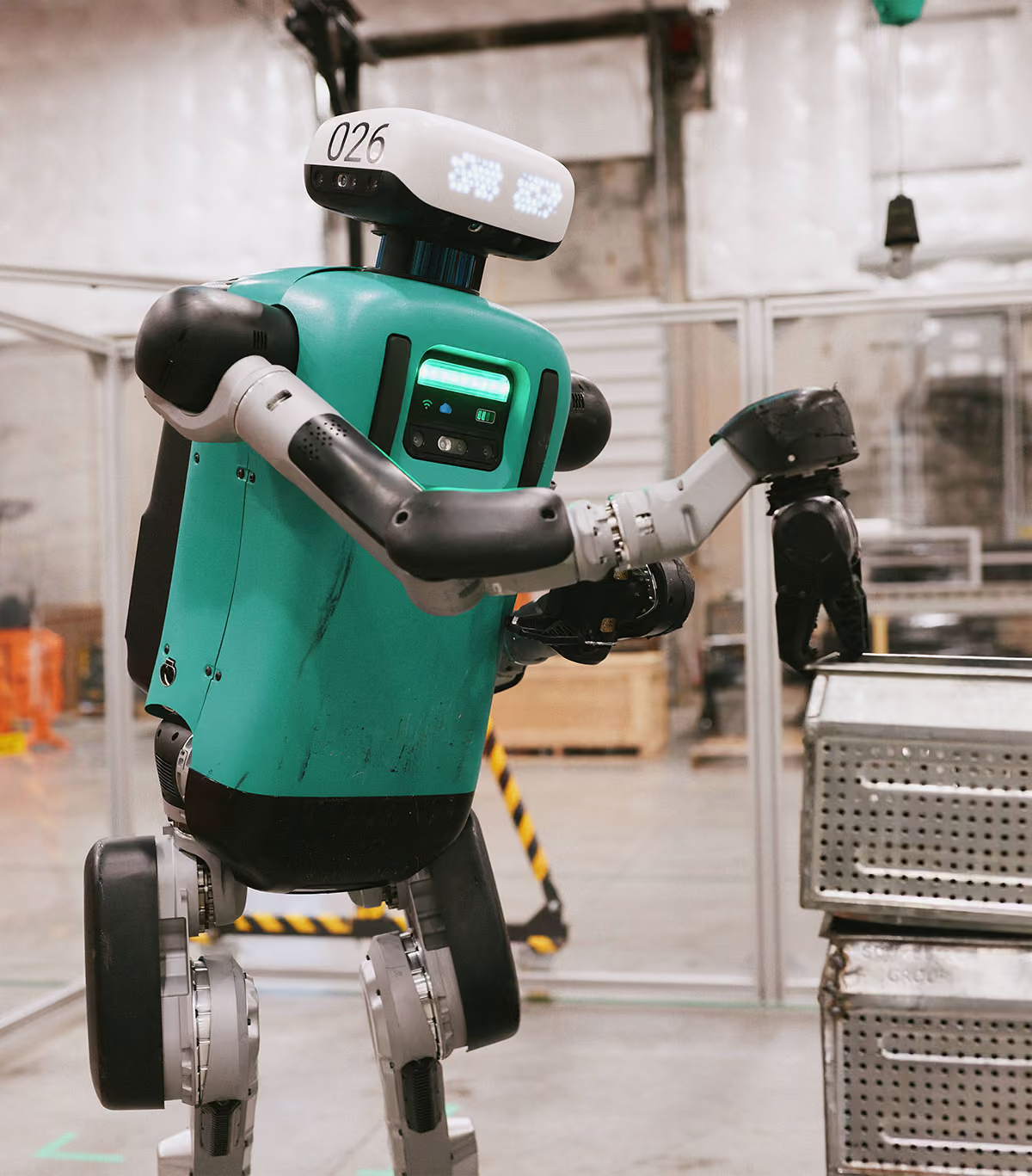
Humanoid robotics is entering a phase where the headline isn’t just what a robot can do in a demo—it’s whether deployments can be repeated safely and reliably inside real operations.
Multiple sources in the humanoid ecosystem are pointing to the same pattern: hardware output is rising, but commercially meaningful deployments are still scarce. The practical takeaway for operators and buyers is that the near-term differentiator is less about flashy behaviors and more about deployment systems: safety architecture, tooling, charging, fleet management, and integration into existing warehouse/factory workflows.
Quick answer
What happened: Market analysis from Interact Analysis reports that global humanoid robot production exceeded 20,000 units in 2025, up from fewer than 2,000 units in 2024, while noting that only around 10% of those 2025 units were deployed in real-world applications and that most “real-world” projects were still small proof-of-concepts. (Interact Analysis)
Why it matters for humanoid robotics: This is a concrete signal that the industry may be shifting from a “can we build it?” constraint toward a “can we deploy it repeatedly?” constraint. If production is rising faster than sustained deployments, then integration, uptime, safety cases, and economics become the real bottlenecks—and the best leading indicators for which humanoid programs can scale.
Context: a widening gap between “units built” and “units working”
Interact Analysis frames 2025 as a step-change in production volume—20,000+ units produced—but also describes a deployment gap, with most units used for research, data collection, and entertainment rather than revenue-generating operations. It further states that real-world use rose only modestly relative to production, and that projects remained mostly POCs, often influenced by subsidies and strategic investment. (Interact Analysis)
Operator-facing commentary on LinkedIn echoes the same theme in different words:
- Gobano Robotics highlights a shift from impressive demos to the engineering required for deployment, calling out safety architecture, tooling, charging, fleet management, and integration with existing operations as the systems that decide whether humanoids scale in factories and warehouses. The post references Agility Robotics’ “Digit 5” in that context. (Gobano Robotics on LinkedIn)
- Aaron Prather argues that pilots are useful, but the scoreboard should track how many pilots convert to production deployments, follow-on purchase orders, repeat customers, and recurring revenue—because “deployments” are what get paid. (Aaron Prather on LinkedIn)
Separately, Productiv positions its Dallas logistics facility as a “real-world training ground” with 500+ workers, 8+ task categories, and 15M+ kits per year—arguing that many humanoid programs have a data problem (sim-to-real gaps) rather than purely a hardware problem. This is a vendor/operator claim, but it’s useful as an example of the type of environment some teams believe is needed to harden systems. (Productiv)
The numbers, in plain English (and what they do not prove)
From Interact Analysis:
- “20,000+ humanoids produced in 2025” and “<2,000 in 2024” implies a rapid manufacturing ramp.
- “Only around 10% deployed in real-world applications” means most units were not doing ongoing, customer-paid work.
- Even within that ~10%, the source indicates many deployments were still small-scale POCs.
What this does not tell us (and what buyers should avoid assuming):
- It does not prove that 2,000+ humanoids were successfully running multi-shift production workloads.
- It does not reveal uptime, mean time between failures, safety incident rates, or the share of “deployments” that were short-lived.
- It does not establish that production is geographically diversified; the same source says growth was highly concentrated in China. (Interact Analysis)
In other words: production volume is a necessary input, but it’s a weak proxy for operational readiness.
Why this matters: the bottleneck is shifting to deployment engineering
When production ramps faster than scaled deployments, the competitive terrain changes:
- Integration becomes product. If a humanoid vendor can’t integrate with WMS/MES/ERP workflows, safety protocols, and facility constraints, the robot may remain a pilot.
- Reliability beats versatility. Operators care less about the 20th task a robot can do once, and more about the 2 tasks it can do every shift.
- Safety architecture is not optional. Scaling from one robot to many turns safety from a paperwork exercise into a systems discipline: constraints, monitoring, emergency procedures, and human-robot interaction patterns.
The Gobano Robotics post is explicit about these deployment “systems” (safety, tooling, charging, fleet management, integration) as the practical determinants of scale. (Gobano Robotics on LinkedIn)
Practical implications for operators and buyers
If you are evaluating humanoids for warehouses, factories, or 3PL operations, treat near-term engagement as a deployment program—not a robot purchase.
1) Ask for conversion metrics, not demo videos
Borrowing from Aaron Prather’s framing, request:
- Pilot-to-production conversion rates (even if anonymized)
- Follow-on purchase orders from the same customer
- The number of customers with second-site deployments
- Whether revenue is recurring (service/maintenance/software) vs. one-time hardware
If the vendor cannot answer, that’s not automatically disqualifying—many programs are early—but it’s a clear signal about maturity. (Aaron Prather on LinkedIn)
2) Treat “real-world deployment” as a spectrum
Interact Analysis suggests many deployments are still POCs. In practical terms, you should define what “deployment” means in your org:
- One supervised robot for a few hours/week
- One robot doing a single task for a full shift
- Multiple robots across shifts with defined handoffs, maintenance, and safety routines
- Fleet-level operations (charging rotation, spare parts, remote monitoring, escalation)
3) Plan for data and iteration loops
Productiv argues the limiting factor is often data from real operations (sim-to-real gaps). Whether or not you agree with the strength of that claim, operators should anticipate that early deployments will involve iteration:
- On-site data collection
- Tooling and gripper changes
- Process redesign to accommodate robot constraints
- Human training and standard work
Competitive / ecosystem context (what’s verifiable vs. not)
There are many “top humanoid robots” lists and vendor pages circulating. Some are useful for discovery, but they often mix marketing claims, unverified pilot announcements, and unequal evidence standards.
For example, RoboZaps publishes an “evidence-ranked” list and cites updates about multiple companies and programs. That may be a helpful starting point for tracking the landscape, but you should still verify primary sources for any procurement decision. (RoboZaps)
Similarly, company pages can clarify positioning (e.g., “early access,” partner logos, deployment targets), but these are self-reported and may not equate to paid production use. One example is The Humanoid’s product pages and partner logo display; treat these as directional signals rather than deployment proof. (thehumanoid.ai)
What can be compared responsibly right now, based on the provided sources:
- The industry-level pattern: production is up sharply, scaled deployments are still limited. (Interact Analysis)
- The operator priority shift: deployment engineering (safety, charging, fleet tools, integration) is becoming central. (Gobano Robotics on LinkedIn)
- The “scoreboard” metrics: pilots are not the end goal; conversion and revenue matter. (Aaron Prather on LinkedIn)
What cannot be verified from the provided sources:
- Which specific humanoid model is “best” for a given site
- Fleet-level uptime benchmarks across vendors
- True unit economics (capex/opex, maintenance cost, utilization) for most deployments
What we are not concluding (uncertainty section)
- We are not concluding that humanoids are “ready” for broad, unsupervised deployment across warehouses and factories. Interact Analysis explicitly describes commercial deployments as limited and many projects as POCs. (Interact Analysis)
- We are not concluding that production volume automatically means cost competitiveness or reliability. Output can be driven by research programs, subsidies, or data-collection objectives.
- We are not concluding that any specific vendor’s “mass production” or “ready to deploy” language equals customer-paid production use, because the provided sources do not supply standardized proof (unit counts at customer sites, operating hours, SLA terms).
What to watch next (signals that scaling is real)
Track these indicators over the next 6–18 months:
- Repeatable deployments: the same customer expanding from 1 robot to a fleet, or from one site to multiple sites.
- Operational transparency: vendors publishing uptime, intervention rate, task success rates, and safety performance—ideally audited or at least consistently defined.
- Deployment tooling maturity: fleet management, remote monitoring, structured incident response, spare parts logistics.
- Procurement structure: clearer pricing, support plans, and contractual SLAs—signals of moving beyond bespoke pilots.
Where to go next (HumanoidHub navigation)
- Browse the broader market landscape: /explore
- Compare vendors and platforms side-by-side: /compare
- See manufacturer directories and profiles: /brands
FAQ
What does “humanoid robot production exceeded 20,000 units” actually mean?
Interact Analysis reports that global humanoid robot production exceeded 20,000 units in 2025, but it also notes that most of those units were used for research, data collection, and entertainment rather than scaled commercial work. (Interact Analysis)
Are humanoid robots widely deployed in factories and warehouses today?
Interact Analysis states that commercially viable real-world deployments remain limited and that most real-world application projects were still small-scale proof-of-concept deployments by the end of 2025. (Interact Analysis)
What should an operator measure to know if a humanoid pilot is succeeding?
A practical scoreboard for a humanoid pilot includes pilot-to-production conversion, follow-on purchase orders, repeat customers, and recurring revenue—because these indicate sustained operational value rather than one-off demos. (Aaron Prather on LinkedIn)
Why are safety, charging, and fleet management becoming central in humanoid deployments?
Gobano Robotics argues that scaling humanoids depends on deployment systems such as safety architecture, tooling, charging, fleet management, and integration with existing operations, because the key question becomes whether the robot can perform tasks safely and reliably at scale. (Gobano Robotics on LinkedIn)
Is the key challenge for humanoid robots hardware or data?
Productiv claims humanoid robots face a “data problem” more than a hardware problem, emphasizing that real operational environments generate the diverse training data needed to close the sim-to-real gap. This is a perspective from an operator/vendor and should be evaluated against your use case. (Productiv)
Sources
- Interact Analysis — “Humanoid robot production surges tenfold in 2025, but commercial deployments remain limited” (June 2026): https://interactanalysis.com/insight/humanoid-robot-production-surges
- Gobano Robotics (LinkedIn post referencing deployment engineering and Digit 5): https://www.linkedin.com/posts/gobano-robotics_physicalai-humanoidrobotics-robotics-activity-7508090240104857600-8CrT
- Aaron Prather (LinkedIn post on pilot-to-production metrics): https://www.linkedin.com/posts/amprather_every-week-another-humanoid-pilot-new-activity-7506352008287649793--jqw
- Productiv — “Humanoid Robotics & Automation | Future of 3PL”: https://getproductiv.com/humanoid-robotics
- RoboZaps — “38 Best Humanoid Robots in 2026 (Evidence-Ranked)”: https://blog.robozaps.com/b/best-humanoid-robots
- The Humanoid (company/product pages): https://thehumanoid.ai