HUBO Robotics
Live profile from global web signals: HUBO in humanoid and automation ecosystems.
Models
7
Featured
0
Use Cases
0
Tech Modules
0
Company Overview
Key facts about HUBO.
HUBO
Unknown
Headquarters
Unknown
Founded
N/A
Employees
Undisclosed
Social
1 channels
Follow HUBO
Get a weekly email only when reviewed, source-backed updates about this profile are available. No price or availability alerts.
Strategic Snapshot
How this brand positions its humanoid systems.
Build reliable robots that deliver measurable value in real-world environments.
Engineering-First Product Strategy
HUBO emphasizes robust hardware, controls, and system reliability.
AI-Driven Automation
Systems are optimized for real-world autonomy and human-robot collaboration.
Global Deployment Focus
Built for scalable deployment across logistics, manufacturing, and enterprise workflows.
HUBO Product Portfolio
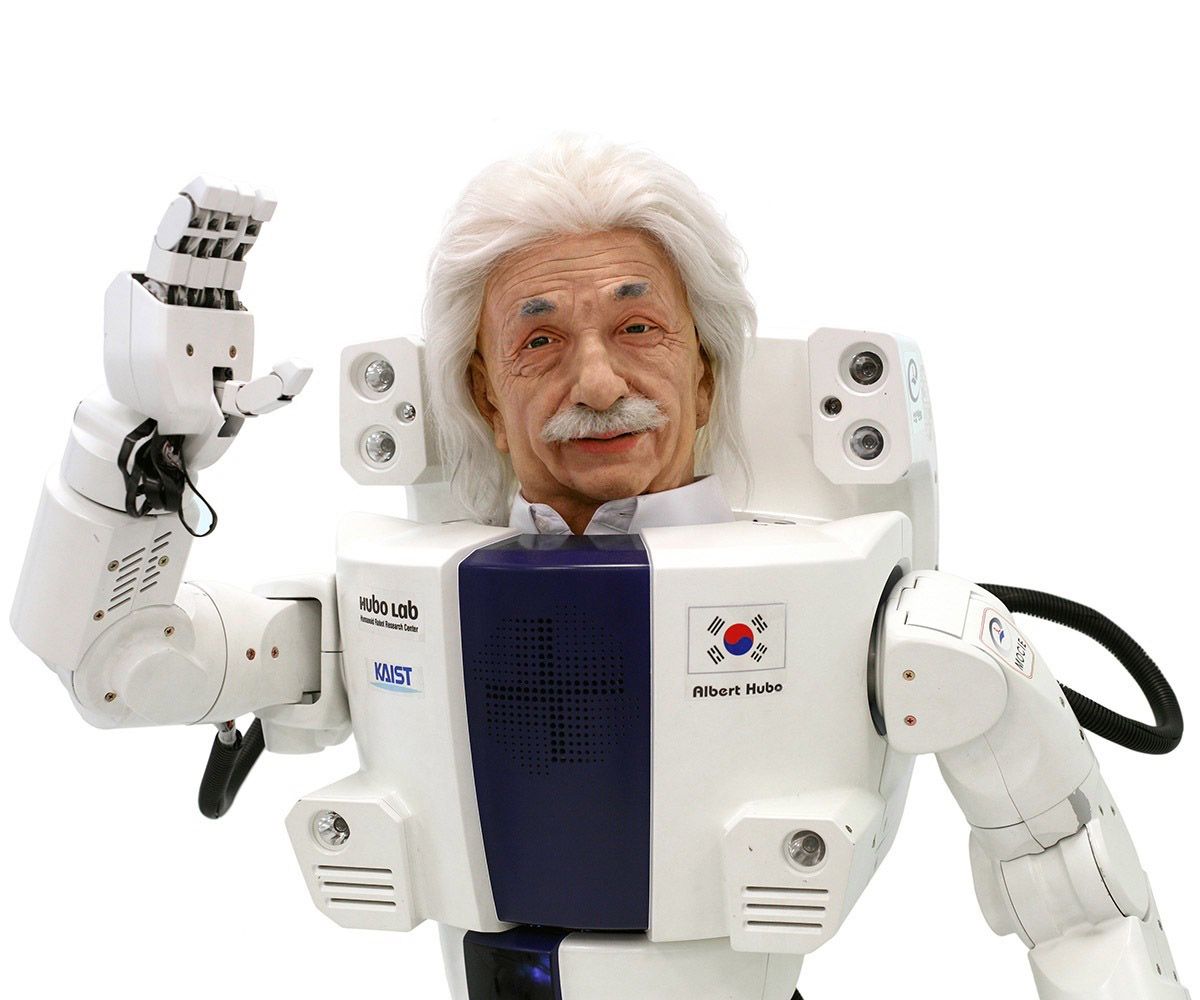
Albert Hubo
Albert HUBO is a KAIST HUBO-platform humanoid with an expressive Einstein-like animatronic head for HRI demos and research.
.jpg)
Hubo (KHR-2 based platform)
HUBO (KHR-2 based) is a full-size biped humanoid research platform developed at KAIST. It is reported at 41 DOF, ~125 cm tall, and ~55 kg.

DRC-Hubo
DRC-HUBO is a transformable humanoid disaster-response robot that won the DARPA Robotics Challenge Finals 2015.
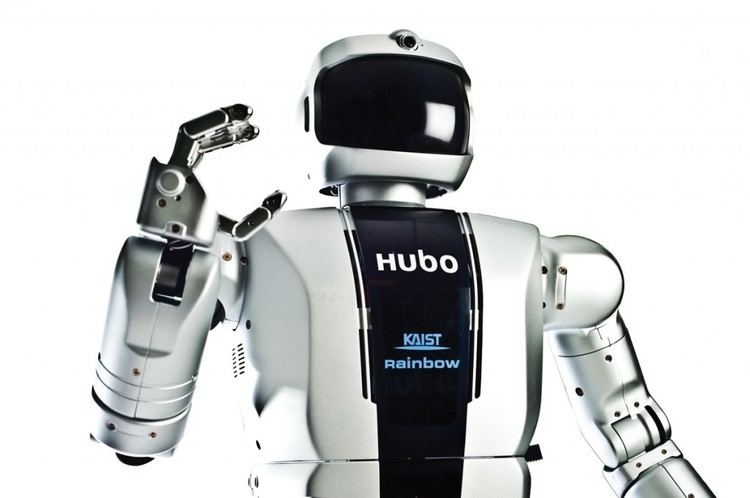
Hubo 2
HUBO 2 is a KAIST Hubo Lab humanoid research robot focused on bipedal locomotion for walking and stair traversal studies.
Hubo FX-1
HUBO FX-1 is an early HUBO humanoid robot platform from KAIST used for biped locomotion and human-carrying mobility research.
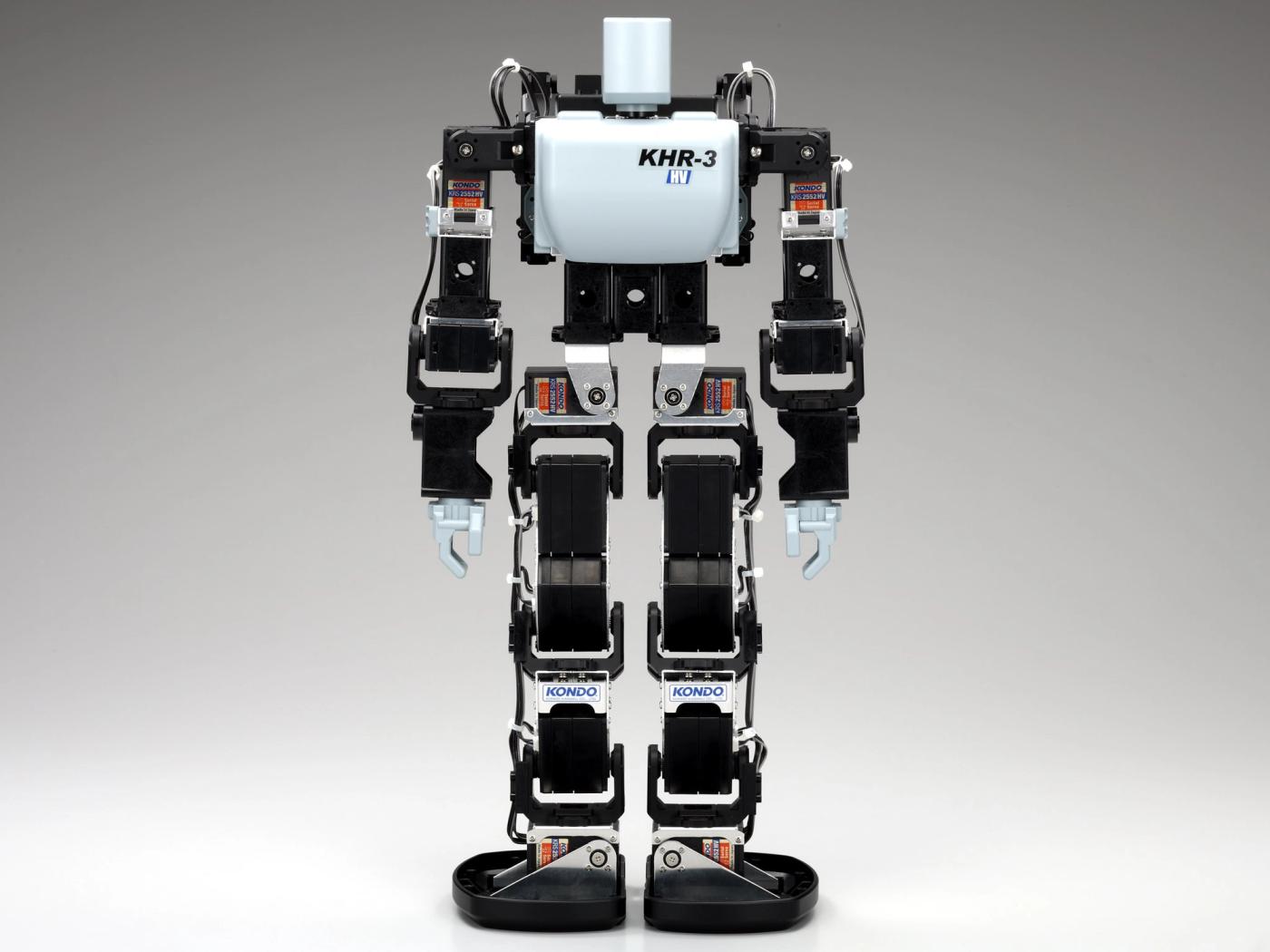
Hubo KHR-3
HUBO KHR-3 is a prototype humanoid robot developed by KAIST’s HUBO Lab for robotics research. It is known for finger independence demonstrations such as rock‑paper‑scissors.
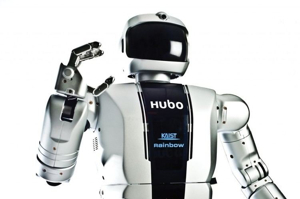
M-Hubo
M-Hubo is a wheeled humanoid research robot from KAIST’s HUBO Lab developed as an autonomous “robotic butler” platform for indoor fetch-and-serve tasks.
Country-specific purchase options
The complete robot catalog remains available worldwide. Seller options below require published evidence of service in your selected country.
HumanoidHub affiliate-program partnerships
These are HumanoidHub’s affiliate relationships. Participation does not establish manufacturer endorsement, authorization or exclusivity. Seller relationship labels reflect independently reviewed evidence.
Choose a purchase country to check affiliate-program offers.
Latest from HUBO
DARPA Robotics Challenge Trials: What We Learned on Day 1 - IEEE Spectrum
## Non-humanoid robots are a situationally effective compromise [NASA](https://spectrum.ieee.org/tag/nasa)JPL's[RoboSimian](https://spectrum.ieee.org/tag/robosimian)negotiates the rough terrain course. While [humanoid robots predominate at the DRC](https://spectrum.ieee.org/automaton/robotics/humanoids/meet-the-amazing-robots-that-will-compete-in-the-darpa-robotics-challenge), several teams are using designs that are more novel, most notably [JPL's RoboSimian](https://spectrum.ieee.org/automaton/robotics/industrial-robots/watch-jpls-robosimian-do-pullups) and CMU Tartan Rescue's CHIMP. Both RoboSimian and CHIMP were very solid on the terrain tasks, which they tackled on all fours (and in CHIMP's case, on tracks) instead of using two legs as most other robots. However, RoboSimian wasn't able to compete in either the car driving or ladder climbing tasks (although they plan to next year), and CHIMP was only able to awkwardly climb up one rung of the ladder, having sacrificed any hope of being nimble to a clever but very heavy array of tracked climbs. We'll be following both of these teams tomorrow to see how well they do in tasks relying more heavily on dexterous manipulation than on movement. *CMU's CHIMP tackles terrain very effectively on all fours.* *CHIMP isn't quite as nimble on ladders, although it did manage to score one point by barely lifting itself off of the ground.* ## Thinking like a human isn't necessarily good [HUBO](https://robotsguide.com/robots/hubo)going backwards up the ladder. The DRC robots are intended to take over from humans, but that doesn't mean that they need to operate the way humans need to operate. For example, Team DRC HUBO reached almost the very top of the ladder task by going up with its back to the ladder. It's perhaps not the most intuitive way to do it, but because of the way HUBO's joints bend, going backwards enabled it to keep its center of mass closer to the ladder itself. ## Hard tasks are still hard, especially driving *HUBO recalibrates after someone accidentally bumped into an E-Stop.* As well as Friday went, we don't want you to get the idea that the DRC is turning out to be easy, and there are still teams working towards their first point. Even the best teams have lots of room for improvement between now and the DRC Finals. The hardest task is turning out to be driving; even with teams being allowed to start the task with their robot in the vehicle already, nobody has so far been able to score a single point. Team DRC HUBO did manage to get the car to move, but they went over time doing it. *Although over the time limit, HUBO was still able to successfully drive the vehicle.*
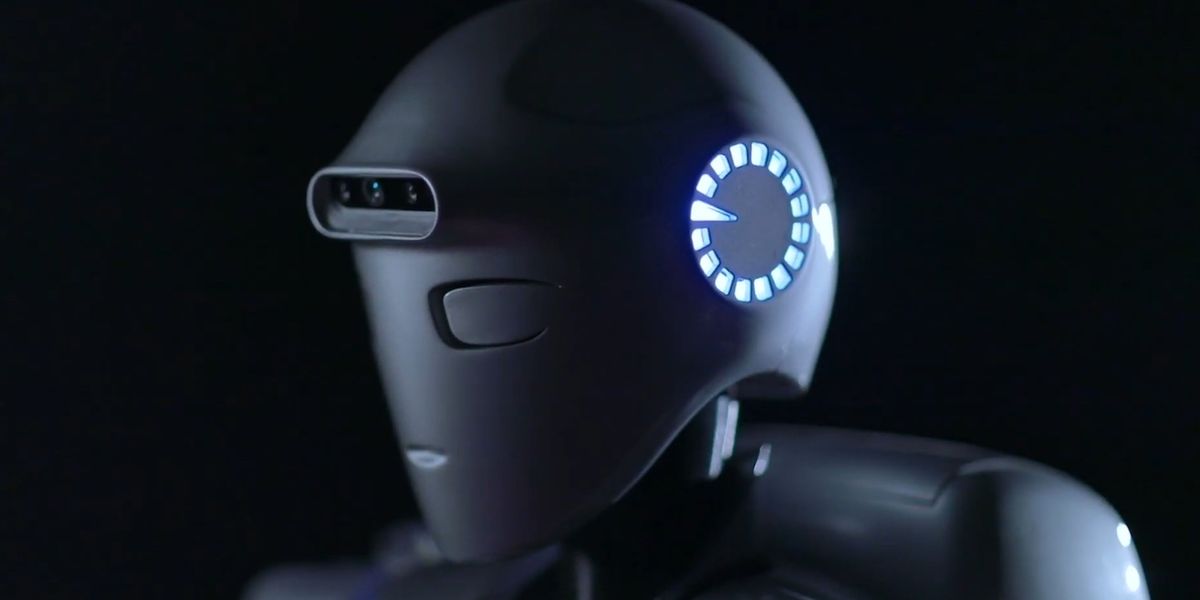
Iran Unveils Its Most Advanced Humanoid Robot Yet - IEEE Spectrum
12h 3 min read A smiling young woman is wearing a leather jacket. Adjacent imagery shows a book cover and above the cover, a black-and-white image of an atomic explosion. History of TechnologyNews ## New Trinity Book Uncovers Images of the First Atomic Test 5 min read Photo of the earliest instant of the first atomic explosion is seen as a grayish-white semi-sphere against a black background. AerospaceMagazineFeatureHistory of Technology ## Striking New Views of the First Atomic Bomb Test 5 min read ## Related Stories RoboticsAINewsHumanoid Robots ## Video Friday: Figure, 1X Ramp Up Humanoid Robot Production RoboticsNewsHumanoid Robots ## Video Friday: Who Wins in Robot vs. Pro Ping-Pong Player? RoboticsNewsHumanoid Robots ## Video Friday: Digit Learns to Deadlift [...] Surena IV is also more nimble. Custom force sensors on the bottom of its feet help the robot step over uneven surfaces by adjusting the angle and position of each foot. Walking speed increased to 0.7 kilometers per hour from 0.3 km/h in the previous generation. While Surena IV is not a highly dynamic machine like Atlas, the famously agile humanoid from Boston Dynamics, it relies on a whole-body motion controller that continuously adjusts its posture to avoid falls. In its overall design, Surena is probably more comparable to humanoids like UBTECH’s Walker, Honda’s Asimo, Pal Robotics’ Talos, KAIST’s Hubo, and AIST’s HRP-2, although these robots have already publicly demonstrated a broader range of capabilities.

Hubo II Humanoid Robot Is Lighter and Faster, Makes His Creator Proud - IEEE Spectrum
It's Hubo II, the humanoid above, which Oh and his colleagues developed at the Korea Advanced Institute of Science and Technology's Humanoid Robot Research Center, aka Hubo Lab. Professor Oh built the original Hubo in 2004. It was one of the first advanced full-body humanoid robots developed outside Japan. But he's probably better known for another humanoid: Albert Hubo, which had a Hubo body and an Albert Einstein animatronic head developed by Hanson Robotics. Now Professor Oh is ready to introduce the new addition to his family. Hubo II is lighter and faster than its older brother, weighing 45 kilograms, or a third less, and capable of walking two times faster. Watch the demo: [...] Watch the demo: A major improvement over early humanoid designs is Hubo II's gait. Most humanoid robots walk with their knees bent, which is dynamically more stable but not natural compared to human walking. Hubo II, Professor Oh says, performs straight leg walking. It consumes less energy and allows for faster walking. Note Hubo II's left knee extended when the leg swings forward (middle image below): The robot has more than 40 motors and dozens of sensors, cameras, and controllers. It carries a lithium polymer battery with a 480 watt-hour capacity, which keeps the robot running up 2 hours with movement and up to 7 hours without movement.
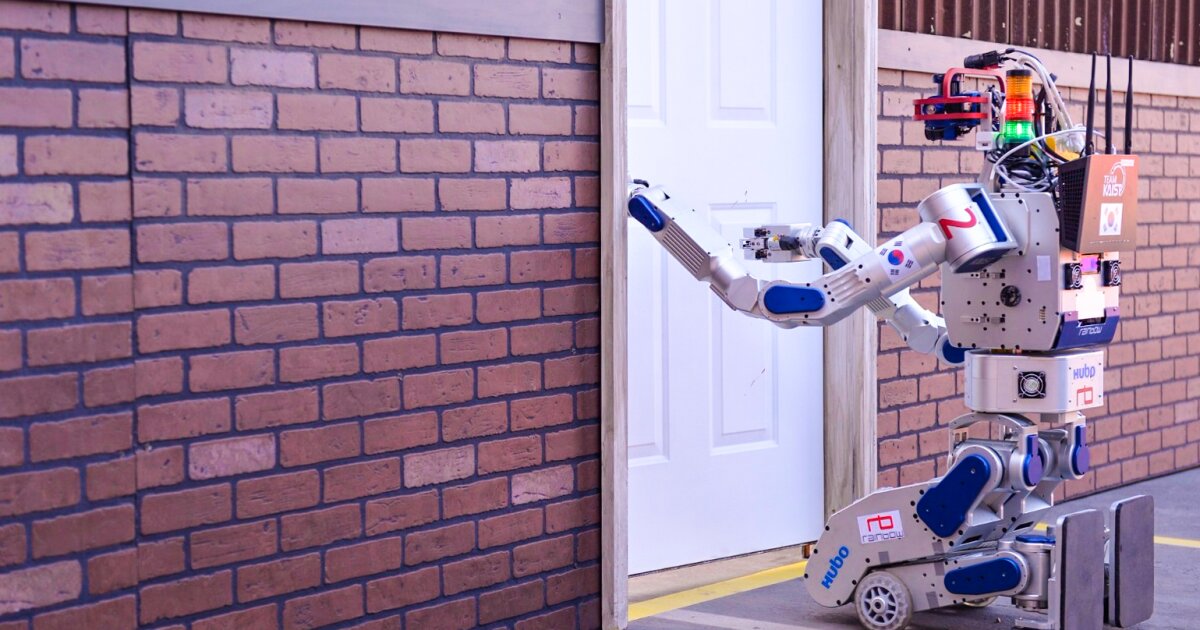
South Korea's Team KAIST wins 2015 DARPA Robotics Challenge
Inline image New Atlas New Atlas DARPA Robotics Challenge winner DRC-HUBO is latest of the "HUmanoid roBOt (HUBO) robots developed by the Korean Institute for Science and Technology KAIST's DRC-HUBO took first place
Team DRC-Hubo Prepares for DARPA Robotics Challenge - IEEE Spectrum
Team DRC-Hubo is a consortium of several universities, including Drexel University and KAIST's HuboLab (and its spin-off RAINBOW Co., which markets its robot technology). Early this year, the team had released a rather nifty computer animation starring Hubo as a disaster response robot in the year 2020. This week the HuboLab researchers have published the first videos showing their robot engaging in DRC-related activities. In the first video we can see a heavily modified version of KAIST's Hubo 2 robot midway up a ladder. The robot's arms have been elongated to better meet the challenge requirements. And, it would appear, the team plans to have their robot climb the ladder backwards (because, you know, that's not much of a problem when you are a robot). [...] CREATE AN ACCOUNTSIGN IN JOIN IEEESIGN IN Close ## Access Thousands of Articles — Completely Free ## Create an account and get exclusive content and features: Save articles, download collections, and post comments — all free! For full access and benefits, subscribe to Spectrum. CREATE AN ACCOUNTSIGN IN RoboticsNewsHumanoid Robots # Team DRC-Hubo Prepares for DARPA Robotics Challenge ## A highly modified version of the Hubo humanoid robot attempts some challenging tasks Jason Falconer 17 Apr 2013 2 min read [...] ## Gravitational Wave Detectors Turn to Quantum Mechanics 22 Aug 2026 3 min read ## Related Stories RoboticsNewsHumanoid Robots ## Video Friday: Do We Need Superhuman Humanoid Robots? RoboticsNewsHumanoid Robots ## Is Shipyard Welding the Right First Job for Humanoid Robots? RoboticsNewsHumanoid Robots ## Walden Robotics Partners With Toyota on Practical Humanoids

HUBO will tear you limb from limb | TechCrunch
HUBO Walking! HUBO Taichi! HUBO with sword! HUBO aiming for your heart and lungs! This clever Korean robot won’t kill you (yet) but it does move in a surprisingly life-life fashion. ...
Build with HUBO
Start procurement discussions, compare model fit, and connect to official channels.